Post-Party Kitchen Reset: Back to Calm in 25 Minutes
Dishes, counters, leftovers, floor, candle — and the kitchen that hosted a party last night is ready to host a normal Tuesday morning.
The post-party kitchen on a Sunday morning is one of those scenes that feels heavier than the sum of its parts — the dishes, the overfull trash, the counter that disappeared under serving platters and leftover containers, the faint smell of yesterday's celebration still hanging in the air. The impulse is to either tackle all of it immediately in a burst of anxious energy or close the door and deal with it later, and neither produces the calm, in-control feeling that actually makes the transition from holiday weekend back to normal life feel manageable. The 25-minute reset is a third option: a specific, sequenced set of tasks that addresses every visible aspect of the kitchen chaos without attempting a deep clean, and that ends with a lit candle and a cleared counter and the particular satisfaction of a space that hosted something joyful and has been returned to order without drama. This is not about getting the kitchen perfect — it is about getting it back, and the distinction matters. Twenty-five minutes of methodical, purposeful work is all the separation needed between the party that was and the week that is coming.
What You'll Need
- Dish soap and dish brush or sponge — for hand-washing anything that did not go in the dishwasher; run the dishwasher first so it is cycling while the rest of the reset happens
- All-purpose cleaner or warm soapy water in a spray bottle — for wiping counters, appliance fronts, and the sink; one product used across all surfaces keeps the reset moving rather than switching between multiple cleaners
- Microfiber cloths or paper towels — at least three: one for counters, one for appliance fronts, one for the sink and faucet shine
- Fresh dish towels — replacing the party-weekend towels is the single detail that makes the reset feel most complete; a clean folded towel on the oven handle signals that the kitchen is back to its normal state
- Leftover containers with lids — for consolidating party food remnants into fewer, properly sealed containers; label each with masking tape and a marker with the date before refrigerating
- Trash and recycling bags — the recycling bag specifically is the highest-volume item after a holiday party with bottles and cans; take both out to the bins before sweeping so the floor is cleared of bags as well as crumbs
- Broom and dustpan or vacuum — for the floor sweep that catches crumbs, dropped food, and the general party debris that accumulates underfoot during entertaining
- Damp mop or Swiffer — for a quick spot pass on any sticky patches or spill residue the broom cannot remove
- Ice cubes and citrus peels — for the garbage disposal freshening cycle that addresses the single most persistent source of post-party kitchen odor
- Candle or stovetop simmer ingredients — lemon slices, rosemary, and a cinnamon stick simmered in a small pot of water for 10 minutes produce a clean, herbal scent that resets the kitchen atmosphere as effectively as the physical cleaning resets the surfaces
The Reset Sequence
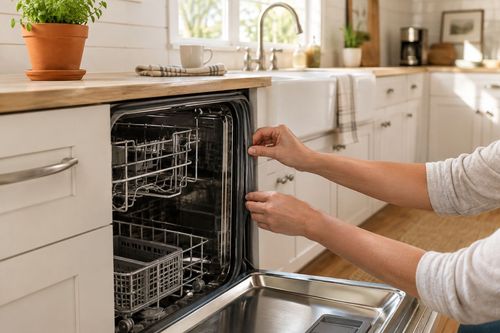
- Start the dishwasher before anything else — load every dish, glass, and utensil that fits, run it immediately, and let it cycle in the background while the rest of the reset happens around it. The dishwasher is the highest-volume task and the one that runs itself; starting it first means clean dishes are available by the time the rest of the kitchen is reset rather than the dishwasher being the last thing standing between a finished kitchen and putting everything away.
- Hand-wash anything that did not fit in the dishwasher or that should not go in it — serving platters, hand-wash-only items, the one pot that fed the whole party — dry them immediately and put them away rather than leaving them in a drying rack that will still be there on Tuesday. A drying rack full of party serving pieces on a Tuesday morning is a visual reminder of the weekend that extends the mental weight of the reset past its actual completion.
- Handle leftovers as a single consolidated task rather than opening the refrigerator repeatedly throughout the reset — pull everything out at once, make quick decisions about what is worth keeping versus tossing, consolidate into the fewest containers that work, label each one with the date, and return everything in one organized load. The date label is the step most people skip and then regret a week later when the container's age is genuinely uncertain; 10 seconds of masking tape and a marker prevents a week of refrigerator uncertainty.
- Take out the trash and recycling before clearing counters — overflowing bins mean counter clearing has nowhere to go and creates a secondary pile rather than a cleared surface. The recycling specifically fills fastest after a party with bottles and cans and needs its own bag; breaking it down and taking both bags to the outdoor bins clears the single largest visual chaos element in most post-party kitchens in under three minutes.
- Clear every counter completely — everything goes either away in its correct home, into the trash, or into a single designated holding spot for items that need decisions that are not part of this reset. An empty counter is the visual anchor of a reset kitchen in a way that a partially cleared counter is not; the difference between 80% cleared and 100% cleared is the difference between a kitchen that looks better and one that looks done.
- Wipe all cleared counter surfaces with all-purpose cleaner or warm soapy water in a single pass from one end of the kitchen to the other — then wipe appliance fronts where fingerprints and splatter accumulated during the party, paying particular attention to the refrigerator handle, the oven door, and the microwave front which accumulate the most contact during entertaining. One damp microfiber cloth handles all of these surfaces in sequence without needing to reload with cleaner between each one.
- Sweep the full kitchen floor with a broom, working toward one corner to collect everything into a single pile rather than pushing debris around the room — then spot-mop any sticky patches or dried spill residue the broom loosened but did not remove. The floor sweep is the reset task that produces the most immediate sensory improvement: the crunch underfoot that announces post-party disorder disappears completely, and the kitchen feels cared-for rather than recovering from something.
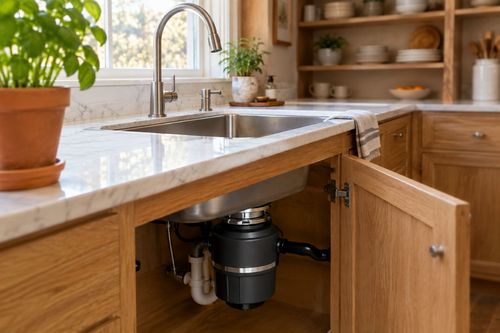
- Freshen the garbage disposal by dropping a handful of ice cubes down the drain followed by citrus peels — the ice mechanically cleans the disposal blades while the citrus oils neutralize the bacterial odor that builds up in disposal residue and is one of the most persistent contributors to the post-party kitchen smell. Run the disposal for 30 seconds with cold water flowing, then wipe the sink basin and shine the faucet with a dry cloth — a gleaming faucet is the disproportionately high-impact finishing detail that makes a wiped sink look finished rather than merely clean.
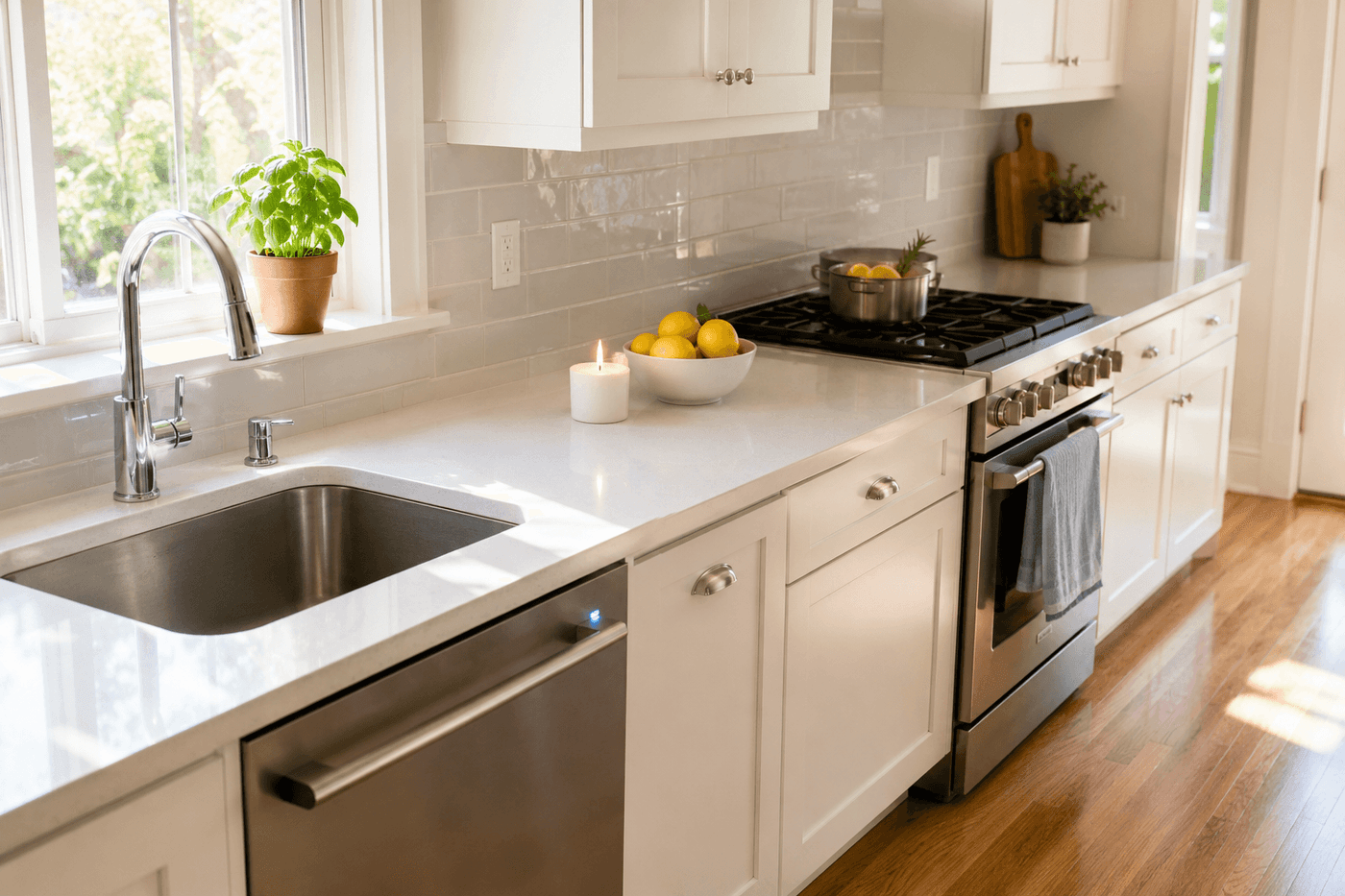
- Reset the atmosphere — replace the dish towels with fresh ones folded neatly over the oven handle or drawer front, light a candle on the counter or set a small pot of water with lemon slices and rosemary to simmer on the stove, and stand in the kitchen doorway for one moment to register that the room is restored. The intentional pause is not incidental; it is the transition point between the work of the reset and the actual feeling of calm that is the whole point of doing it — and skipping it means moving immediately to the next thing without letting the reset actually land.
Professional organizers and household systems consultants who work with families on post-event recovery consistently recommend one kitchen reset principle that reduces the psychological weight of the task before it begins: set a visible 25-minute timer on the counter before touching a single dish, and commit to stopping when it goes off regardless of what remains. The open-ended post-party kitchen feels overwhelming partly because it has no defined end — it will take as long as it takes, which the brain interprets as potentially forever. A timer converts an open-ended recovery task into a bounded, completable one, and the sequence above is specifically designed to address every high-visibility element within that window so that stopping at 25 minutes leaves a kitchen that feels genuinely reset rather than partially done. Household systems designers call this "time-boxing domestic recovery," and the research behind it consistently shows that people who time-box post-event cleanup report lower stress, higher completion rates, and faster return to normal routine than those who approach the same task without a defined endpoint — because the brain that knows when something will be over can engage with it fully rather than bracing against it indefinitely.