Entryway Refresh: First Impression Reset in 20 Minutes
Clear the clutter, wipe the door, edit the surfaces to three intentional items, add one seasonal touch — and the space that sets the tone for the whole house is reset before the morning is over.
The entryway is the only space in a home that every person — every family member, every guest, every delivery driver who catches a glimpse through the open door — encounters every single time they arrive. It sets the tone for what follows in both directions: a clean, organized, intentionally arranged entry produces a specific sense of calm and welcome that follows everyone through the door; a cluttered, disorganized one produces a low-grade friction and mild embarrassment that also follows everyone through the door, just in the opposite direction. Twenty minutes is the complete investment required to convert an accumulated entry back into an intentional one — clear the clutter, wipe the door inside and out, shake the rug, sweep the floor, edit the surfaces down to a few deliberate items, and add one seasonal touch that signals the space is maintained and cared for rather than merely endured. The psychological effect of a clean entry on the daily experience of coming home is one of those household improvements that is difficult to fully articulate before it is experienced and immediately obvious after — the specific sense of arriving somewhere welcoming rather than arriving at another problem to manage.
What You'll Need
- All-purpose cleaner and microfiber cloths — for the door surfaces inside and out, the door handle, any glass panels, light switch plates, and wall areas near the handle where hands make contact repeatedly; a single spray bottle of all-purpose cleaner handles every surface in the entryway without switching products
- Glass cleaner and paper towels — specifically for any glass sidelights, door window panels, or mirrors in the entry; all-purpose cleaner leaves streaks on glass that are particularly visible in an entry where light hits the glass directly
- Broom and dustpan or vacuum — for the entry floor after the rug is removed and shaken; entry floors accumulate grit, tracked-in debris, and fine dust under the rug that is only visible and addressable when the rug is moved during the refresh
- Small trash bag — positioned at the entry before beginning; junk mail, expired coupons, worn-out receipts, and the miscellaneous paper accumulation that appears in every entryway requires a receptacle immediately at hand to prevent the sort-and-relocate step from becoming sort-and-set-on-a-different-flat-surface
- Small tray or catchall dish — the single organizational addition with the highest impact in any entry; a tray on the console or shelf creates a designated landing zone for keys, sunglasses, and small daily-carry items that otherwise scatter across every entry surface; if a tray is already present, confirm it is holding only the items intended for it and not serving as general overflow storage
- Seasonal touch — choose one:
- Summer: a bright fresh doormat, a small vase of garden flowers or grocery store blooms, or a simple wreath of greenery
- Fall: a small potted mum, a bundle of dried grasses, or a seasonal wreath
- Winter: a evergreen arrangement, white candles, or a wreath with warm texture
- Year-round: a healthy potted plant — snake plant, pothos, or ZZ plant thrive in variable entry light conditions
- Replacement light bulb — on hand in case the entry light check reveals a burned-out bulb; entry lighting that is dim or half-functioning is the single detail that most undermines the welcoming quality of an otherwise clean and organized entry at evening and nighttime arrivals
The 20-Minute Refresh Sequence
- Clear every surface and the floor completely first — pull everything off the console, shelf, or bench; remove all items from the hook area; gather every shoe, bag, and object from the floor into a temporary sorting pile. Seeing the full accumulation in a pile rather than distributed across the entry surfaces is what makes the editing decisions easier and faster; the pile reveals the actual volume of what has been living in the entry and makes the decision to relocate or discard individual items more straightforward than evaluating each one in its current position.
- Sort the pile into four groups immediately — items that belong in the entry and will return to a designated spot, items that belong elsewhere in the house and need to go there now, items leaving the house (outgoing mail, donations, returns), and trash. Execute the relocation and trash steps before doing any cleaning; items that are set aside to relocate later migrate back to the entry surfaces within 48 hours and undo the refresh within the first week.
- Remove and shake the entry rug outdoors — hold it by two corners and give it three to four sharp shakes to dislodge the embedded grit, hair, and debris that vacuuming alone does not fully remove from a rug that receives daily foot traffic. The quantity of debris that falls from a shaken entry rug that appeared clean is a reliable and slightly startling measure of how much particulate matter an entry rug captures from incoming foot traffic in a single week.
- Sweep the entry floor thoroughly while the rug is outside — work from the baseboards toward the center and then toward the door, which moves debris outward rather than distributing it further into the house. Wet-mop any sticky spots or visible grime on hard entry floors; the entry floor receives more tracked-in outdoor material per square foot than any other floor surface in the house and requires more frequent cleaning than the traffic in the rest of the house.
- Wipe the front door inside and out with all-purpose cleaner — the exterior door face accumulates weather grime, pollen, and handling marks at the pull area; the interior door face accumulates fingerprints, product transfer, and the general film of a surface that is touched by every hand that enters the house. Clean the door handle and any glass panels specifically, since handle grime and glass smudges are the details that read as most visually prominent in an entry and are most dramatically improved by a thorough wipe.
- Wipe the light switch plate and the wall area within 18 inches of the door handle on both sides — these surfaces accumulate the highest concentration of hand contact in the entire entry and are the specific areas where grime buildup is most visible as a darkened or discolored patch that distinguishes a cleaned entry from a merely tidied one. A single pass with an all-purpose cleaner cloth addresses both surfaces in under a minute and produces a visibly cleaner wall surface that reads as maintained rather than neglected.
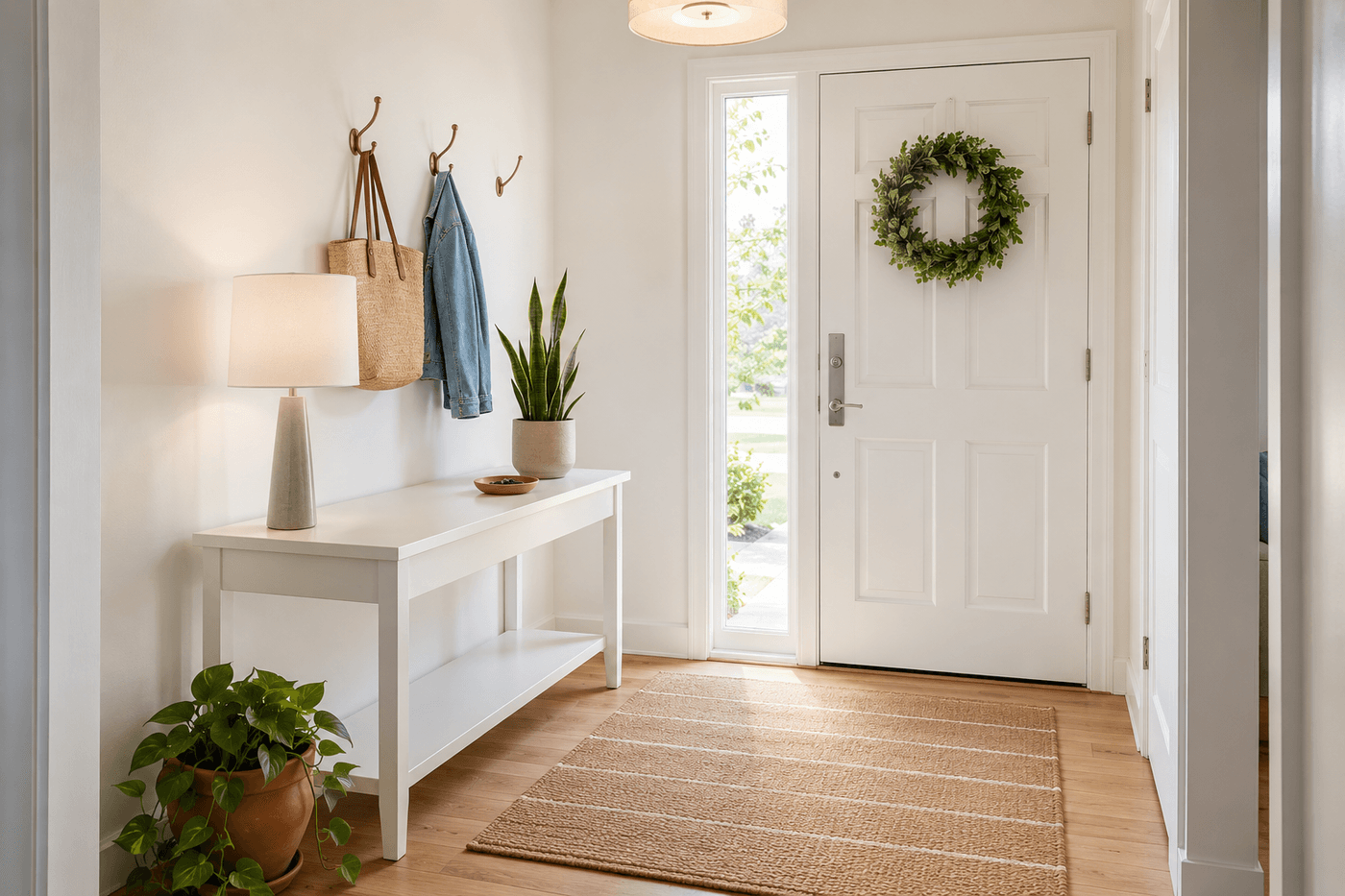
- Edit the return of items to the console, shelf, or bench surface to a maximum of three intentional items — one functional item (the key tray or catchall dish), one living item (a plant or fresh flowers), and one decorative item (a lamp, a small framed print, or a seasonal object). The three-item maximum is the specific editing discipline that converts a console from a flat accumulation surface into a curated vignette; every item beyond three reduces the visual impact of the whole surface and nudges the entry back toward the accumulated quality the refresh was designed to address.
- Check the entry lighting by switching on every light source in the space — overhead, lamp, and any exterior lighting visible through the door — and confirm all bulbs are functioning, the wattage provides genuinely welcoming illumination rather than dim adequacy, and that no fixture has a burned-out bulb that has been ignored during daylight-only entrances. Entry lighting that is inadequate or partially burned out is the detail that most affects the experience of arriving home after dark and the perception guests have of the space at evening visits.
Interior designers and home stagers who prepare residential entries for sale and for editorial photography consistently apply one surface styling principle to the console or entry shelf that produces a vignette that reads as professionally designed rather than personally accumulated: style the entry surface with items at three distinct heights — a tall item, a medium item, and a low item — and position them in a triangle arrangement rather than a line. A lamp or tall branch at the back left, a medium plant or framed object at the center, and a low tray or small object at the front right creates a triangular silhouette that the eye reads as composed and intentional from every entry angle; three items of similar height in a row read as a display rather than a vignette and lack the visual depth that makes an entry surface feel designed. Stagers who apply this triangle principle to entry styling describe it as the single fastest way to make any surface — regardless of the specific objects on it — read as curated rather than collected, because the height variation creates the dimensional quality that flat arrangements cannot produce no matter how carefully the individual items are chosen.