Reset Your Junk Drawer in 15 Minutes for Free
Empty it completely, throw away the obvious trash, sort what's left — and open it tomorrow without the low-level dread
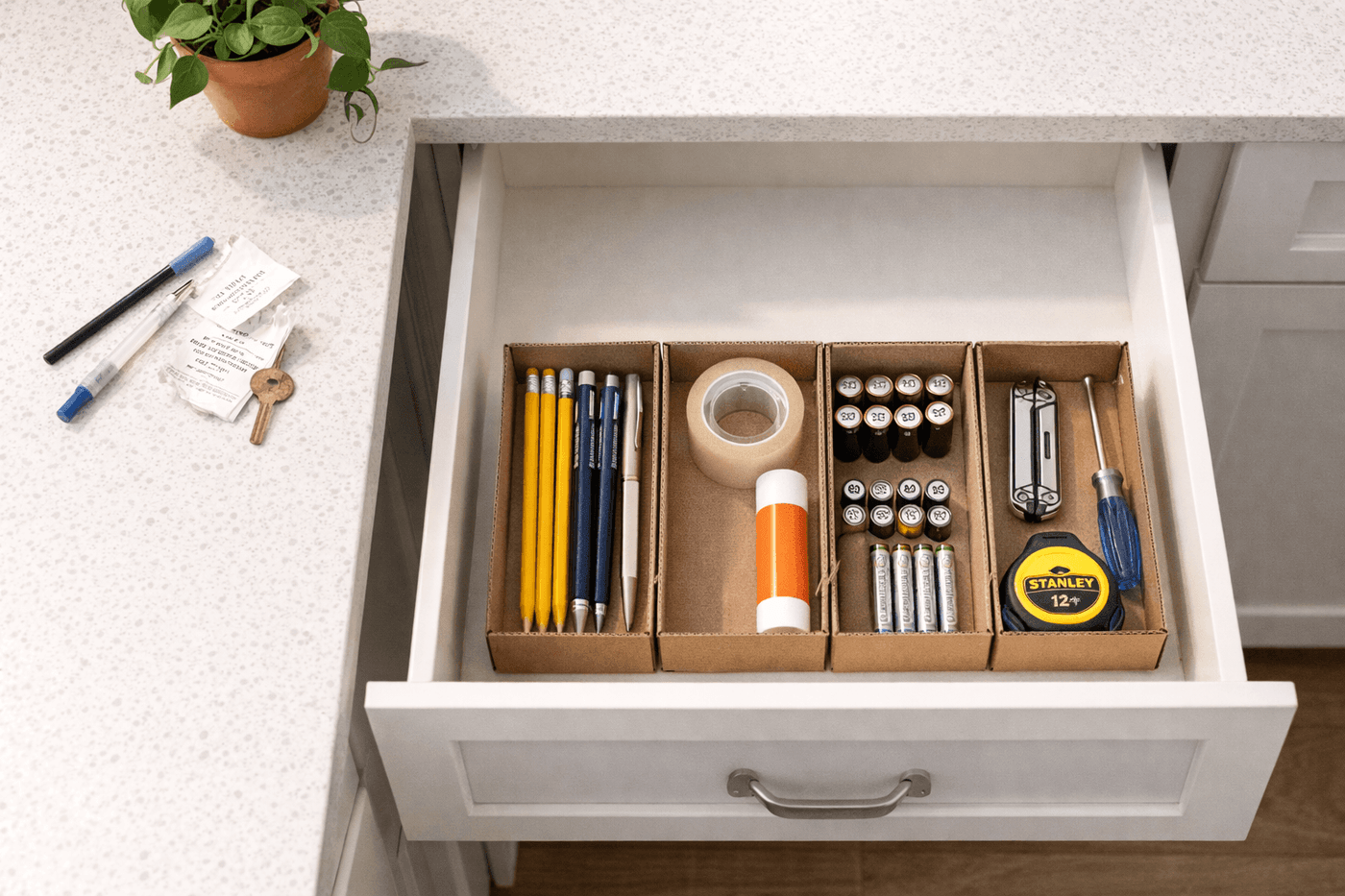
Every home has a junk drawer, and every junk drawer reaches a point where it stops being a convenient catch-all and starts being a source of low-level daily frustration — the place where you spend ninety seconds every time you need a pen, where mystery objects accumulate until nobody remembers what they're for, and where useful things go to become permanently inaccessible under everything else. The fifteen-minute reset works because it is ruthlessly simple: everything out, obvious trash immediately gone, what remains grouped and returned in categories with visible access to each. No special organizers required, no trips to a store, no system more complex than small boxes and cut cardboard creating sections. The result is a drawer that genuinely functions again — where finding the tape takes three seconds rather than two minutes — and that tends to stay organized longer than any previous attempt because this time the underlying chaos has been addressed rather than tidied around.
What You Need
- A cleared counter surface — large enough to spread the full drawer contents in a single layer so every item is visible and assessable without having to move other items to find what's underneath; the full-spread is what makes the discard decisions fast and obvious rather than slow and uncertain
- A trash bag or bin immediately beside the counter — positioned so discarding an item requires a single motion rather than a walk across the room; the physical distance between the sorting surface and the trash container directly determines how many borderline items get kept rather than discarded
- Small cardboard boxes or cut-down cereal boxes — for creating drawer compartments without buying any organizational products; a cereal box cut to two inches tall becomes a perfectly functional pen and pencil holder, a tea box holds tape and adhesives, and a small shipping box holds batteries in a way that keeps them sorted and prevents the terminals from contacting each other (free from recycling)
- Scissors — for cutting cardboard box sections to the correct height for the drawer depth
- A damp cloth — for wiping the drawer interior completely clean before any items go back in; the crumbs, dust, and debris at the bottom of an uncleared junk drawer are visible only when the drawer is empty, and returning items to a dirty drawer undermines the psychological effect of the reset
- A working pen for testing — for the pen and marker audit that is one of the most satisfying phases of the reset and typically eliminates thirty to forty percent of the writing utensils in an average junk drawer
How to Do It
- Empty the drawer completely onto the counter in a single sweep rather than sorting items as they come out — the complete-empty approach is what makes the reset work where previous tidying attempts haven't. Sorting while removing allows the brain to make justifications for items that would be immediately discarded if seen in the full context of everything else the drawer contains; seeing the full spread at once makes the truly unnecessary items obvious in a way that extracting them one at a time does not.
- Discard the obvious trash immediately without deliberation — dried-up pens, dead batteries, expired coupons, broken items, old receipts, mystery keys that fit nothing you can identify, and any object whose purpose you cannot name within three seconds of picking it up. The three-second rule is not arbitrary: an item whose purpose requires extended thought to remember is an item you will never reach for intentionally, and keeping it means it will occupy space that useful items need for the next two years until the next reset.
- Test every single pen and marker by scribbling on a scrap of paper — this phase eliminates a surprising percentage of the writing utensils in most junk drawers and takes less than two minutes for a typical collection. A non-working pen kept because it looks functional takes up the same space as a working pen and produces a moment of minor frustration every time it's reached for and fails; clearing them now eliminates those future frustrations entirely.
- Separate the remaining items into category groups on the counter surface — writing utensils together, tape and adhesives together, batteries together, small tools together, takeout menus or coupons together, and anything that belongs in a different location entirely in its own group to the side. The side group — items that ended up in the junk drawer because they had nowhere more specific to go — should be relocated to their correct homes before the reset is complete rather than returned to the drawer where they will continue to take up space that actual junk drawer items need.
- Wipe the drawer interior completely with a damp cloth before anything goes back in — pay attention to the corners where debris compacts and the bottom where crumbs settle into a fine layer that is invisible against the drawer color but immediately apparent on the cloth. A clean drawer bottom is a detail that most people skip and that contributes significantly to how long the reset feeling lasts; returning organized items to a dirty surface subtly undermines the satisfaction of the whole project.
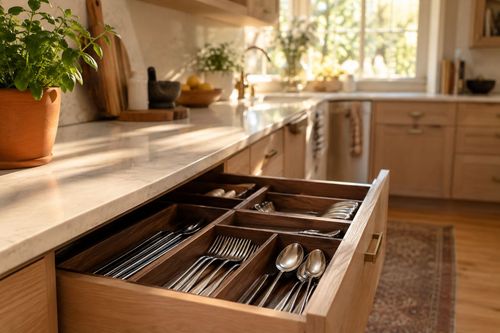
- Cut cardboard boxes to drawer depth — approximately two inches tall for most kitchen drawers — and arrange them in the clean drawer as compartments before returning any items. The compartments don't need to be beautiful or perfectly fitted; they need to be distinct enough that items returned to the wrong section are immediately obvious, which is the mechanical feature that makes a categorized drawer stay organized through regular use rather than gradually reverting to mixed chaos.
- Return items by category to their designated compartments, placing the most frequently reached-for categories at the front of the drawer where they're accessible without opening the drawer fully — most people reach into their junk drawer the same three or four times per week for the same items, and those items at the front mean the drawer never needs to be fully opened for routine use, which dramatically reduces how much the contents get disturbed and mixed between resets.
- Close the drawer and open it again immediately — the moment of opening an organized drawer for the first time after a reset is genuinely satisfying in a way that is disproportionate to the fifteen minutes invested, and noticing that satisfaction is what makes the organizational habit more likely to persist. Take thirty seconds to relocate the side-group items to their proper homes before walking away; items left on the counter after a junk drawer reset reliably end up back in the drawer within forty-eight hours, which partially undoes the reset before it has a chance to establish itself.
Professional organizers who specialize in kitchen systems always establish what they call a maximum item count per category for junk drawer compartments rather than letting each section expand to fill available space — a writing utensil compartment that holds twelve pens and pencils is functional and easy to navigate; one that holds thirty because there was room for thirty becomes as difficult to search as an unorganized drawer. They set the rule at installation: when a category compartment is full, one item must leave before a new one enters. This one-in-one-out rule costs nothing to implement and is the single habit that keeps a reset drawer organized for years rather than months, because it prevents the gradual accumulation that returns any organized space to chaos given enough time and inattention.