Organize Your Linen Closet with Rolled Towels for $9
Three dollar store bins, forty-five minutes of rolling, and your linen closet looks like a boutique hotel storage room
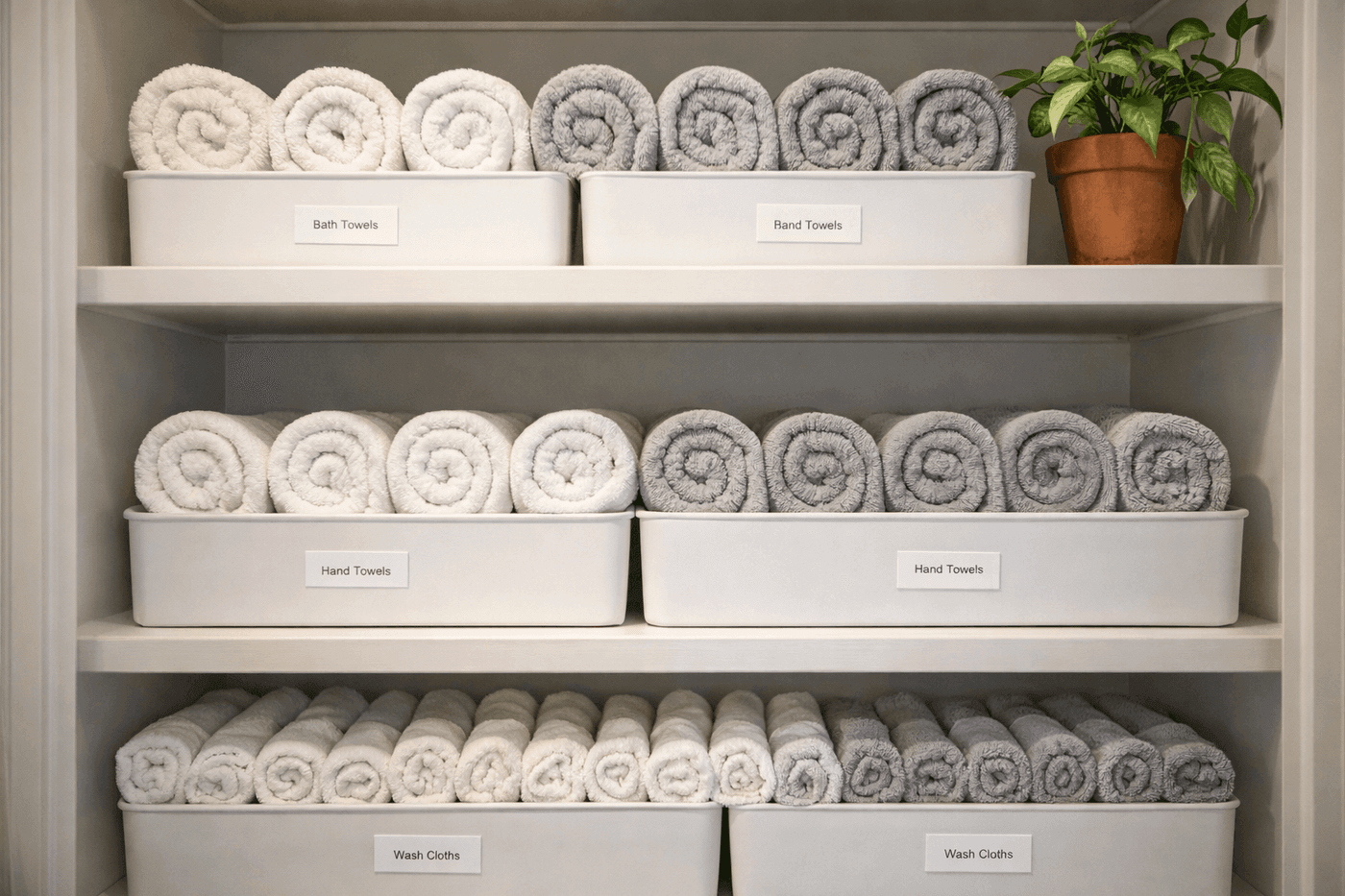
The linen closet is the household space most people reorganize repeatedly, with diminishing conviction each time, because the standard flat-folding and stacking method is fundamentally flawed — every towel you remove disturbs the ones above it, the stack gradually leans and collapses between laundry days, and after two weeks the closet looks exactly like it did before you spent an afternoon on it. The rolled towel method solves all three problems simultaneously: rolls stand upright in bins rather than stacking, so removing one towel never disturbs another; the rolled format fits dramatically more towels in the same shelf space than flat folding; and the visual of towel ends facing forward in a labeled bin is stable and self-maintaining in a way that stacked towels simply are not. Three rectangular bins from the dollar store for $9 total, forty-five minutes of rolling, and a linen closet that has defeated every previous organizational attempt becomes the kind of calm, ordered, genuinely pleasant space you actually want to open in front of guests.
What You Need
- Rectangular storage bins, qty 3 — sized to fit your closet shelf depth; dollar store rectangular bins in white or natural tones read cleanest on a closet shelf (~$3 each, $9 total)
- Label maker or adhesive labels and a marker — for marking each bin by towel category; labels are the detail that makes the system self-maintaining for every member of the household rather than just the person who set it up (~$10–15 for a basic label maker, or free with a marker)
- Measuring tape — for confirming bin dimensions fit your shelf depth before purchasing; a bin that overhangs the shelf edge tips forward when full and a bin that's too shallow wastes the back half of the shelf
- All your towels, freshly laundered — rolling works best on clean, flat towels rather than towels that have been sitting stuffed in a closet for months; this is the moment to launder anything that needs it before it goes back into the newly organized space
- A flat surface for rolling — a bed or table gives you the space to fold and roll each towel properly before placing it in the bin
How to Do It
- Empty the entire linen closet completely before starting — pull every towel, washcloth, and sheet out onto the bed and assess what you actually have. This full-empty start is what most partial reorganization attempts skip, and it's why those attempts never quite work: organizing around existing clutter means the clutter stays and the organization builds on an unstable foundation. This is also the moment to retire towels that are threadbare, permanently stained, or just taking up space that better towels deserve.
- Wipe every closet shelf completely clean while it's empty — dust, laundry residue, and the occasional lost dryer sheet accumulate on linen closet shelves in ways that are only visible when everything is removed. A fresh, clean shelf makes the finished result feel more intentional and extends the time before the space needs attention again.
- Sort all towels into three groups — bath towels, hand towels, and washcloths — before rolling anything. Sorting first rather than rolling each towel as you pick it up lets you see the full inventory of each category, confirm you have the right number of bins, and identify any category that is dramatically overstocked relative to shelf space available.
- Fold each bath towel in thirds lengthwise by bringing one long edge to the center and folding the opposite long edge over it to create a long, narrow rectangle approximately one-third the original towel width. The precise thirds fold is the detail that determines how uniform the finished rolls look standing in the bin — a sloppy fold produces rolls of inconsistent diameter that don't stand stably upright or pack efficiently side by side.
- Roll each folded towel tightly from one short end to the other, maintaining even tension throughout the roll so the finished cylinder is firm and consistent in diameter rather than loose and floppy at the outer layers. A loosely rolled towel unravels when handled and collapses in the bin, which defeats the entire visual and functional purpose of the rolling method.
- Stand each finished roll upright in the bin with the spiral end facing up — this is the presentation face that will be visible when you look into the bin from above, and the consistent spiral pattern of rolls standing at the same height creates the boutique hotel visual that makes this system so satisfying. Pack rolls snugly enough that they support each other upright without gaps, but not so tightly that removing one roll requires disturbing its neighbors.
- Repeat the fold-and-roll process for hand towels — folded in thirds lengthwise and then in half crosswise before rolling, which produces a shorter, narrower roll appropriate to the smaller towel size — and for washcloths, which fold in half and roll into small compact cylinders that pack densely into a bin and remain individually accessible without any of the avalanche problem that folded and stacked washcloths produce inevitably.
- Label each bin clearly on the front face before loading the shelf — bath towels, hand towels, washcloths — and place the bins on the shelf with the labels facing outward and the rolled towel ends facing up. The label is what makes the system work for everyone in the household rather than requiring anyone to open each bin to identify its contents, and it's the single detail that determines whether the organization holds for six months or quietly collapses within two weeks as unlabeled bins become catch-alls.
Professional home organizers who specialize in linen storage always arrange the rolled towels within each bin in a single consistent color gradient — lightest towels at the left, darkest at the right, or all whites together and all colors together — rather than mixing colors randomly within the bin. The color organization adds no time to the rolling process and costs nothing, but it transforms a bin of rolled towels from merely tidy into visually composed in a way that reads as genuinely designed rather than just organized. It also makes it immediately apparent when a towel from the wrong set has been returned to the wrong bin, which is the low-effort quality control that keeps a linen closet looking intentional through months of regular household use.