Bathroom Drawer Declutter: Done in 15 Minutes
Empty it, toss the obvious, wipe it out, sort what's left, put back only what you actually use — and a drawer that was causing low-grade morning stress is calm and functional before the coffee is done.
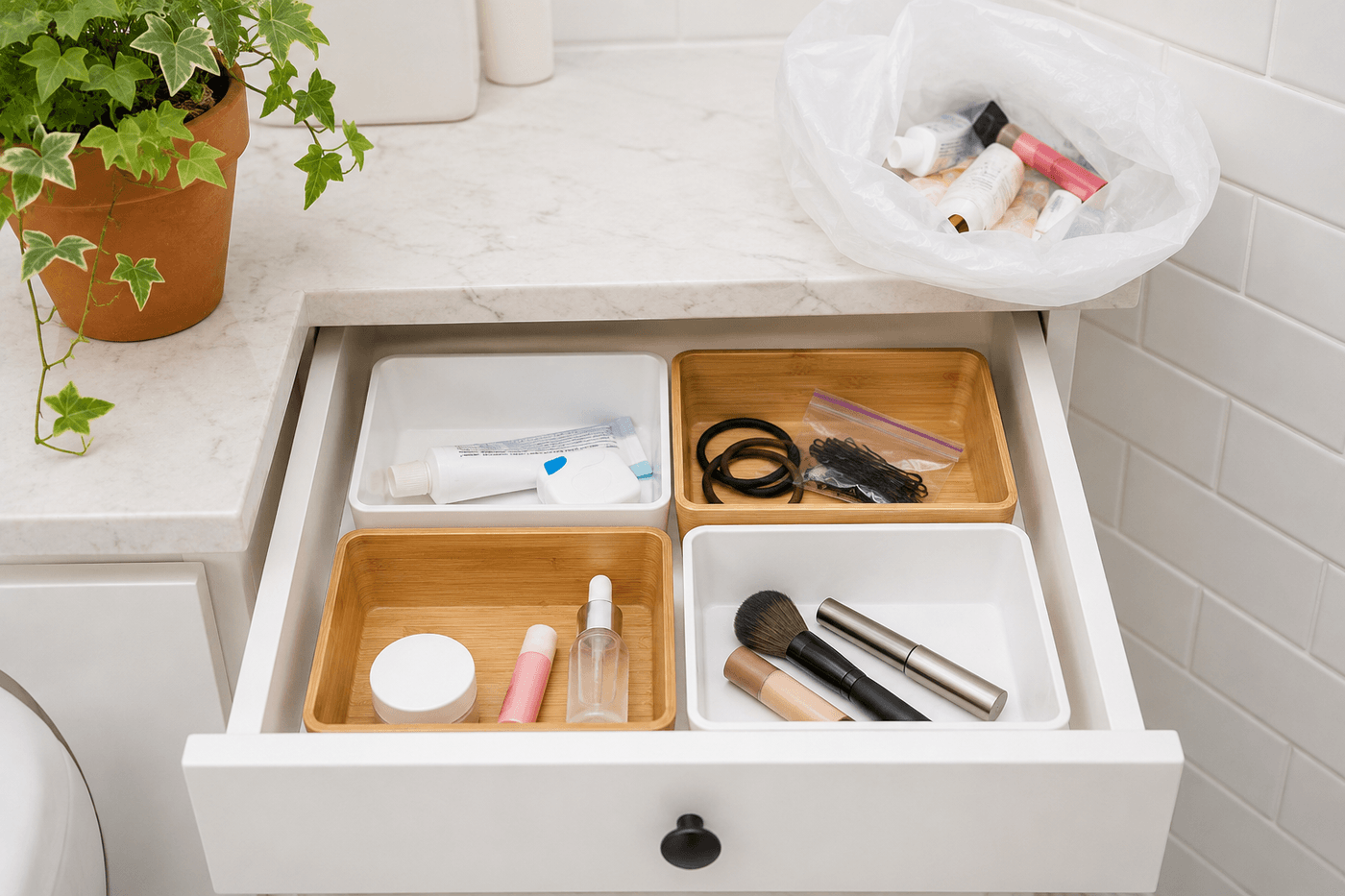
The chaotic bathroom drawer is one of those household situations where the daily friction it creates is so normalized that it stops feeling like a problem and starts feeling like just how that drawer is — the hunt for the right item every morning, the expired products that get pushed to the back and never addressed, the sticky residue and accumulated powder that nobody wipes out because wiping it out would require emptying the drawer first. Fifteen minutes is the complete investment required to convert that drawer from a source of low-grade daily stress into the kind of organized, category-sorted, everything-visible space that makes a morning routine measurably smoother. The sequence matters: empty completely, toss aggressively, wipe thoroughly, sort into categories, return only what earns its place. The items that do not make it back into the drawer are not a loss — they are the reason the drawer was chaotic in the first place, and releasing them is the repair rather than the sacrifice. One organized bathroom drawer also has a specific psychological effect on the surrounding space that is larger than the drawer itself: the calm it produces extends into the morning routine and often produces the motivation to address the next drawer the following Sunday.
What You'll Need
- Trash bag or bin — positioned within arm's reach before the drawer is emptied; the toss phase is faster and more decisive when the trash receptacle is immediately available rather than requiring a trip across the bathroom between each discarded item
- All-purpose cleaner and paper towels or microfiber cloth — for wiping the drawer interior after emptying; bathroom drawers accumulate a surprisingly dense layer of powder, hair, product residue, and general debris that is only visible and addressable when the drawer is completely empty
- Drawer organizers or dividers — choose what is available:
- Purpose-built drawer organizers — bamboo or plastic drawer divider sets sized to standard bathroom drawer depths; most effective for creating consistently sized compartments (~$8–15 for a set)
- Small containers from around the house — mint tins, small cosmetic boxes, jar lids, and takeout sauce containers all function as drawer dividers without any cost; the size variety allows custom-fitting to the specific items that will live in each compartment
- Dollar store bins — small rectangular bins in two or three sizes from a dollar store set create a flexible compartment layout (~$1–3 per bin)
- Sticky note and pen — for labeling any opaque containers that will hold items not visible from above; a label on the container front eliminates the need to open or move containers to locate a specific item category
- Small zip-lock bags — for grouping loose small items like bobby pins, hair ties, and individual medication packets that would otherwise scatter throughout the drawer regardless of how carefully they are initially organized
The 15-Minute Sequence
- Empty the entire drawer onto the counter in one motion — pull everything out without sorting or evaluating as it comes out, which keeps the emptying phase moving quickly and prevents the evaluation paralysis that slows most drawer declutters to a halt before they properly begin. Seeing everything from the drawer laid out on the counter at once also produces a clear and sometimes startling picture of how much the drawer contained versus how much of it is genuinely useful.
- Toss the obvious immediately and without deliberation — expired makeup and medications go directly in the trash without a second look; dried, cracked, or separated products regardless of how much remains in the bottle; sample products that have been in the drawer for more than one move; broken hair accessories that have been kept in case they become useful; anything sticky, unlabeled, or unidentifiable. The toss phase is where most of the drawer volume disappears, and speed rather than deliberation is the correct approach — an item that requires extended consideration about whether to keep it is almost always an item that should be discarded.
- Wipe the drawer interior thoroughly with all-purpose cleaner and paper towels before returning anything — the powder, hair, and product residue that accumulates in bathroom drawers is visible only when the drawer is empty, and cleaning it now is infinitely easier than cleaning around items. Allow the drawer to dry completely before adding any organizer containers or returning items; moisture under organizer containers creates a mold-friendly environment in a bathroom drawer that already experiences high ambient humidity.
- Sort the surviving items into categories on the counter before deciding on organizer placement — grouping dental items, hair items, skincare items, and makeup items separately on the counter surface reveals the volume of each category and informs which compartment sizes are needed for each. A category with three items needs a small compartment; one with twelve needs a larger one; and a category that is larger than the drawer can accommodate in a single compartment is a signal that some of that category belongs in a different storage location rather than all of it competing for drawer space.
- Apply the daily-use test to the sorted items before finalizing which return to the drawer — hold each item and ask whether it is used at least weekly; items used daily or weekly earn their place in the primary bathroom drawer; items used occasionally belong in a secondary location like a cabinet shelf or a backup storage bin under the sink; items used rarely or speculatively belong out of the bathroom entirely. A drawer organized around daily-use items only is a drawer that stays organized without maintenance, because every item in it is reached for and returned regularly enough that the system reinforces itself.
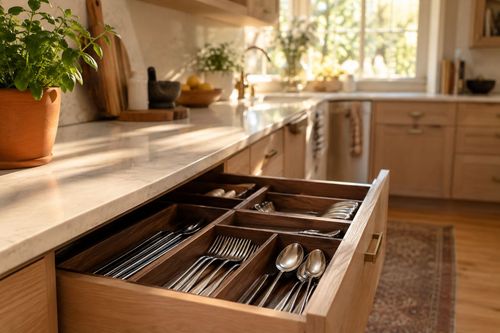
- Place organizer containers in the cleaned drawer and assign one category per container — position containers so the most-reached-for categories are at the front of the drawer closest to the opening, and less-frequent categories toward the back. Confirm the container layout makes physical sense by miming the actual reach into the drawer for each category item before returning anything; a container positioned in an awkward corner that requires moving another container to access will be the first organizational element to fail as the drawer is used normally.
- Return items to their assigned containers with daily-use items placed at the front of each container where they are immediately reachable, and backup or occasional items placed behind them — within each container, the same front-to-back organization principle that applies to the drawer as a whole applies at the container level, so the most-reached-for item within each category is always the first thing the hand contacts rather than something that must be moved to reach.
- Relocate the items that did not return to the drawer to their correct secondary location rather than setting them on the bathroom counter as a temporary measure — items placed on the counter as temporary overflow from the decluttered drawer become permanent counter residents within 48 hours and undermine the declutter's effectiveness as completely as if they had been returned to the drawer. Backup products go under the sink or in a bathroom cabinet; seasonal items go in a labeled bin in the linen closet; items that belong in another room of the house leave the bathroom immediately.
Professional organizers who specialize in bathroom and bedroom organization use one container sizing principle that produces a drawer layout that stays organized significantly longer than the standard one-container-per-category approach: size each compartment container to hold the category's items with approximately 20% empty space rather than fitting the current quantity exactly. A container sized to hold twelve lipsticks when the current collection has ten leaves two slots empty — which reads as organized slack rather than wasted space — and accommodates the natural accumulation that occurs when new items are purchased before old ones are fully used without immediately destroying the organizational system. A container sized exactly to the current quantity fills to overflowing with the first new purchase, which then sits on the container top, then beside the container, and within two weeks has produced the original chaos that the declutter addressed. Professional organizers call the 20% empty space the "organizational buffer," and it is the specific design decision that makes the difference between a drawer that stays organized for six months and one that needs to be redone every six weeks.