Moonlight Garden: White Glow Planting for $55
White blooms and silver foliage reflect available light so completely that the whole planting appears to glow from within as the sky darkens — and the fragrance arrives right on schedule.
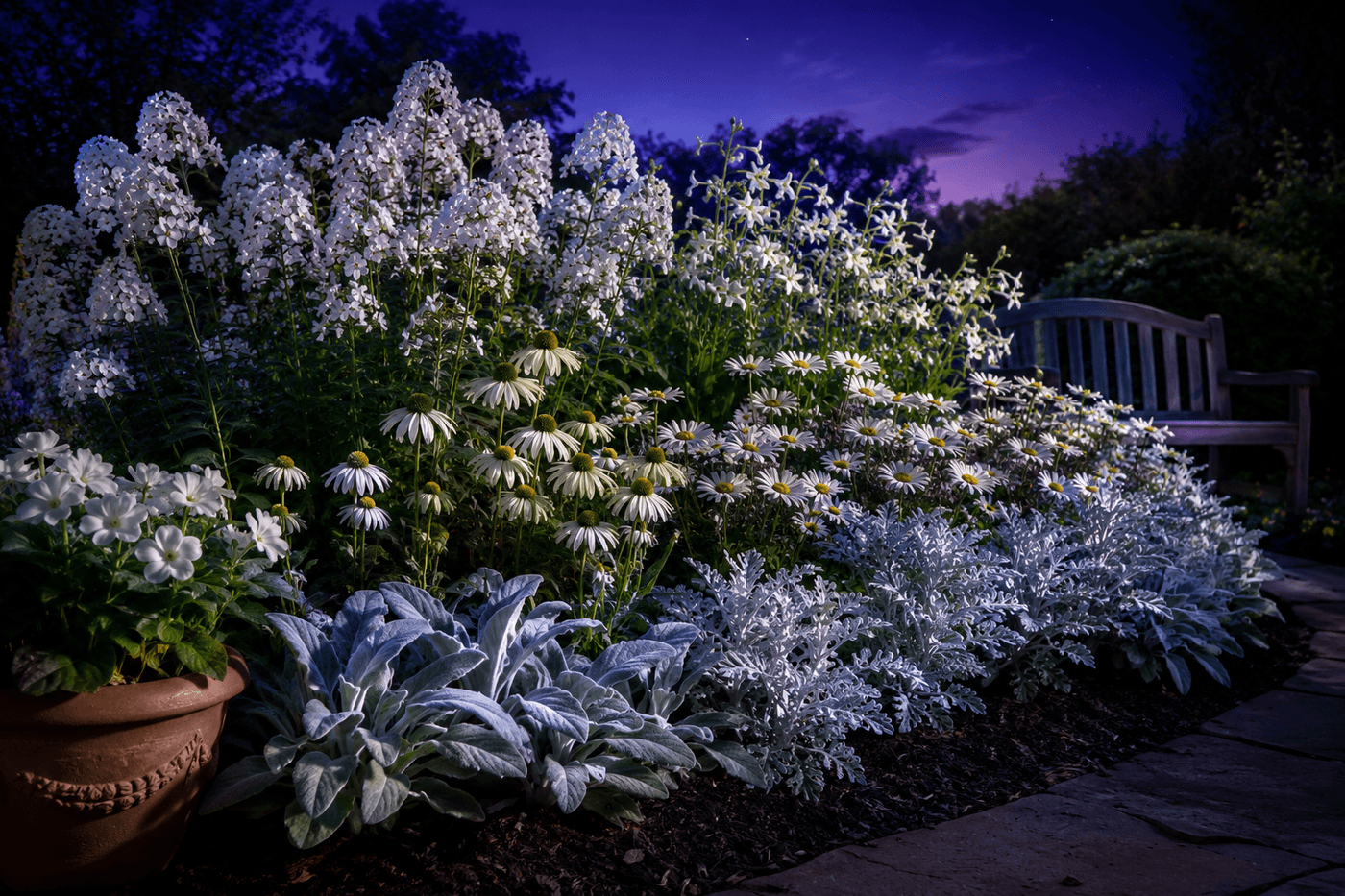
Most garden design is about the daytime — color in sunlight, structure visible from the house, bloom timing that peaks during the hours when people are most likely to look at the garden from inside or walk past it on the way to something else. A moonlight garden inverts this completely and intentionally: it is designed for the hours after the sun goes down, when white flowers and silver foliage reflect starlight, ambient artificial light, and whatever moon is available so effectively that the planting appears luminous rather than merely visible in low light. The fragrance dimension amplifies this into something genuinely multi-sensory — white phlox and nicotiana release their strongest scent in the evening specifically to attract night pollinators, and the combination of visual luminosity and concentrated sweet fragrance on a warm summer night is a sensory experience that is difficult to describe and immediate to understand the first time it is experienced. Three layers of white and silver planting — tall fragrant varieties at the back, structural midlevel bloomers through the center, and soft silver foliage cascading along the front edge — creates the garden that earns its space not by what it does during the day but by what it becomes at eight in the evening when you finally sit down to enjoy the backyard you spent all weekend working in.
What You'll Need
- Back tier — tall fragrant varieties, 3 plants:
- White garden phlox (Phlox paniculata 'David') — 36–48 inch perennial; the most reliable white phlox for evening fragrance and disease resistance; blooms mid to late summer exactly when evening garden use peaks (~$8–12 per plant)
- Nicotiana alata (flowering tobacco), white — 24–36 inch annual; the evening fragrance anchor of any moonlight garden; releases its sweetest scent specifically at dusk and through the night to attract hawk moths; plant in groups of three for maximum fragrance impact (~$3–5 per 4-pack)
- Middle tier — structural bloomers, 4–5 plants:
- White coneflower (Echinacea 'White Swan' or 'Magnus White') — 24–30 inch perennial; the reflexed petals catch and reflect available light particularly effectively; long bloom season from midsummer through fall (~$8–10 per plant)
- Shasta daisy (Leucanthemum 'Becky') — 24–30 inch perennial; the large flat white ray flowers are among the most effective light-reflectors in any moonlight garden; blooms for eight to ten weeks (~$6–8 per plant)
- White astilbe — 18–24 inch perennial for a partially shaded moonlight garden; the feathery white plumes catch even minimal light and move beautifully in evening breezes (~$8–10 per plant)
- Front edge — silver and white foliage, 3–4 plants:
- Lamb's ear (Stachys byzantina) — 12–18 inch spreading perennial; the silver-gray felt-textured leaves are the most reflective foliage available in any garden plant and define the front edge of a moonlight garden in the most romantic and beautiful way possible (~$5–8 per plant)
- Silver dusty miller (Senecio cineraria) — 12–18 inch annual; deeply cut silver foliage that acts as a light-reflecting ground plane throughout the planting (~$2–4 per 4-pack)
- White impatiens — 10–14 inch annual for shade positions; the most continuous white bloom producer for low-light garden positions (~$3–5 per 4-pack)
- Quality compost or planting mix — worked into each planting hole at installation; moonlight garden plantings benefit from rich, well-amended soil that supports the continuous blooming that makes the evening display consistent through the full summer season (~$6–10 for a small bag)
- Slow-release granular fertilizer — worked into the soil at planting; the continuous bloom production that moonlight garden plants require depletes nutrients quickly in summer heat (~$5–8 for a small bag)
- Dark bark mulch, 2–3 inches — the dark mulch ground plane between plants creates the maximum contrast against the white and silver planting that makes the luminosity effect most visible after dark; light or reddish mulch reduces the contrast and diminishes the glowing effect (~$6–8 for a bag)
How to Plant It
- Choose the site with evening use in mind rather than daytime aesthetics — a moonlight garden performs best in a location that is visible from the primary outdoor seating area, receives at least four hours of sun for the flowering plants to bloom well, and is positioned where any ambient light from the house, string lights, or streetlights reaches the planting from an angle that maximizes the reflective effect of white flowers and silver foliage. A moonlight garden positioned in a dark corner away from any ambient light source will glow significantly less than one positioned where even minimal light reaches the white flowers from the front or side.
- Plan the three-tier layering before purchasing any plants — stand at the primary viewing position (your outdoor seating area at the height you will actually be seated) and visualize the back tier of tall fragrant plants, the middle tier of structural bloomers, and the front edge of cascading silver foliage from that specific sightline. The layering that reads correctly from a seated evening position is different from the layering that reads correctly from standing height during daytime planting; designing from the seated evening sightline produces the correct depth and height relationships in the finished planting.
- Amend the full planting area before installing any plants — spread compost across the bed to a 2–3 inch depth and work it into the existing soil to a full spade depth, which improves drainage, water retention, and nutrient availability across the complete root zone rather than only at individual planting holes. Broadcast slow-release granular fertilizer across the amended area at the rate specified on the package and rake in before planting.
- Plant the back tier first — position the white phlox and nicotiana at the rear of the planting area, spacing phlox 18–24 inches apart for their mature spread and nicotiana in groups of three at 12-inch spacing within each group. Plant these first because their height will determine the visual scale of the entire composition, and seeing them in place allows informed decisions about the middle tier positioning before any of those plants are committed to the ground.
- Install the middle tier plants — white coneflowers and shasta daisies — in an irregular, naturalistic arrangement rather than a straight row, which reads as a designed planting rather than a lined-up border. Odd numbers of each variety (three coneflowers, five daisies, or similar) arranged in overlapping clusters produce the most naturalistic and visually full result; even numbers in symmetrical arrangements read as formal rather than the romantic, flowing aesthetic that a moonlight garden's white and silver palette most naturally suggests.
- Plant the front edge silver foliage — lamb's ear and dusty miller — along the full front border of the planting, allowing each plant to touch or nearly touch its neighbor so the silver ground plane is continuous rather than interrupted by gaps of visible soil or mulch. The continuous silver foliage edge is what creates the soft, romantic blur between the planted area and the surrounding garden or lawn that makes a moonlight garden look like it is lighting itself from below rather than simply containing white flowers.
- Apply dark bark mulch to the full planting area between all established plants at a 2–3 inch depth — the dark mulch ground between the silver and white plants creates the maximum color contrast that makes the reflective effect most visible at night. A light-colored mulch between moonlight garden plants reduces this contrast significantly and is the single surface material choice that most diminishes the evening luminosity effect regardless of how well the plants are selected and arranged.
- Visit the garden at dusk on the first evening after planting and again after dark — the specific quality of the moonlight effect is only visible after the sky darkens past the blue hour, and assessing the planting in full daylight or even at early dusk gives an incomplete picture of how the design is performing at the time it was designed for. Adjust plant positions that appear in the wrong layer from the seated evening sightline while everything is still freshly planted and roots have not yet established; this assessment window closes quickly once the plants begin establishing in their initial positions.
Garden designers who specialize in night gardens and sensory landscape design for residential wellness spaces consistently recommend one plant addition that transforms a visually beautiful moonlight garden into a genuinely multi-sensory evening experience: include at least one plant with white flowers that move and catch air currents in ways that are disproportionate to the ambient breeze — specifically white Japanese anemones or white gaura (Oenothera lindheimeri 'Whirling Butterflies'). These plants have flowers on long, flexible stems that move at the slightest air current, and in a white-planted garden after dark the moving flowers catch whatever light is available and appear to flutter and dance in a way that stationary white flowers cannot — creating the visual impression that the garden is animated by some internal energy rather than simply reflecting available light. Sensory garden designers describe this movement quality as the distinction between a moonlight garden that is beautiful and one that is genuinely magical, because the motion of white flowers in an evening breeze at low light levels creates a visual effect that is unlike anything else in residential garden design and that produces the specific quality of enchantment that makes people stop mid-conversation to watch.