Workshop 101: The Skills That Make Every Project Easier
Learn these fundamentals once and use them forever
Every DIY skill compounds. Learning to use a drill properly makes every project faster. Understanding how to measure accurately prevents wasted lumber. Knowing which fastener to use where means your projects don't come apart six months later. These are the foundational skills that nobody teaches explicitly — you're just expected to absorb them somehow. Here they are, explicitly.
Measuring Like a Pro
"Measure twice, cut once" exists because cutting wrong is expensive and irreversible. A few habits that prevent most measuring errors: always mark your cut line with a pencil, not just a mental note. Mark an X on the waste side of the line so you know which side your saw blade goes. When measuring for a fit (like a shelf between two walls), measure at the front, middle, and back — walls are rarely perfectly parallel, and the shortest measurement is your safe cut length.
Understanding fractions on a tape measure: the marks between inch lines go 1/2", 1/4", 1/8", and 1/16" — longest mark to shortest. A mark that falls two short marks from an inch mark is 1/8" past that inch. For most woodworking, working to 1/16" is sufficient precision. Anything requiring tighter tolerance should be done with a story stick (a physical reference piece) rather than a tape measure.
Drilling and Fasteners
Use a drill bit slightly smaller than your screw shank when drilling into hardwood — this prevents splitting and gives the threads something to grip. Use a countersink bit when you want screw heads flush or below the surface. Drive screws at a consistent, controlled speed — too fast strips the head or blows out the wood.
Fastener selection: wood screws for joining wood to wood (coarse thread grips better). Drywall screws are not the right fastener for woodworking — they're brittle and will snap under shear load. For load-bearing connections (shelves, beds, benches), structural screws or pocket screws with glue are significantly stronger. Construction adhesive plus screws is stronger than either alone — this is how professionals build things that last decades.
The Essential Tool List (Actually Essential)
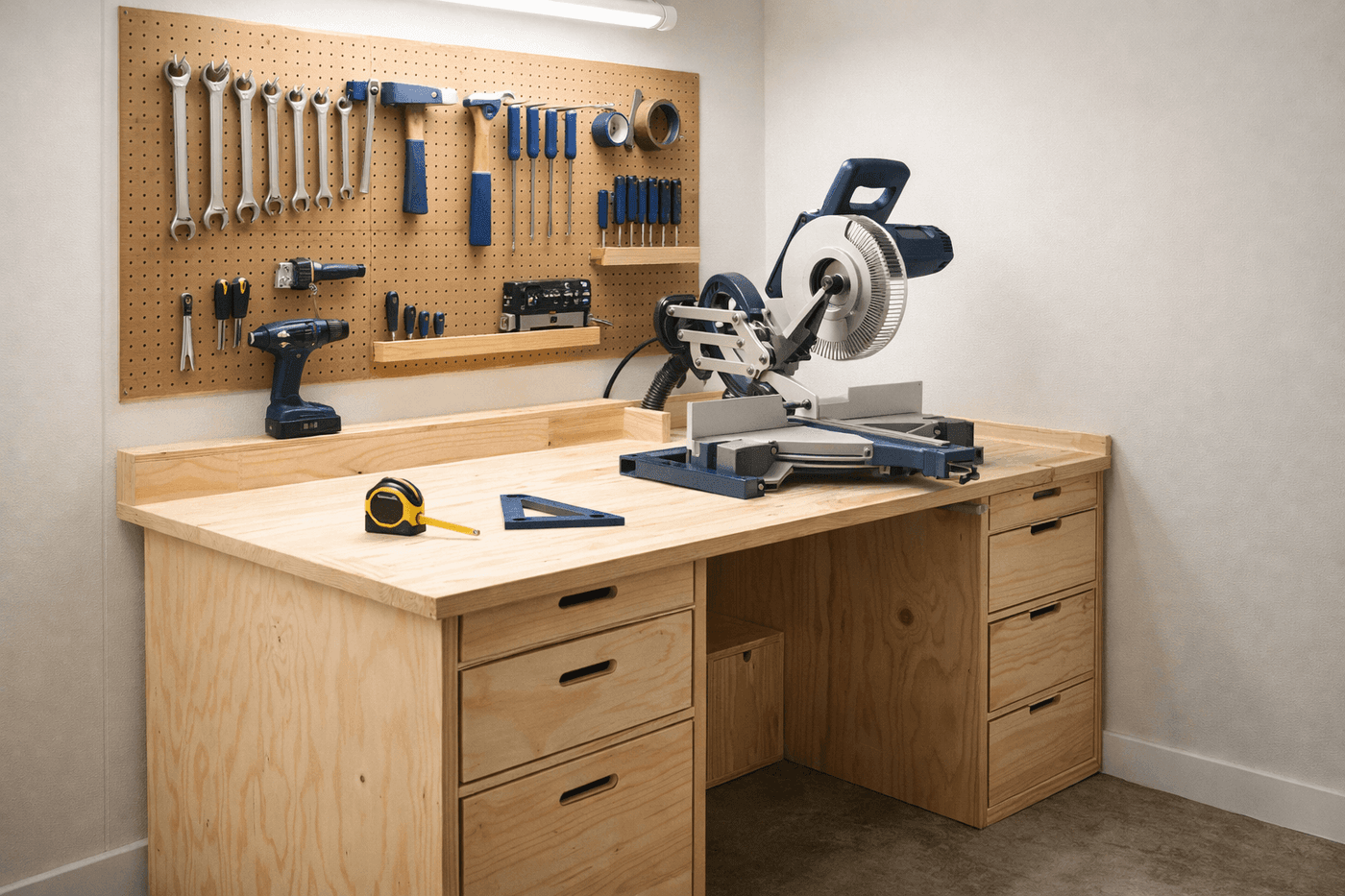
You don't need a full woodshop to do 90% of the projects on this site. The genuinely essential list: a cordless drill/driver, a circular saw, a jigsaw, a random orbital sander, a stud finder, a 25-foot tape measure, a combination square, a 4-foot level, and a quality set of drill bits. That's it. A miter saw is the next logical addition for anyone building furniture regularly — it makes precise crosscuts fast and repeatably. Everything else is bonus. Resist the urge to buy tools speculatively; rent or borrow first to confirm you'll actually use them.
Buy one good tool rather than three cheap ones. A quality drill from Milwaukee, DeWalt, or Makita will outlast four generations of budget-brand drills and actually perform better in use — better clutch feel, more consistent power, battery platform that grows with you. The same principle applies to hand tools: a good tape measure, a real combination square, and quality clamps are worth every extra dollar. The areas to be budget-conscious are single-use tools you'll rarely reach for. The tools in your hand on every project deserve real investment.