Turn Thrift Store Frames into Serving Trays for $8
Boutique trays cost $40. Yours cost $8 and look better — here's exactly how
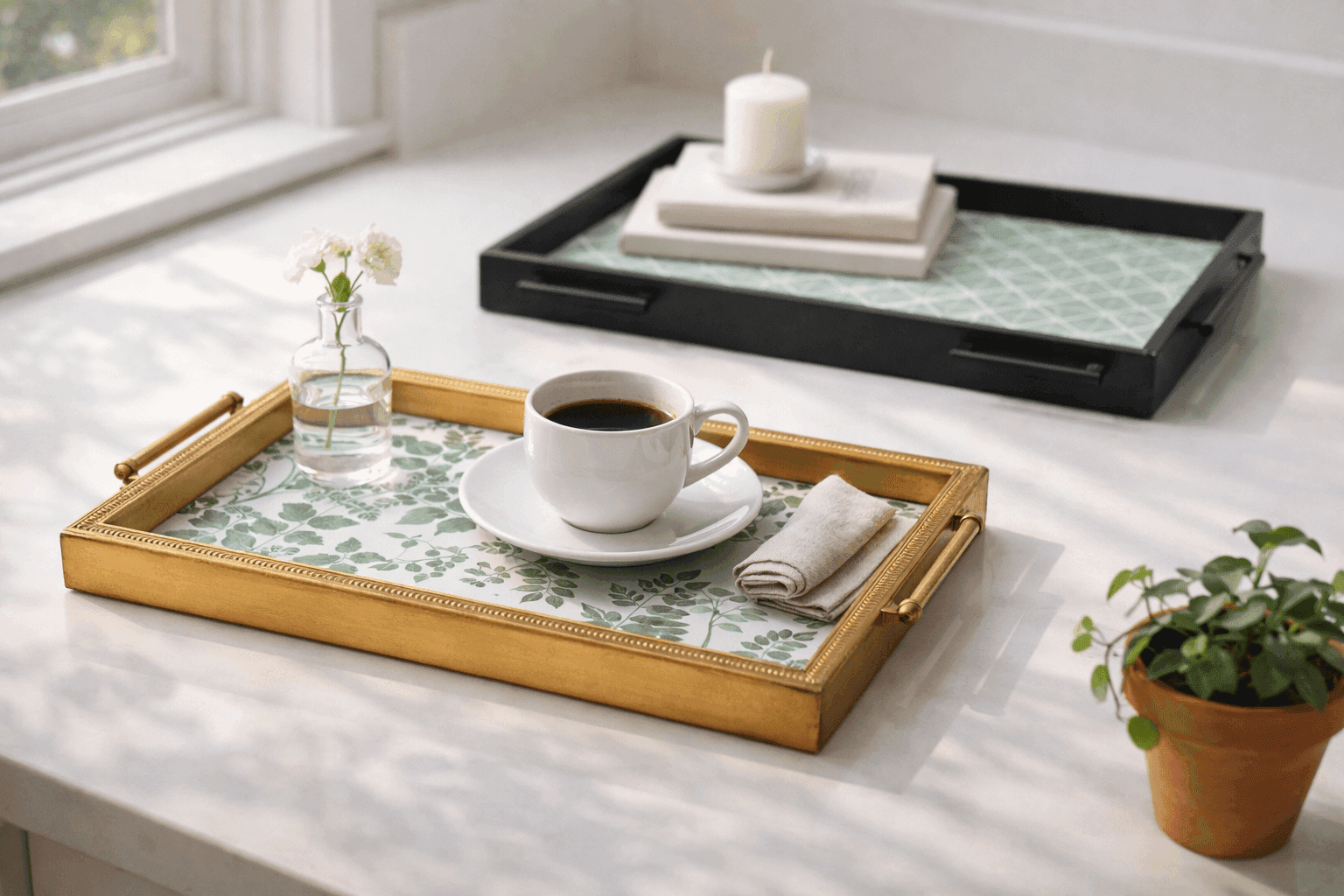
Decorative serving trays are one of those home accessories that cost a genuinely baffling amount of money at boutique shops and home goods stores — $35, $45, $60 for what is essentially a flat surface with handles and a pretty bottom. A thrift store picture frame with interesting bones, two drawer pulls from the hardware store, and a sheet of decorative paper gets you the exact same thing for $8 total, and the customization possibilities are so wide open that your tray can match your decor in a way that no mass-produced version ever quite manages. Ornate gold frames become elegant breakfast trays. Chunky distressed wood frames become rustic entertaining boards. Brightly painted frames become the most cheerful coffee table styling accessory you own. The glass surface wipes clean in seconds, the decorative insert swaps out whenever you want a refresh, and the whole project takes about forty-five minutes from thrift store find to finished piece sitting on your counter ready to use.
What You Need
- Thrift store picture frame with glass — look for frames at least 8×10 inches for a functional tray size; ornate, distressed, or interestingly shaped frames give the most character (~$1–4)
- Two drawer pulls or cabinet handles — bar pulls in brass, black, or chrome work especially well; match the scale to the frame size so handles look proportional rather than afterthought (~$3–6 per pair at hardware stores)
- Decorative paper, fabric, or wallpaper sample — for the tray bottom insert visible through the glass; scrapbook paper gives the widest pattern variety for the least cost (~$1–2 per sheet)
- Spray paint — optional, for refinishing the frame in a new color; Rust-Oleum metallic gold, matte black, or coral all transform a tired thrift store frame dramatically (~$5–7 a can)
- Small bolts, washers, and nuts — sized to fit your specific drawer pull mounting holes; hardware stores sell these individually for cents each
- Drill with small bit set — for drilling pilot holes through the frame sides for the handle bolts
- Screwdriver — for tightening the handle bolts from inside the frame
- Measuring tape and pencil — for marking centered, level handle placement on both sides of the frame
- All-purpose cleaner and cloth — for cleaning the frame and glass thoroughly before assembly
How to Make It
- Disassemble the frame completely by removing the backing, any existing picture or mat, and the glass — set the glass aside carefully on a flat surface. Clean the empty frame thoroughly with all-purpose cleaner, paying attention to any decorative grooves or carved details where grime accumulates and dulls the finish.
- Paint the frame if you're refinishing it, applying two even coats of spray paint with the frame lying flat and the can held twelve inches away. Allow full drying time between coats — rushing this step on a thrift store frame that may have multiple existing paint layers is what leads to a finish that chips within weeks of regular use.
- Mark your handle placement on both short sides of the frame using a measuring tape and pencil, centering the handle horizontally on each side and positioning it vertically at the midpoint of the frame's side rail. Handles that are even a quarter inch off-center are immediately visible on a finished tray — measure twice before drilling anything.
- Drill pilot holes through the frame sides at your marked points using a bit slightly narrower than your bolt diameter. Work slowly on thrift store frames, which may be hollow-backed wood composite that splinters under aggressive drilling — a slow steady pressure produces a clean hole that the bolt threads through without splitting the frame wall.
- Attach the handles by threading bolts from inside the frame outward through the pilot holes, sliding the handle over the protruding bolt ends, and securing with washers and nuts tightened firmly from the handle side. The bolt heads inside the frame will be covered by the decorative insert and glass, so they won't be visible in the finished tray.
- Cut your decorative paper or fabric to fit the frame opening precisely — use the original frame backing as a cutting template for a perfect fit. A paper insert that falls short of the edges leaves an unfinished gap visible through the glass, while one cut too large buckles and creates visible ridges under the glass surface.
- Layer the components back into the frame in order: decorative insert face-up first, then the clean glass on top of it, then secure the original frame backing clips to hold everything flat and in place. The glass now sits directly over your decorative paper, creating a smooth wipeable surface with the pattern showing through beneath.
- Flip the completed tray right-side up and assess the finished piece — handles level, glass clean, insert centered and visible without gaps or buckling. Style it immediately with a small plant, candles, or a coffee cup arrangement to confirm the proportions work for your intended use, and to start enjoying the thing you just made for $8.
Interior stylists who work with decorative trays in professional home staging always select handle hardware in a finish that appears at least one other place in the room — a brass pull on the tray that echoes the brass lamp base on the side table, or a matte black handle that repeats the matte black picture frame on the wall above. This single design principle, called finish repetition, is what makes a room feel deliberately curated rather than assembled from unrelated pieces, and it costs nothing to apply when you're already standing in the hardware store choosing between handle finishes. Buy the pull that matches something you already own, not the one that simply looks prettiest on its own.