Table Manners: Fix a Wobbly Table in 30 Minutes
Flip the table over, find the actual cause of the wobble, and apply the right fix — the 30-minute repair that ends the rocking, the spills, and the daily annoyance for good
A wobbly table is one of those everyday frustrations that sits below the threshold of urgency — not broken enough to deal with immediately, annoying enough to be noticed every single meal, every coffee, every time you set something down and feel it rock. The fix is almost always simpler than the wobble makes it seem, and almost always one of four specific problems: loose hardware that just needs tightening, a stripped screw hole that needs the toothpick-and-glue treatment, one leg that's marginally shorter than the others, or a loose mortise-and-tenon joint that needs re-gluing. The diagnosis takes two minutes and the repair takes fifteen to thirty depending on which problem you find. This Fix-It Friday covers all four causes and their specific solutions so that whatever is making your table wobble, you'll know exactly what to do about it before the next cup of coffee hits that surface.
What You'll Need
- Diagnosis Tools
- A flashlight for examining leg-to-frame connections, joint gaps, and hardware condition on the underside of the flipped table
- A tape measure or ruler for measuring any leg-length discrepancy by placing the table on a flat surface and checking the gap under each leg
- Your hands — pressing and pulling each leg individually while the table is flipped over tells you immediately whether a leg is loose at the joint, whether hardware is loose, or whether the leg length is the issue rather than any connection problem
- For Loose Hardware
- Phillips and flathead screwdrivers in multiple sizes — loose table hardware is usually either wood screws or machine bolts, and having both driver types ensures you can tighten whatever you find
- An adjustable wrench or socket set for any bolt-and-nut connections at leg attachment points on metal-hardware tables
- A drop of thread-locking compound (Loctite Blue) on any bolt threads before re-tightening prevents the bolt from working loose again through the vibration of normal table use — ~$5–$8 per small tube at a hardware store
- For Stripped Screw Holes
- Round wooden toothpicks — two to four per stripped hole — for filling the enlarged hole with wood fiber that gives the screw new material to grip. Golf tees work identically for larger screw holes where toothpicks don't fill the full diameter
- Wood glue — standard PVA or carpenter's glue applied to the toothpicks before inserting them into the hole to bond the fill material permanently to the surrounding wood
- A sharp utility knife or flush-cut saw for trimming the dried toothpick fill flush with the wood surface before re-driving the screw
- The original hardware screw — re-driven into the filled hole once the glue has cured for at least two hours
- For Short Legs
- Self-adhesive furniture felt pads in multiple thicknesses — stack them to reach exactly the right height to eliminate the gap under the short leg — ~$4–$6 for a multi-thickness assorted pack
- Adjustable furniture levelers — screw-in feet that replace the existing leg bottom and adjust height by turning — ~$8–$15 for a set of four, ideal for tables that will be moved between different floor surfaces where leg length needs ongoing adjustment
- For Loose Joints & Extra Reinforcement
- Wood glue — Titebond III or similar waterproof formula — for injecting into loose mortise-and-tenon joints. A syringe-style glue applicator or a thin palette knife allows you to work glue deep into a joint gap without disassembling the whole table
- Bar clamps or ratchet straps for clamping re-glued joints during the 24-hour cure — a joint that's glued but not clamped bonds at a fraction of the strength of a properly clamped joint
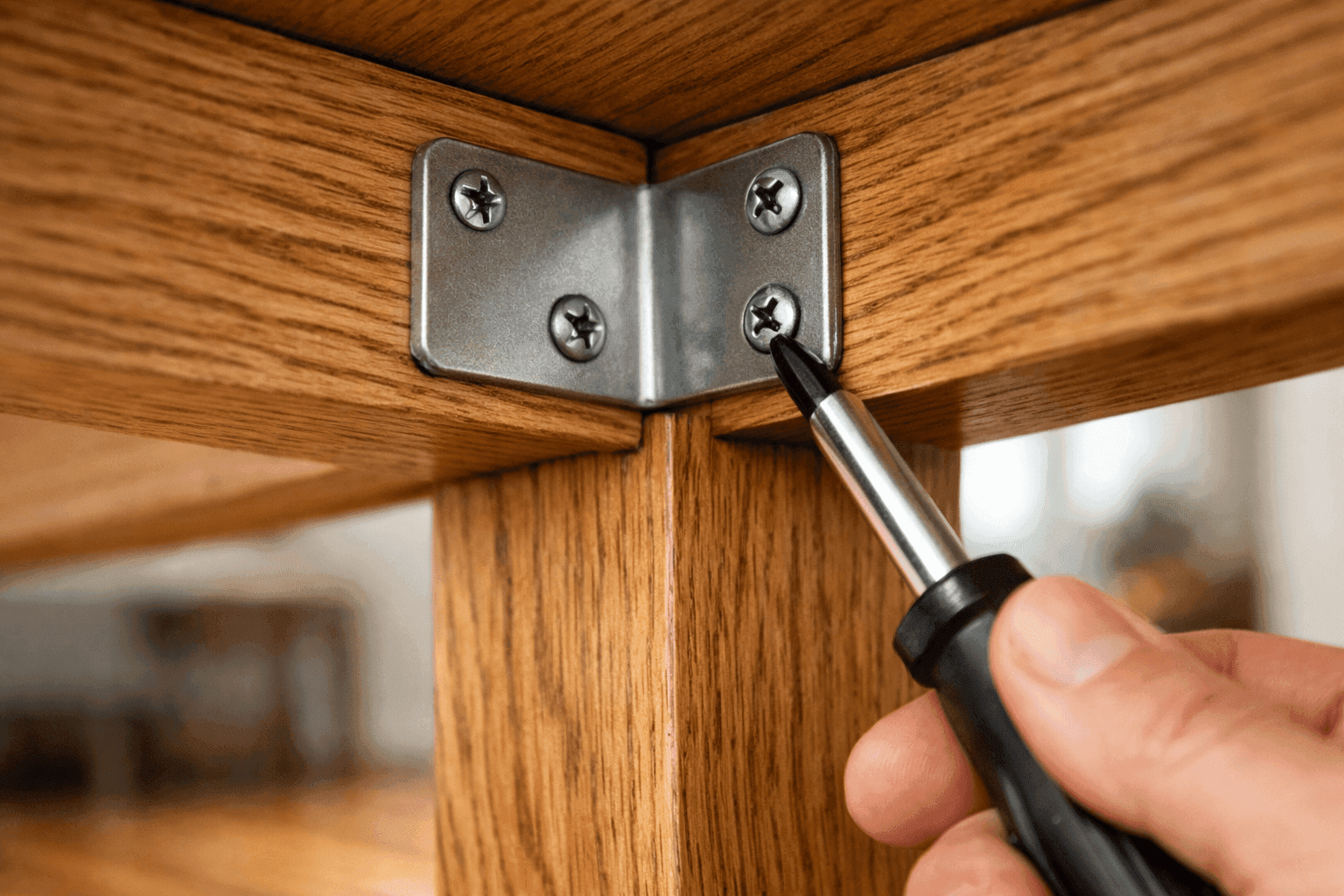
- Corner braces (L-shaped metal brackets) for adding permanent mechanical reinforcement to leg-to-apron connections — ~$5–$8 for a pack of four at any hardware store. Screwing a corner brace into both the leg and the table apron converts a glued-only joint into a glued-and-mechanically-fastened joint that won't loosen again under normal use
How to Fix It
- Diagnose before touching any hardware — flip the table upside down on a padded surface and examine every leg connection, every piece of hardware, and every joint while pressing and pulling each leg individually. A leg that moves when pressed sideways has a loose joint or loose hardware; a table that wobbles only on certain floors but not others has a leg length issue rather than a structural problem; a leg that has visible gap at the joint where it meets the apron has a mortise-and-tenon that needs re-gluing. Identifying the correct cause before applying any fix means you solve the actual problem rather than treating a symptom.
- Tighten every screw and bolt first regardless of what else you find — a surprising number of wobbly tables are wobbly for no reason more complicated than hardware that has gradually loosened through the vibration of regular use and needs nothing more than a firm quarter-turn of a screwdriver to become completely stable. Work methodically around every connection point, tightening each screw until it resists firmly without stripping, and check the table for wobble before proceeding to any more involved repair. Many tables that seemed to need significant repair are completely stable after this single step.
- Fix stripped screw holes if tightening didn't solve the problem — remove each screw that turns without gripping, push two to three toothpicks coated in wood glue firmly into the hole, allow the glue to cure for at least two hours, trim the toothpick ends flush with a utility knife, and re-drive the original screw into the filled hole. The toothpick wood fibers give the screw threads new material to grip and restore full holding strength — this repair is more permanent than any commercial stripped hole repair product and costs about two cents in materials per hole.
- Measure and correct any leg length discrepancy by placing the table right-side up on the flattest floor surface available and sliding a ruler under each leg to measure the gap. For a gap under one leg of ⅛ inch or less, a single layer of self-adhesive furniture felt pad corrects the issue invisibly. For larger gaps, stack felt pads to the required thickness or install adjustable furniture levelers — screw out the leveler until the gap is eliminated, confirm the table no longer rocks, and check that any remaining three legs are still in firm floor contact after the adjustment.
- Re-glue loose mortise-and-tenon joints by working wood glue into the gap between the joint faces using a thin palette knife, a syringe-style applicator, or a folded piece of paper as a makeshift spreader — the goal is getting glue onto both the tenon (the protruding piece) and the mortise (the receiving socket) surfaces rather than just into the visible gap. Work the leg back and forth slightly after applying glue to distribute it across all joint contact surfaces, wipe away all squeeze-out, apply clamps or ratchet straps to hold the joint tightly closed, and leave undisturbed for a full 24 hours before any load is applied to the table.
- Add corner braces to any leg-to-apron connection that has been re-glued or that shows signs of repeat loosening — position each L-bracket with one arm flat against the table apron and the other flat against the leg face, mark the screw hole positions, drill pilot holes to prevent splitting, and drive screws firmly into both surfaces. Corner braces are the mechanical reinforcement that converts a glued joint that could loosen again over time into a glued-and-braced connection that won't — and they're completely invisible from table height since they sit on the underside of the apron.
- Check every other table in the house while you have the tools out — press down on each corner of every table and feel for any movement that indicates loose hardware or a beginning joint failure that hasn't developed into a full wobble yet. Tightening hardware on a table that's starting to loosen takes thirty seconds; fixing a table that's been wobbly for two years because nobody caught it early takes thirty minutes. The preventative check costs almost nothing in time and eliminates the next wobbly table repair before it becomes necessary.
- Test the repair before declaring it done by placing the table right-side up on a flat floor, pressing down firmly on each corner and each side to confirm there is zero movement in any direction, setting a glass of water on the surface and pressing each corner to confirm it doesn't tip or rock enough to disturb the water level. A table that passes this test has been repaired correctly and will stay stable through years of normal use; one that still shows any movement has a second issue that the diagnosis missed and needs another round of examination from the underside before it's actually fixed.
Furniture restoration specialists who work on antique and high-quality wooden tables make one observation about table wobbles that most homeowners never hear: the majority of tables that develop wobbles in the first few years of ownership do so not because of any manufacturing defect or material failure but because of a single assembly oversight — the leg connections were not fully tightened during the original assembly, and the natural settling of the piece under regular load gradually works the hardware to the point where movement becomes noticeable. The professional prevention for this is applying a small amount of Loctite Blue thread-locking compound to every bolt thread during the original assembly — it prevents bolts from vibrating loose without making them permanently fixed, and a single application lasts the lifetime of the furniture. For any table with bolt-style leg connections that you've just tightened, adding this compound now before the bolts can loosen again is a five-minute step that eliminates the next repair entirely. The second observation that professional restorers make about table stability: the floor itself is more often the cause of perceived wobbling than the table — placing a truly stable table on an uneven floor produces the same rocking behavior as a table with a short leg, and a folded piece of cardstock under one leg often reveals instantly whether the wobble is a table problem or a floor problem.