Stand Tall: Build a Wooden Plant Stand for $10
Four legs, a few cross braces, and 90 minutes — the minimalist plant stand that makes every pot look like it belongs in an interior design shoot
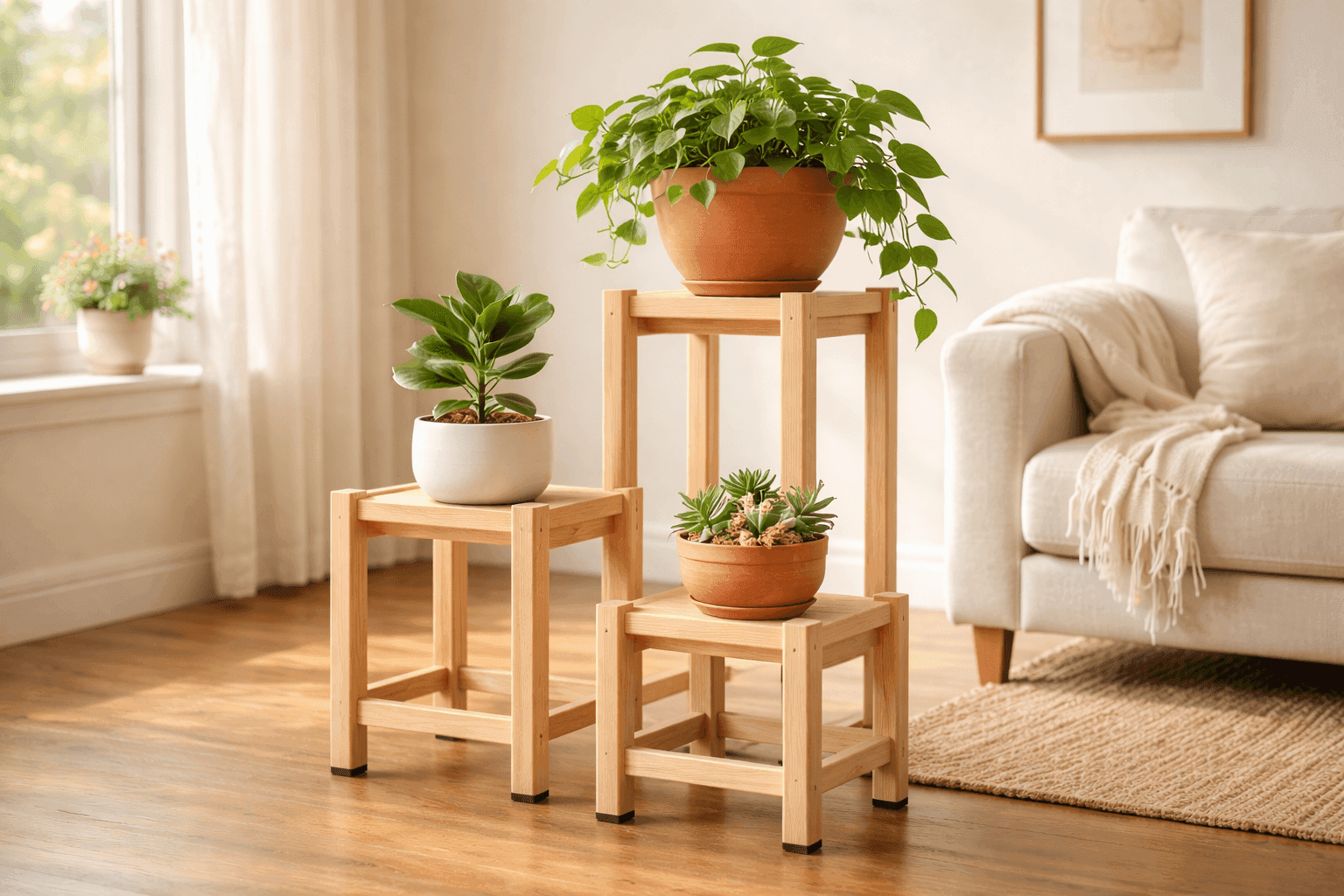
A plant sitting directly on the floor is just a plant. The same plant elevated on a well-proportioned wooden stand becomes a design element — it occupies vertical space, it creates layered visual interest at different heights, and the open structure of a simple stand gives it a lightness that a solid base or a heavy pot never achieves. Store-bought plant stands that look this clean and minimal routinely run $40–$80, which is genuinely hard to justify for what amounts to four legs and a few cross braces. This build uses $8–$12 in 2x2 and 1x2 lumber, takes about 90 minutes from first cut to final finish, and produces a stand that is indistinguishable from the retail versions in every way that matters — including the way it makes whatever plant you set on it look deliberately placed rather than incidentally there. Build several at different heights and group them as a layered display, and the whole collection costs less than a single mid-range store-bought stand.
What You'll Need
- Lumber
- One 2x2x8 board for the four legs — one 8-foot board yields four legs at 18 inches each with minimal waste, or four legs at 12 inches for a shorter stand — ~$4–$6
- One 1x2x8 board for the top frame pieces and lower cross braces — one board covers a complete stand with enough left over for a second stand's braces — ~$3–$5
- Choose poplar or pine for a clean, smooth finish that takes stain and paint evenly; oak or maple for a more premium grain that looks stunning with a clear natural finish
- Measure your pot before buying lumber — the top frame opening should be about 1–2 inches smaller than the pot diameter so the pot rim rests on the frame rather than dropping through
- Hardware
- 1¼-inch wood screws for attaching the 1x2 frame pieces to the 2x2 legs — ~$4–$5 for a small box that covers multiple stands
- Exterior wood glue for reinforcing every joint before screwing — standard Titebond or similar
- Four small rubber furniture feet for the bottom of each leg — ~$3–$5 for a pack — they protect floors from scratching and prevent the stand from rocking on slightly uneven flooring
- Optional: four corner brackets for additional joint reinforcement on stands that will hold heavy pots — ~$4–$6 for a pack of eight
- Finish Options
- Natural clear polyurethane for a clean, honest wood look that suits any interior style — one small can covers four to six stands — ~$8–$12
- Wood stain in warm walnut or natural oak tones for a warmer, richer look — one small can covers several stands — ~$6–$10
- Chalk paint in matte white, black, or sage green for a modern, painted finish — ~$8–$12 per small can
- Tung oil or Danish oil for a hand-rubbed finish that soaks into the wood grain and produces a beautiful low-sheen surface with no brush marks — ~$10–$14 per quart
- Tools
- Miter saw or circular saw for consistent leg and brace cuts — or request cuts at the hardware store
- Drill/driver with a small Phillips bit and ⅛-inch pilot hole bit
- Speed square and tape measure
- Clamps — two minimum — for holding joints during glue-up
- 120 and 220-grit sandpaper for smoothing and finishing
How to Build It
- Measure your pot first and establish your stand dimensions before cutting anything — the top frame opening needs to be sized so the pot rim rests securely on the frame without tipping, and the stand height needs to suit both the pot size and the space where it will live. A 12-inch stand suits a small pot on a shelf or side table; an 18-inch stand creates a strong floor-level display for a medium pot; two stands at different heights grouped together immediately creates the layered plant display that interior designers use in every well-photographed living space.
- Cut all pieces in a single session — four legs at your chosen height, two top frame pieces at your chosen width, and two lower cross brace pieces at the same length as the top frame pieces. Cutting everything before assembly lets you lay all pieces out together, confirm the proportions feel right, and catch any measurement errors while they're still a matter of a re-mark rather than a wasted board. Label each piece with painter's tape so assembly doesn't require re-measuring every joint.
- Sand all pieces before assembly with 120-grit paper on all faces and edges — it is dramatically easier to sand flat individual boards than an assembled stand with interior corners and tight spaces between the legs and braces. Pay particular attention to the top edges of the frame pieces where the pot will rest and the leg bottoms where the rubber feet will attach, and knock all sharp corners to a gentle roundover with a few angled sanding strokes.
- Build the two H-shaped side frames by laying two legs parallel on a flat surface, positioning one top frame piece flush across the top connecting them, applying wood glue to the contact surfaces, clamping square, and driving two pre-drilled 1¼-inch screws through the frame piece into the top of each leg. Pre-drilling pilot holes in 2x2 lumber is non-negotiable — driving screws into the end grain of a 2x2 without a pilot hole splits the wood at the joint every single time, which ruins both the joint and the leg.
- Connect the two side frames with the lower cross braces by standing both H-shaped assemblies upright parallel to each other at your chosen width, clamping the cross braces across the inside faces of the legs at a height of 3–4 inches from the bottom, and confirming the overall structure is square before fastening. The lower cross braces are what convert two wobbly H-shaped frames into a rigid, stable stand — their placement height matters less than their consistent level on both sides, so use a tape measure rather than eyeballing.
- Check for square and stability by setting the assembled stand on a flat surface and pressing gently on each corner — a stand that rocks or feels loose at any joint needs a clamp and a few minutes of additional cure time for the glue before it's ready for finish. A plant stand that wobbles under an empty test press will wobble significantly more under a soil-filled pot, and fixing a loose joint before finishing is a five-minute task versus a frustrating one after the finish is applied.
- Final sand the assembled stand with 220-grit paper to smooth any rough spots at the screw heads, joint lines, and transition between the leg and frame surfaces — this pass is what gives the finished stand that seamless, furniture-quality feel where all the individual pieces read as a unified object rather than a collection of connected boards. Wipe off all sanding dust with a tack cloth or slightly damp rag before applying any finish.
- Apply your chosen finish in thin, even coats — two coats of polyurethane, one coat of stain followed by one coat of clear sealer, or two coats of chalk paint followed by a clear wax — letting each coat dry fully between applications and sanding lightly with 320-grit paper between coats for a smooth, professional surface. Attach rubber feet to each leg bottom once the finish is fully cured, set your pot on the finished stand, and place it in the space where it will live — then immediately start planning the second stand at a different height, because one is never enough once you see how good it looks.
Interior stylists who dress plant displays for editorial shoots always follow one rule when grouping plant stands at multiple heights: the height difference between stands needs to be significant enough to read as intentional rather than accidental. A 12-inch stand beside a 14-inch stand looks like a measurement error; a 10-inch stand beside an 18-inch stand beside a 24-inch stand reads as a deliberate cascading display. The rule of thumb they use is a minimum 6-inch difference between any two adjacent stand heights — anything less collapses into visual ambiguity at room distance. When finishing a set of stands for a grouped display, apply identical finish to every stand in the set even if they're different heights — a unified finish treatment is what makes multiple stands read as a cohesive collection rather than a random assortment of objects at different heights. And always build one stand taller than you think you need — in a grouped plant display, the tallest element is always the anchor the eye returns to, and undershooting that height is the most common reason a beautifully built plant stand grouping fails to make the visual impact it should.