Space Savers: Make Your Own Seed Tape for $5
Glue tiny seeds at perfect spacing onto toilet paper strips and plant an entire row in seconds — no thinning, no crowding, no wasted seeds
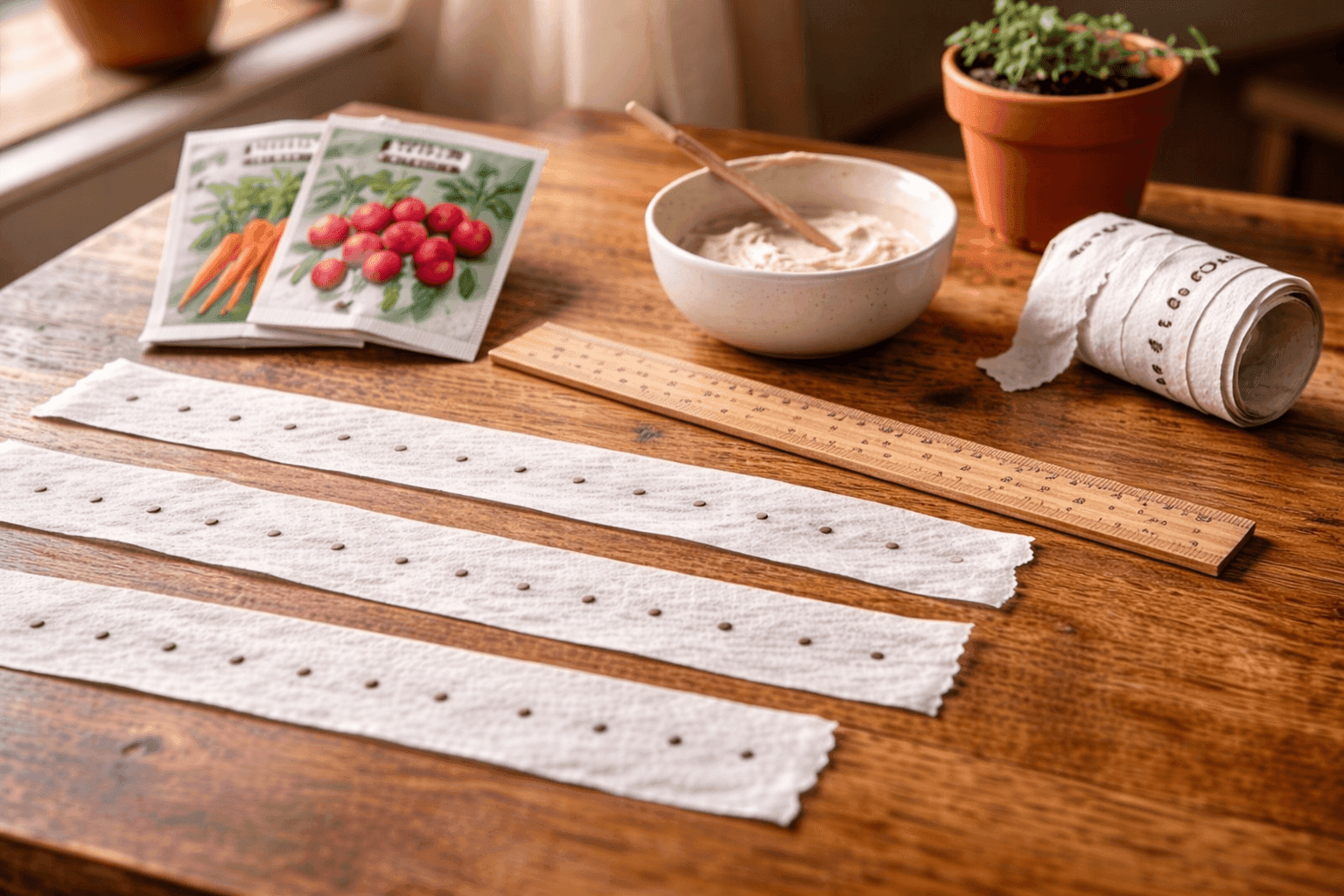
Anyone who has ever tried to sow carrot seeds directly into a garden bed knows the particular frustration of tiny seeds — you shake the packet, they scatter unevenly, you end up with a dense mat of seedlings that all need thinning, and half the seeds you pull out were perfectly good plants you're sacrificing because past-you didn't space things properly. Seed tape solves this problem completely and permanently, and the homemade version costs pennies per foot compared to the $3–$5 store-bought rolls that only give you a few feet of tape per variety anyway. The technique is genuinely simple: mix a small amount of flour and water into a paste, use a toothpick to place seeds at the correct spacing intervals on a strip of single-ply toilet paper, let it dry, and roll it up for planting day. Lay the tape in a furrow, cover with soil, water once, and every seed comes up exactly where it should with zero thinning required. This is the kind of smart prep work that separates gardens that look effortlessly tidy from ones that feel perpetually behind.
What You'll Need
- The Tape Base
- Single-ply toilet paper — the thinner the better, since it needs to break down quickly in soil without forming a moisture barrier over seeds. Scott 1000 or any store-brand single-ply works perfectly — cost is essentially zero since you already have it
- Paper towels or newspaper strips cut to 1–2 inches wide work as alternatives for larger seeds that need more structural support during handling
- Cut or tear strips to the length of your garden row — working in 12–18 inch sections is easier to handle than one very long strip that folds and sticks to itself
- The Adhesive
- All-purpose flour and water paste — mix 1 tablespoon of plain flour with enough water to reach a smooth, thick glue consistency similar to white school glue — completely free if you have flour in the pantry and the safest possible adhesive for seeds and soil
- Cornstarch paste works identically and is the preferred choice for anyone concerned about attracting insects to flour-based paste in storage — same ratio, same consistency
- Avoid commercial glues of any kind — even non-toxic craft glue can inhibit germination by creating a water-resistant film around the seed
- Seed Placement Tools
- Toothpicks for picking up and placing individual seeds — the pointed tip picks up one tiny seed at a time with a small dab of paste, which is far more precise than trying to place seeds by hand
- A small bowl or bottle cap for holding your paste during work
- A ruler or measuring tape for marking consistent seed intervals on the paper strip before placing seeds
- A fine-tip marker or pencil for marking spacing dots on the tape before seeding — dot first, seed second, never try to eyeball spacing
- Seeds — Best Candidates
- Carrots (space 2 inches apart) — the single best seed tape candidate because carrot seeds are tiny, notoriously difficult to sow evenly, and desperately need precise spacing for straight, properly sized roots
- Radishes (space 2 inches apart), lettuce (space 6 inches apart), beets (space 3 inches apart), and spinach (space 3 inches apart) are all excellent candidates
- Avoid very large seeds like beans, peas, corn, or squash — they're easy enough to place by hand and the tape adds unnecessary work for seeds that don't need the precision help
- Storage & Labeling
- Wax paper or parchment paper for drying finished tapes without sticking
- Paper towel tubes for rolling and storing finished tapes — label each tube with the seed variety, spacing, and planting depth with a permanent marker
- A dry storage location — seed tapes store perfectly for months in a cool, dry spot and can be made weeks or months ahead of planting season
How to Make Them
- Mix your paste by combining one tablespoon of flour or cornstarch with water a few drops at a time, stirring until it reaches the consistency of thick white school glue — it should hold a shape when dropped from a toothpick rather than running immediately flat. Make only a small amount at a time since it dries out quickly during work, and cover the bowl with plastic wrap between sessions to keep it workable.
- Check your seed packet for the recommended spacing before marking anything — this is the number you'll use for your interval marks, and using the correct spacing is the entire point of making seed tape in the first place. Write the spacing measurement, planting depth, and variety name on a piece of paper beside your work area so you're not constantly re-reading the packet with pasty hands.
- Mark your spacing intervals on the toilet paper strip using a ruler and fine pencil, placing a small dot at each seed position before touching any paste or seeds. Working dot-first means you can check that your spacing is consistent and correct across the full strip length before committing to the irreversible step of adding paste and seeds — a strip with wrong spacing is a strip you have to remake.
- Apply paste dots at each marked interval using a toothpick dipped in your flour paste — a dot about the size of a small pea is the right amount, large enough to hold the seed securely through drying and handling but small enough that it dissolves quickly in moist soil without slowing germination. Work in sections of 6–8 dots at a time so the paste doesn't dry before you've placed seeds on it.
- Place one seed per dot by touching a clean toothpick tip to the seed in your packet — the slight tackiness of the toothpick wood picks up one tiny seed at a time — then touching that seed gently onto the paste dot and pressing lightly to embed it. For seeds specified to plant two per location (like beets, which are actually seed clusters), place two seeds per dot spaced just slightly apart so both have room to germinate without immediately competing.
- Let each completed strip dry fully by laying it flat on a piece of wax paper in a warm dry spot for at least 1–2 hours — the paste needs to be completely dry and hard before the tape is handled further or rolled for storage, because a seed that gets bumped off its dot during rolling is a gap in your garden row that you won't know about until planting day. Prop a small fan nearby if you're making tapes in humid conditions to speed the drying process.
- Roll and label finished tapes loosely around a paper towel tube, securing the end with a small piece of painter's tape, and write the full planting information directly on the tube in permanent marker — variety, spacing, planting depth, and the date you made it. Store tubes upright in a cool dry location, and make a separate tape for each seed variety rather than combining multiple varieties on one roll, which creates chaos and potential mislabeling at planting time.
- Plant by laying the tape in a prepared furrow at the correct depth for the seed variety, covering gently with fine soil, firming lightly with your palm, and watering with a gentle spray so the toilet paper absorbs moisture without washing seeds sideways. The paper breaks down within a few days of consistent moisture contact — by the time seeds are germinating, the tape is already decomposing naturally into the soil with no residue and no barrier left behind.
Market gardeners who grow cut flowers and salad greens at scale use a variation of this technique called succession seed taping — instead of making one long tape for an entire row, they make a series of shorter tapes for the same variety staggered two to three weeks apart, all labeled and stored in the same tube. When planting day comes, they plant the first tape and set the others aside, then plant the second tape two to three weeks later, and so on through the season. The result is a continuous harvest of carrots, lettuce, or radishes that comes in manageable waves rather than all at once — which is the difference between a garden that feeds you steadily from June through October and one that produces an overwhelming glut in July that you can't possibly eat before it bolts. Making five shorter tapes in a single 30-minute session costs no more time or materials than one long tape, and it transforms your harvest rhythm for the entire growing season.