Space Saver: Build Wall-Mounted Desks That Vanish On Demand
Create functional workspace that disappears in tight quarters
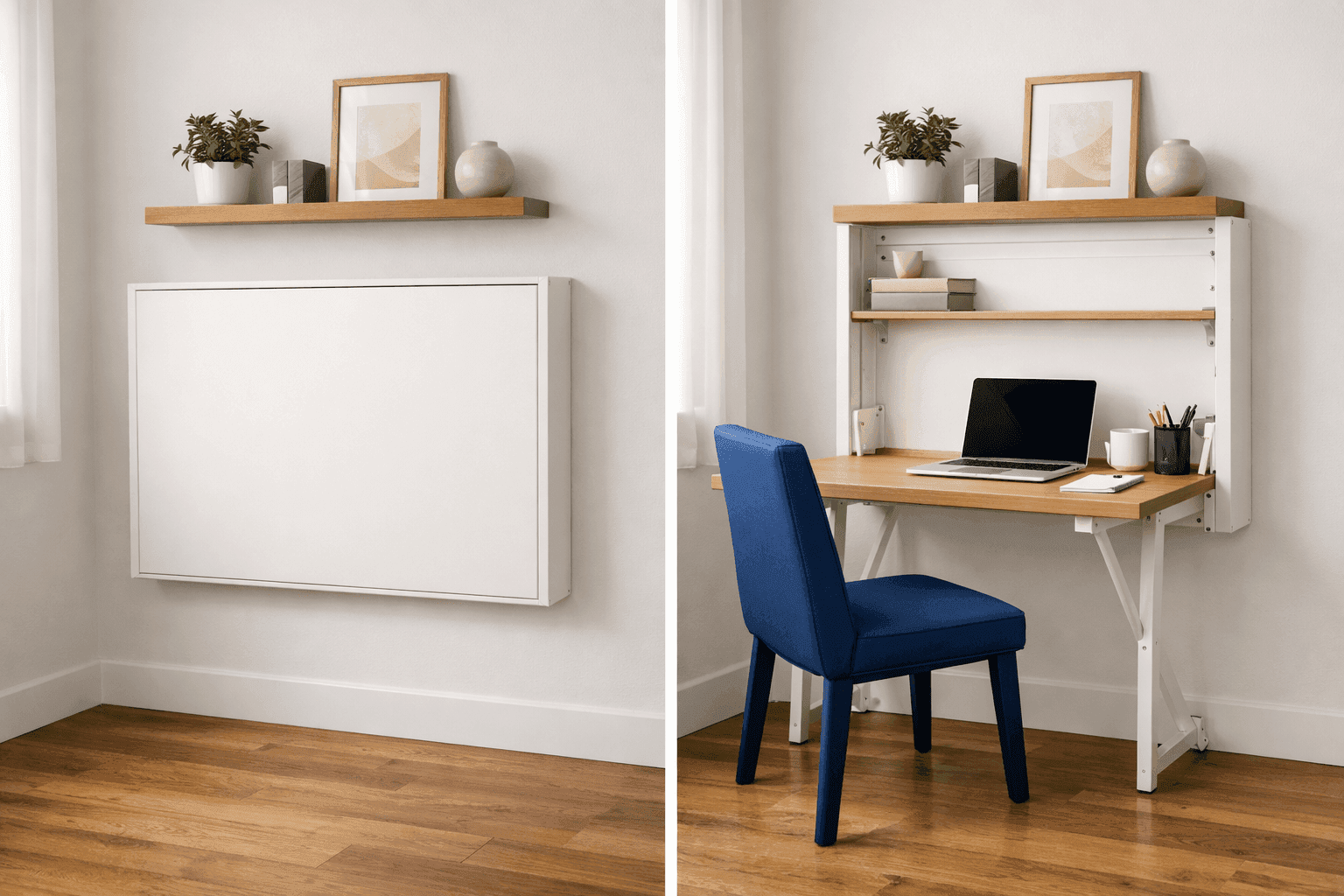
Small apartments, spare bedrooms doubling as offices, and multi-purpose spaces demand furniture that provides full functionality when needed but disappears when not in use rather than permanently consuming precious square footage. Murphy-style fold-down desks mount directly to walls, providing sturdy work surfaces that fold flat against the wall when the workday ends, instantly transforming home offices back into guest rooms, playrooms, or simply open space that makes small areas feel less cramped. While commercial wall-mounted desks cost $300-600, building your own takes 3-4 hours and $50-80 in materials while offering complete customization for your specific space dimensions, aesthetic preferences, and functional requirements. The fundamental design is brilliantly simple: a sturdy board attached to the wall with heavy-duty hinges that allow it to fold down for use and up for storage, with optional fold-down legs providing additional support when the desk is in working position. This project requires intermediate woodworking skills and the ability to locate and mount into wall studs for secure installation that supports computer equipment, books, and typical work materials without sagging or pulling away from walls. Beyond practical space-saving benefits, these desks create psychological boundaries between work and home life in shared spaces—folding up the desk literally closes the office for the day, preventing the "always on" mentality that plagues people whose permanent desks constantly remind them of unfinished tasks.
Materials & Tools
- Wood Materials ($30-40):
- 3/4" plywood or solid wood board for desktop (30-40" wide x 18-24" deep)
- Optional: 1x2 lumber for front edge trim
- Optional: 2x2 or folding brackets for leg support
- Sandpaper (120, 180, 220-grit)
- Hardware ($20-30):
- Heavy-duty piano hinge or 3-4 large butt hinges
- 3-4 lag bolts (3-4 inches) for wall mounting into studs
- Wood screws for attaching hinges
- Optional: folding shelf brackets or leg hinges
- Cabinet latch or magnetic catch to hold desk closed
- Finish Supplies ($5-10):
- Wood stain or paint matching your space
- Polyurethane or clear coat for protection
- Wood filler for edge imperfections
- Tools Required:
- Drill with bits and driver bits
- Circular saw or table saw
- Stud finder (critical for proper mounting)
- Level (essential for even installation)
- Measuring tape, pencil, square
- Clamps for assembly
Build Your Desk
- Measure your available wall space carefully, determining maximum desk width and depth that fits when folded down without blocking doors, furniture, or walkways—undersizing slightly beats discovering fit issues after installation.
- Cut your desktop board to final dimensions using a circular saw with a straight-edge guide, ensuring perfectly square corners and smooth edges that won't snag clothing or papers during daily use.
- Sand all surfaces and edges thoroughly with progressively finer grits (120, 180, 220), rounding sharp corners slightly to create comfortable work surface that feels pleasant under arms during long working sessions.
- Finish your desktop with stain and polyurethane or paint before installation—working on horizontal surfaces produces better results than trying to finish pieces already mounted vertically on walls.
- Locate wall studs using a stud finder, marking their positions clearly—mounting into studs rather than drywall alone determines whether your desk supports equipment safely or pulls away from walls catastrophically.
- Mount piano hinge or multiple butt hinges to the wall first, positioning them at comfortable working height (typically 28-30 inches from floor) and ensuring they're perfectly level before driving lag bolts into studs.
- Attach the desktop board to the installed hinges, testing folding motion before fully tightening all screws—adjust hinge placement if needed to ensure smooth operation without binding or gaps when closed.
- Add support legs or folding brackets to the front edge if desktop depth exceeds 18 inches—these prevent sagging under weight and provide stability that makes the desk feel solid rather than bouncy during typing.
Professional carpenters recommend building fold-down desks slightly smaller than your theoretical maximum dimensions to ensure comfortable operation—a 36-inch-wide desk that barely fits becomes frustrating to fold up around furniture or people, while a 32-inch version folds easily with clearance to spare. Add a small shelf above the desk for frequently-used supplies that stay accessible even when the desk is folded up, creating a mini command center that maximizes vertical space. For truly minimal profiles when folded, recess the hinge mounting board slightly into the wall by routing out a channel or building a shallow mounting frame—this allows the desktop to sit flush against the wall rather than protruding several inches. Consider cable management from the start by drilling a small hole near the back corner for routing charging cables, or install a power strip on the underside of the desk that stays connected when folded so you don't need to plug/unplug equipment daily. For children's rooms or craft spaces, add a fold-down chalkboard or corkboard to the underside of the desktop that becomes visible and functional when the desk is folded up—this dual-purpose design maximizes utility of what would otherwise be wasted space. The biggest mistake beginners make is underestimating the importance of stud-mounting—even the best hinges and hardware fail if they're screwed only into drywall rather than the solid framing behind it, so take time to locate studs accurately and adjust your desk position to align with them rather than forcing installation where studs don't exist.