Silver Lining: Make Vintage Silverware Wind Chimes
Thrift store spoons and forks, a driftwood branch, and an hour — the $10 wind chime that sounds better than anything in a boutique garden shop and costs a fraction of the price
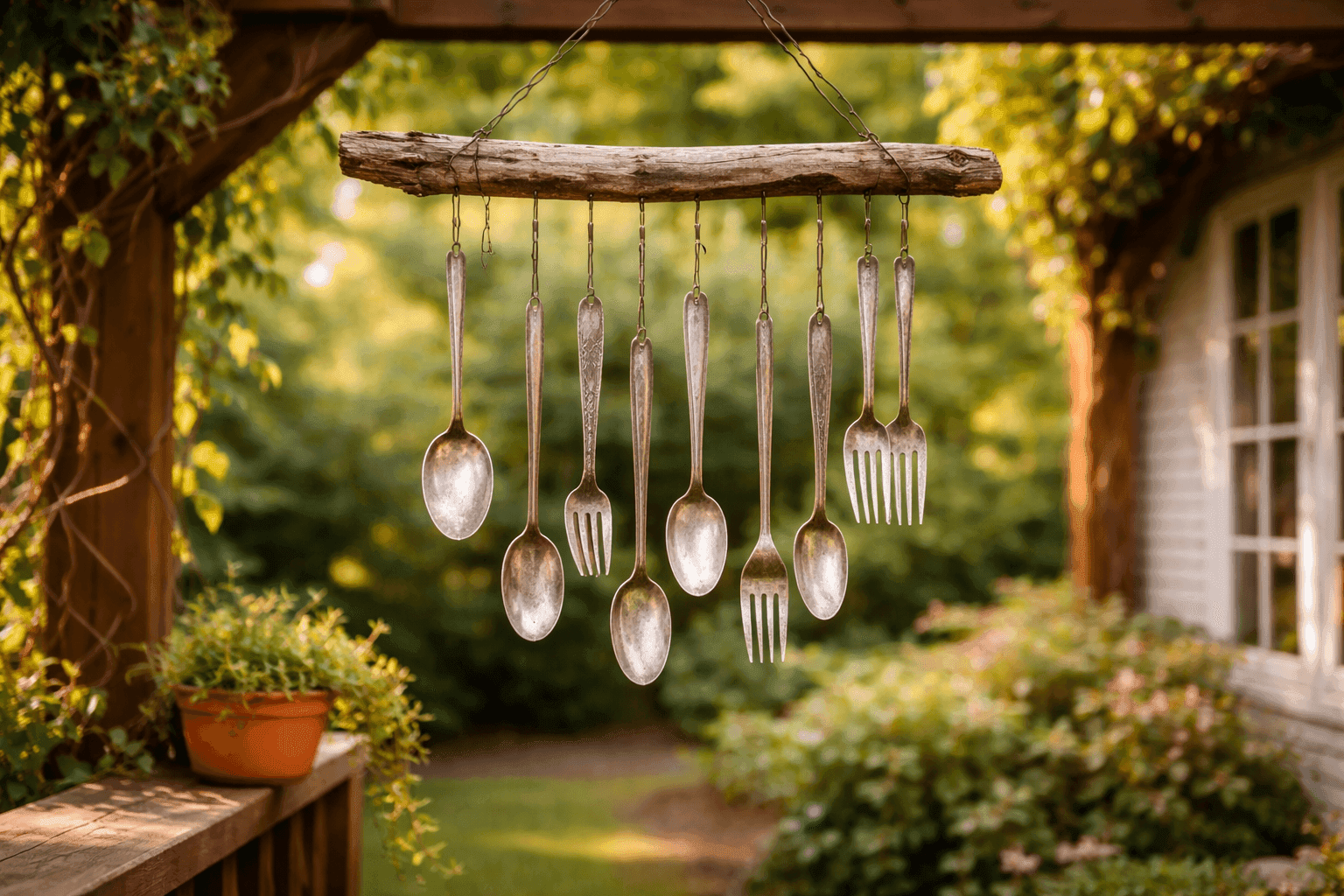
Wind chimes made from vintage silverware occupy a very specific design category — they're the kind of handmade object that looks like it required serious craft skills and costs serious money, and turns out to require neither. A handful of mismatched thrift store spoons and forks, a weathered driftwood branch, some wire, and an hour of patient drilling produces a wind chime with a genuinely beautiful layered sound that boutique garden shops charge $40–$60 for versions of, and the handmade version has something the boutique version doesn't: every piece of silverware in it came from a different table in a different home, and that collected quality gives it a character that matched sets simply cannot replicate. The sound each piece makes is determined by its weight, length, and the metal it's made from — which means a set of genuinely mismatched vintage silverware produces a more complex, more musical sound than anything designed to be uniform. Make this for your patio, give it as a housewarming gift, or hang it in the garden where the breeze finds it on quiet summer evenings and turns it into the most peaceful thing in the entire outdoor space.
What You'll Need
- The Silverware
- Eight to twelve mismatched vintage spoons, forks, and knives from a thrift store — aim for variety in size, weight, and pattern for the most interesting sound and visual profile — ~$3–$5 for a full lot at a thrift store or estate sale, or free from your own kitchen drawer if you have orphaned pieces
- Silver-plated pieces produce the clearest, most resonant sound — stainless steel is slightly duller in tone but more weather-resistant for a permanently outdoor chime. A mix of both is fine and produces the tonal variety that makes the chime sound most musical
- Heavier, thicker pieces ring longer than thin lightweight pieces — include a mix of heavy serving spoons and lighter teaspoons for varied sustain in the sound
- Avoid pieces with ornate three-dimensional handles that are difficult to drill through cleanly — flat-handled silverware drills most easily and produces the neatest finished hanging hole
- The Hanging Bar
- A driftwood branch 12–18 inches long and at least ¾ inch in diameter — found free on a beach or woodland walk, or sourced from a craft store for ~$3–$5. Driftwood has a naturally weathered texture that complements the vintage silverware beautifully and holds wire attachments without splitting the way green or freshly cut wood does
- A straight section of hardwood dowel rod as an alternative to driftwood — more uniform in appearance but can be painted, stained, or decorated for a more polished look if the rustic driftwood aesthetic isn't the right fit for the intended display location
- The branch should be thick enough that drilling holes for the hanging wire doesn't risk splitting it — ¾ inch minimum diameter is the practical threshold for reliable wire attachment holes
- Wire & Hardware
- 20 or 22-gauge galvanized craft wire or fishing line for hanging each silverware piece — wire produces a more rustic look that suits the vintage aesthetic; monofilament fishing line is nearly invisible and creates a floating appearance where the silverware seems to hang in mid-air — ~$3–$5 per spool at a craft store
- Heavier gauge wire (16 or 18-gauge) or jute twine for the main hanging loops at each end of the driftwood branch — these carry the full weight of the assembled chime and need to be proportionally stronger than the individual silverware hanging wires
- Needle-nose pliers for making clean wire loops and twists at each attachment point — twisted wire joints that are made with pliers rather than by hand are significantly tighter and more secure under the dynamic load of wind movement
- Drilling Supplies
- A drill with metal drill bits — a ⅛-inch or 3/32-inch bit is the right size for most wire gauges and produces a hole large enough to thread wire through without weakening the handle — ~$5–$8 for a basic metal drill bit set if you don't already own one
- A center punch or nail for creating a small starting divot in the metal before drilling — this prevents the bit from wandering across the smooth metal surface during the first seconds of drilling before it bites in
- A small vice or a piece of scrap wood with a clamp for holding each silverware piece completely stationary during drilling — the metal handle needs to be completely immobile for the drill bit to produce a clean, round hole rather than an oval slot
- Cutting oil or even a drop of regular cooking oil applied to the drill bit before each hole — reduces heat and friction that dull the bit and cause the metal to grab rather than cut cleanly
How to Make It
- Lay out the full composition before drilling anything — arrange all your silverware pieces on a flat surface in the order and spacing you want them to hang, alternating spoons and forks, mixing large and small pieces, and planning the graduated length variation that will make adjacent pieces strike each other at slightly different points. Photograph the layout before picking up the drill so you have a reference for the final assembly order — the composition that looks visually balanced when laid flat almost always produces the best spatial arrangement when hung.
- Mark and punch the drill point on each handle — position the hole about ½ inch from the end of each handle, centered on the flat handle face. Use a center punch or the tip of a nail and a firm hammer tap to create a small starting divot at the mark — this step takes five seconds per piece and prevents the drill bit from skating across the smooth metal surface during the critical first moments of drilling when the bit is most prone to wandering off the mark.
- Drill each handle slowly with cutting oil — clamp the silverware firmly so it cannot move, apply a single drop of oil to the drill bit, and drill at slow to medium speed with consistent downward pressure. The key is maintaining steady pressure without forcing — a sharp bit cutting at the right speed produces a clean, round hole with minimal heat; a dull bit or a rushed technique generates heat that work-hardens the metal and makes each successive hole harder to complete. Let the bit do the work rather than pushing through, and back the bit out briefly every few seconds on deeper cuts to clear metal shavings from the flutes.
- Deburr every hole after drilling by running the tip of a larger drill bit by hand in a circular motion in the hole opening — this removes the sharp metal burr that the drill leaves around the hole edge and that would otherwise cut through the wire over time under the constant movement of wind. A hole that has been properly deburred feels smooth when you run a fingertip across it; one that hasn't feels slightly raised and sharp at the rim.
- Cut hanging wire lengths in graduated measurements — the shortest piece should hang about 4 inches below the branch, with each subsequent piece 1–2 inches longer than the previous one up to the longest piece at 10–14 inches below the branch. This graduated length variation is the specific detail that creates the layered chiming sound — pieces of identical length all move together in the same wind and produce a uniform clank rather than the staggered, overlapping ring of pieces hitting each other at slightly different moments as the chime moves.
- Attach wire to each silverware piece by threading the wire through the drilled handle hole, doubling it back on itself to create a loop, and twisting the wire end tightly around the main wire length three or four times with needle-nose pliers to create a secure connection that won't unravel under the repetitive stress of wind movement. The wire twist joint at the silverware handle is the most mechanically stressed point in the entire chime — make it tight enough that pulling firmly on the silverware piece produces no movement at the joint before moving on.
- Attach all silverware wires to the driftwood branch at your planned spacing — wrap each wire around the branch at the correct position, twist it tight with pliers, and trim any excess wire end so no sharp points extend outward. Space the pieces so they can swing freely and strike each other in a light breeze without becoming tangled — a spacing of 1½ to 2 inches between adjacent pieces is the practical minimum for tangle-free movement in most wind conditions.
- Add the main hanging loops at each end of the branch using heavier gauge wire or jute twine — wrap firmly around the branch end, twist or knot securely, and join both loops at a point 8–10 inches above the branch center to form the single hanging point. Test the balance by holding the chime from this hanging point and adjusting the loop attachment positions along the branch if the chime tilts significantly to one side — a level chime hangs and moves more gracefully than one that's weighted unevenly to one end, and the balance adjustment takes thirty seconds before the loops are permanently tightened.
Metal artists and sound designers who create musical garden installations use a tuning technique that can turn a pleasant-sounding silverware chime into a genuinely musical one — and it requires nothing beyond the pieces you already have and a willingness to experiment before finalizing the wire lengths. Each piece of silverware has a natural resonant frequency determined by its length, weight, and metal composition, and pieces whose frequencies are harmonically related to each other — spaced at musical intervals like thirds, fifths, or octaves — produce chord-like combinations when they strike that sound intentionally musical rather than randomly pleasant. To find harmonically related pieces, hold each silverware item loosely by the tip and tap it gently with another piece — the tone you hear is its resonant note. Group pieces that produce notes that sound good together when struck simultaneously, and separate pieces that produce clashing tones by spacing them further apart on the branch so they rarely make contact. This takes about ten minutes of listening and rearranging before the final assembly and produces a wind chime that musicians and non-musicians alike describe as sounding unusually beautiful compared to standard commercial chimes — because it actually is, and the reason is the same harmonic relationship that makes any chord sound better than a random cluster of notes.