Rung Up: Transform an Old Ladder into a Bookshelf
A vintage wooden ladder, a few shelf boards, and an afternoon — the leaning bookshelf with genuine character that costs $15–$30 and looks like a deliberate design choice in any room
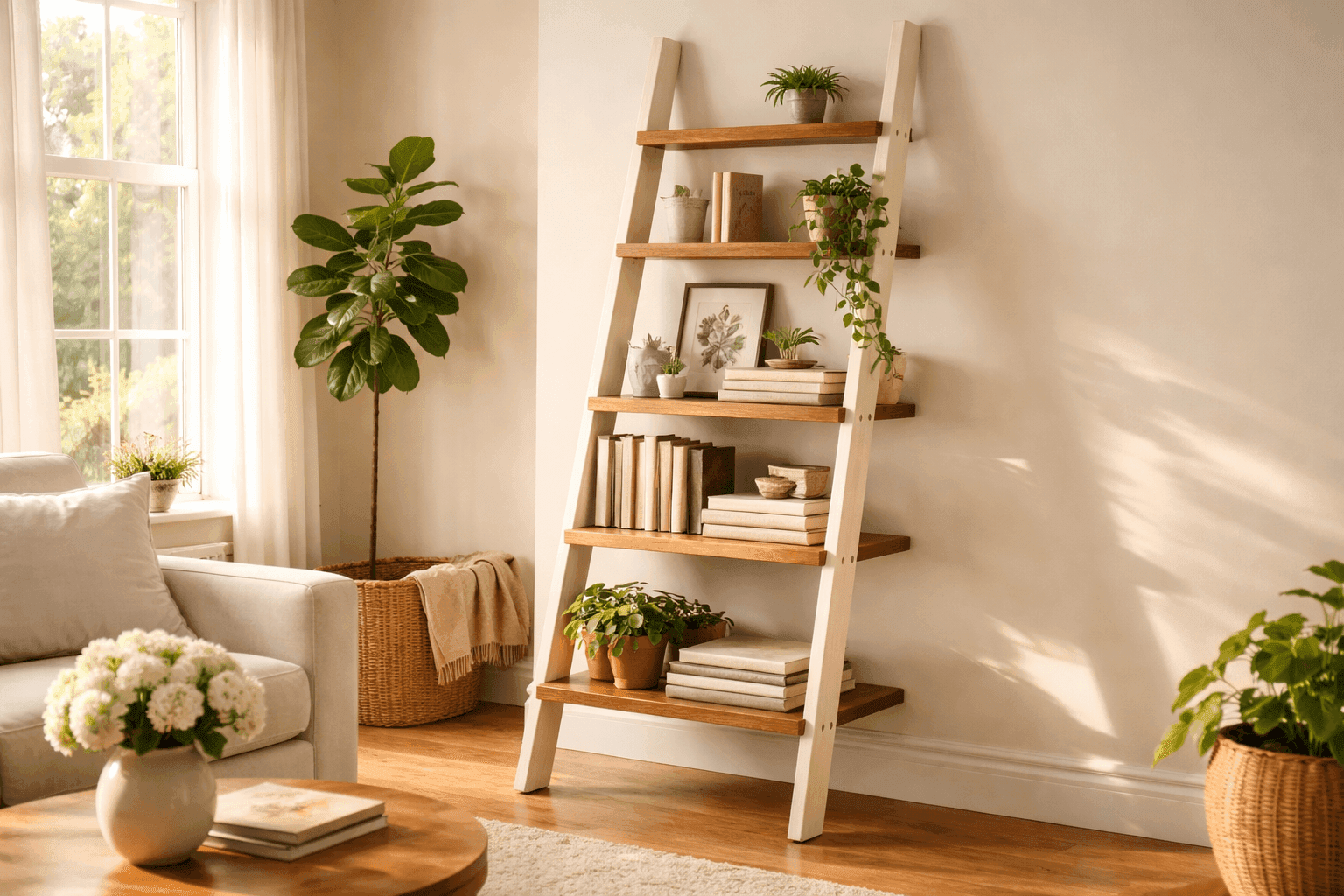
A leaning ladder bookshelf is one of those pieces that retailers have been selling for $150–$300 for years precisely because the concept is so appealing — the visual interest of a diagonal line in a room full of verticals and horizontals, the graduated shelf depth that creates a natural display hierarchy from large at the base to small at the top, the open design that never makes a space feel heavy. The version you build from an actual vintage ladder does everything the retail version does and adds something no flat-pack piece ever can: the genuine character of a real object with a real history, finished in whatever paint or stain suits your specific room rather than whatever ships from a warehouse. A 6–8 foot ladder from a thrift store or garage sale, a few boards cut to span the rungs, and an afternoon of sanding and finishing produces a piece that people will ask about every time they visit — and costs $15–$30 total depending on the wood you choose for the shelves. This is the Transform-It Thursday project that turns functional salvage into genuine furniture.
What You'll Need
- The Ladder
- A wooden straight ladder or A-frame stepladder in the 6–8 foot range — straight ladders lean against the wall naturally and work best for a single-sided display; A-frame stepladders open freestanding and display on both sides for a room divider application — free to ~$15 from thrift stores, garage sales, Facebook Marketplace, or the curb
- Solid wood construction only — aluminum ladders don't take paint or stain well and have a cold industrial quality that doesn't warm up to furniture status regardless of finish treatment
- Check every rung before committing to the ladder — press firmly on each rung to confirm none flex or crack under load, since a rung that fails under the weight of books and decorative objects after the bookshelf is finished and styled is a significant problem to fix after the fact
- Rungs spaced 10–14 inches apart vertically give shelf-to-shelf clearance appropriate for standard book heights and most decorative objects — ladders with very closely spaced rungs produce awkward shallow display levels that limit what can be placed on each shelf
- Shelf Boards
- 1x10 or 1x12 pine, poplar, or oak boards cut to span the width between the ladder sides at each rung level — measure each rung span individually since the taper of a leaning ladder means the lower rungs are wider than the upper ones, and identical board lengths won't fit the graduated spacing — ~$3–$6 per linear foot depending on species
- Use the ladder itself as a sizing guide at the hardware store by bringing your rung measurements on a cut list — most hardware stores cut lumber to length for free or a small fee, which eliminates the need for a saw at home
- Board depth of 10–12 inches provides adequate shelf space for books, plants, and objects at the lower levels; a shallower 8-inch board at the upper levels can reflect the natural taper of the ladder for a more proportional look
- Reclaimed wood boards for a more rustic look — pallet boards, old fence boards, or salvaged floorboards cut to length complement a vintage ladder's character better than bright new pine and require minimal finish treatment
- Hardware & Finish
- 1¼-inch wood screws for driving through the shelf boards from underneath into the rung — two screws per rung per board, pre-drilled to prevent splitting — ~$4–$5 for a small box
- Four small L-brackets per shelf as an alternative fastening method for anyone who wants the shelf boards to be removable for refinishing or replacement without pulling screws — ~$3–$5 per pack of four
- 120 and 220-grit sandpaper for prep and finishing the ladder and boards
- Paint, stain, or clear finish in your chosen aesthetic — white chalk paint for farmhouse, matte black for modern industrial, warm walnut stain for mid-century, natural clear wax for rustic — one quart covers the full ladder and all boards — ~$8–$18
- Two small rubber furniture feet or felt pads for the bottom ladder legs to protect the floor and prevent the ladder from sliding — ~$3–$5 for a small pack
- Wall Security
- A small L-bracket or picture hook at the top of the ladder secured to the wall — a bookshelf leaning against a wall loaded with books can tip forward if bumped by a child or pet, and a single wall attachment at the top rung eliminates that risk entirely without affecting the visual appearance of the piece from the front — ~$3–$5
- Wall anchors appropriate for your wall type — stud-mounted screws for maximum security, drywall anchors rated for the expected load if stud mounting isn't possible at the top ladder position
How to Transform It
- Inspect and repair the ladder before any finish work — press firmly on every rung, push on each side rail, and check every rung-to-rail joint for looseness or separation. Re-glue any loose joints with wood glue and clamp overnight before proceeding, and sand any cracked or splintered rung surfaces smooth so the finished piece is safe to handle during styling and use. A ladder that feels solid and rigid when pressed and pushed in all directions is ready for transformation; one that flexes or has visibly compromised joints needs repair or replacement before becoming a weight-bearing piece of furniture.
- Sand the entire ladder with 120-grit paper to remove old paint, varnish, rough grain, and any surface contamination that would prevent the finish from bonding evenly — work with the grain on the flat rail surfaces and wrap the sandpaper around a small block to reach the curved rung surfaces. Follow with 220-grit for a smooth final surface, then wipe all surfaces with a tack cloth or slightly damp rag to remove every trace of sanding dust before applying any finish.
- Measure each rung span individually from the inside face of one rail to the inside face of the other at every rung position where a shelf will sit — the taper of a leaning ladder means each measurement is slightly different, and cutting all boards to the same length produces boards that fit correctly on one rung but overhang the rails above it or fall short below it. Record each measurement on a cut list and label which measurement corresponds to which rung position before going to the hardware store for cuts.
- Finish the ladder and boards before assembly — apply your chosen paint, stain, or clear finish to the fully sanded ladder and to all faces and edges of every shelf board before attaching them. Finishing pieces individually before assembly produces complete, even coverage including the undersides and ends of boards and the rung surfaces beneath where the boards will sit — areas that become inaccessible or awkward to finish once the boards are screwed in place. Two thin coats with full drying time between them and a light 320-grit sand between coats gives the smoothest, most professional final surface.
- Lean the finished ladder against the wall in its permanent position and confirm it sits stably and at a pleasing angle before attaching any boards — a ladder that leans at too shallow an angle sits too close to the wall and the shelves feel cramped; one that leans at too steep an angle protrudes too far into the room and tips easily. The ideal lean angle is approximately 70–75 degrees from horizontal — stable, visually pleasing, and leaving adequate clearance between the wall and the back edge of each shelf board.
- Attach the shelf boards from the bottom rung up — position the first board across the bottom rung, confirm it overhangs the rungs evenly on both sides, drill pilot holes up through the board into the rung from below, and drive two screws per rung to secure each board firmly. Work from bottom to top so you can stand comfortably while attaching lower shelves without the upper boards in the way — and confirm each board is level with a small torpedo level before driving the final screw, since a shelf that's visibly tilted is one of the details that prevents a ladder bookshelf from reading as furniture rather than a ladder with boards on it.
- Secure the ladder top to the wall using a small L-bracket screwed into the top rung from behind and into the wall at a stud or anchor point — position it so the bracket is hidden behind any books or objects placed on the upper shelf where it's completely invisible from the front viewing angle. This single safety attachment is the difference between a beautiful piece of furniture and a tip hazard in a home with children or pets, and it takes five minutes to install before the bookshelf is styled and loaded.
- Style the finished shelves by distributing weight evenly across all levels rather than loading the upper shelves heavily — books on the lower two shelves where the ladder is widest and most stable, lighter decorative objects and plants on the middle shelves, and a single small item or trailing plant on the top rung where the narrow width limits what can be displayed anyway. Vary the heights and types of objects at each level, lean a framed print or two against the wall behind a lower shelf, and add one small trailing plant that cascades down over a shelf edge — the finished ladder bookshelf styled with that kind of deliberate attention looks like a piece that took real thought and taste to create, because it did.
Interior designers who style ladder bookshelves for editorial shoots and model home installations use a shelf composition principle called the rule of three that makes every level of the bookshelf look deliberately curated rather than just filled. On each shelf, group objects in sets of three — one tall item, one medium item, and one short or flat item — and vary the type within each grouping so no two consecutive items are the same category. A stack of books beside a small plant beside a framed photo reads as a styled vignette; three books, three plants, or three framed photos reads as a collection that belongs in a storage unit rather than on a display shelf. The other styling detail that separates a bookshelf that looks designed from one that looks loaded is intentional negative space — leaving one shelf partially empty or styling one level with only a single object creates a visual rest point that makes the busier shelves read as more interesting by contrast. A bookshelf where every inch of every shelf is fully occupied has no rhythm and no breathing room, and the eye moves across it without stopping anywhere — which is the opposite of what a display piece is supposed to do.