Repair Cracked Pots with Gold Kintsugi for $12
The Japanese art that turns your broken pottery into the most beautiful thing on your patio
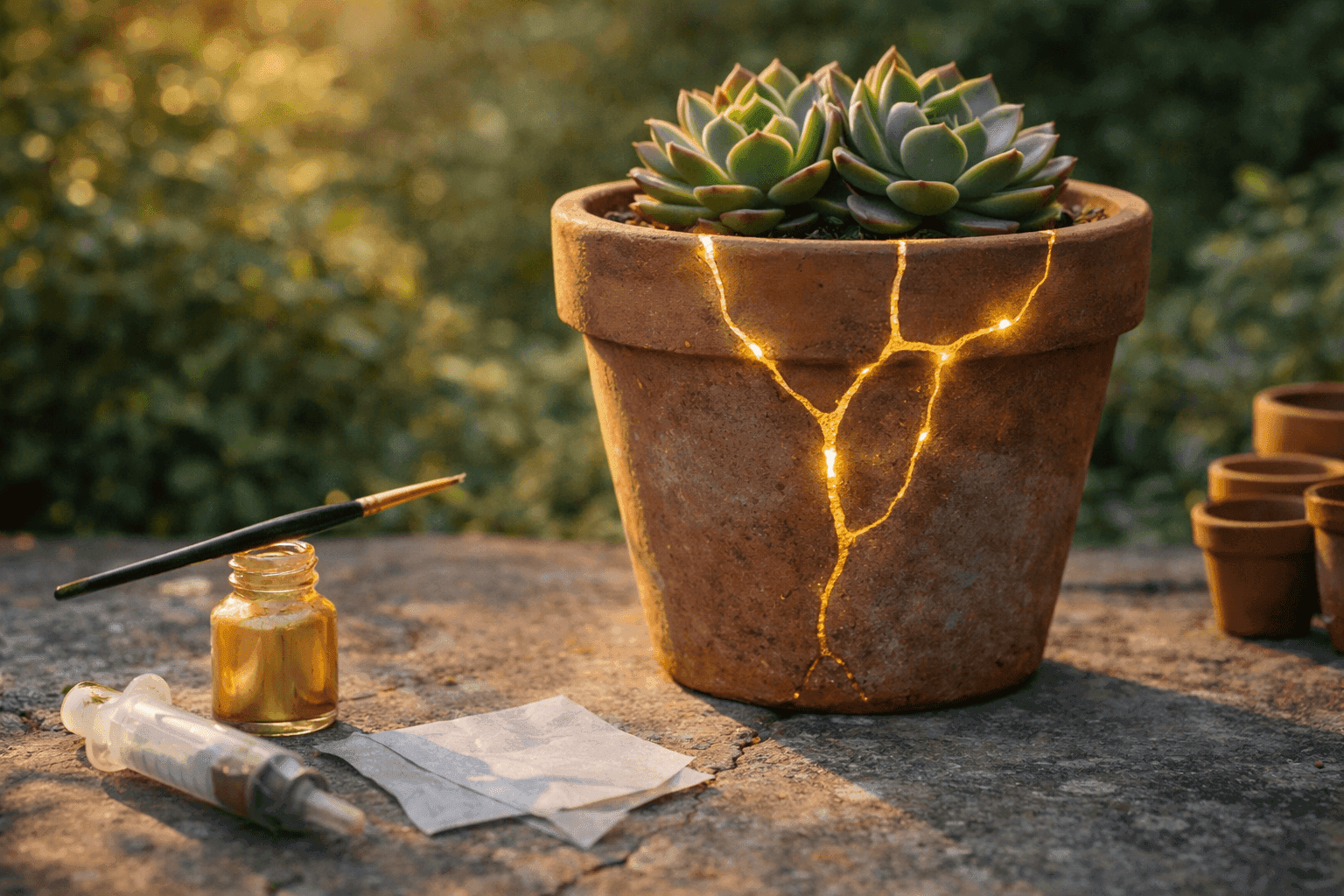
The moment a favorite pot hits the patio and splits into pieces is a specific kind of small heartbreak — and kintsugi is the Japanese philosophy that turns that heartbreak into something genuinely extraordinary. Rather than hiding the damage, kintsugi repairs broken pottery with gold, treating the fracture lines as part of the object's history and beauty rather than a flaw to be concealed. The result is a pot that is more visually interesting repaired than it ever was intact, and the process itself — fitting the pieces back together, tracing each seam with gold — is one of the most quietly satisfying forty-five minutes you can spend in your garden. At $12 in materials and with no special skills required, this is also the project that will have you haunting thrift stores for cracked and chipped pottery to bring home and transform. Broken things are not finished things. They're just waiting for their gold.
What You Need
- Broken terracotta or ceramic pot — clean breaks with intact pieces work best; heavily shattered pieces with missing fragments are harder to align cleanly
- Two-part epoxy adhesive (Loctite or Gorilla brand) — the strongest bond for porous terracotta; available in small mixing syringes (~$6–8)
- Gold craft paint or gold mica powder mixed with clear adhesive — acrylic gold paint in a small bottle works well for beginners (~$3–5)
- Fine detail paintbrush, size 0 or 1 — a thin brush gives you control over the seam lines without smearing onto the surrounding pot surface
- Painter's tape — for holding pieces in alignment while epoxy cures
- Disposable mixing surface — a piece of cardboard or wax paper for mixing two-part epoxy
- Rubbing alcohol and cloth — for cleaning break surfaces before bonding
- Nitrile gloves — epoxy is difficult to remove from skin once cured
How to Do It
- Clean all broken edges thoroughly with rubbing alcohol and allow them to dry completely. Terracotta is porous and holds dust and moisture in the break surface — skipping this step is the single most common reason kintsugi repairs fail to bond properly and reopen under the weight of soil.
- Dry-fit all your pieces together before mixing any adhesive. Work out exactly how the fragments nest together and in what order you'll need to attach them — like a puzzle with a sequence. Trying to figure out piece placement after the epoxy is mixed and working against its open time is where repairs go wrong.
- Mix a small amount of two-part epoxy on your disposable surface according to the package instructions, combining both components in equal parts and blending thoroughly until the color is completely uniform. Most two-part epoxies give you five to ten minutes of working time once mixed.
- Apply a thin, even bead of mixed epoxy along one break edge using a toothpick or the mixing stick — you want enough adhesive to fill the seam without excess squeezing out onto the pot face, as cured epoxy is difficult to remove from terracotta without surface damage.
- Press the pieces together firmly and hold for sixty seconds, then secure the join with painter's tape wrapped around the pot to maintain pressure while the epoxy sets. Work one join at a time rather than trying to bond multiple pieces simultaneously.
- Cure the fully assembled pot undisturbed for a minimum of one hour — longer if your epoxy specifies it — before handling or moving to the next step. Full epoxy cure typically takes twenty-four hours for maximum bond strength.
- Paint the dried seams with gold craft paint using your finest detail brush once the epoxy is fully cured. Work slowly along each seam line, letting the gold follow the natural path of the break. Multiple thin coats build richer color than one heavy application that risks bleeding onto the surrounding surface.
- Seal the gold seams with a thin coat of clear acrylic sealer once the paint is dry if you plan to use the pot outdoors — this protects the gold from weathering and keeps the seams looking fresh through rain and seasonal temperature changes.
Ceramic restoration artists mix a small amount of gold mica powder directly into the epoxy itself before applying it to the seam — rather than painting gold over cured adhesive — so the metallic color is embedded in the repair line rather than sitting on top of it. The result is a seam that catches light differently at every angle and never risks the paint layer flaking away from the epoxy surface over time. Gold mica powder is available from most craft suppliers for a few dollars and a little goes an extraordinarily long way — a quarter teaspoon is enough to treat a dozen pots.