Mason Jar Potting Bench Organizer for Under $20
Every seed, marker, and small tool visible at a glance — no more rummaging before you can plant
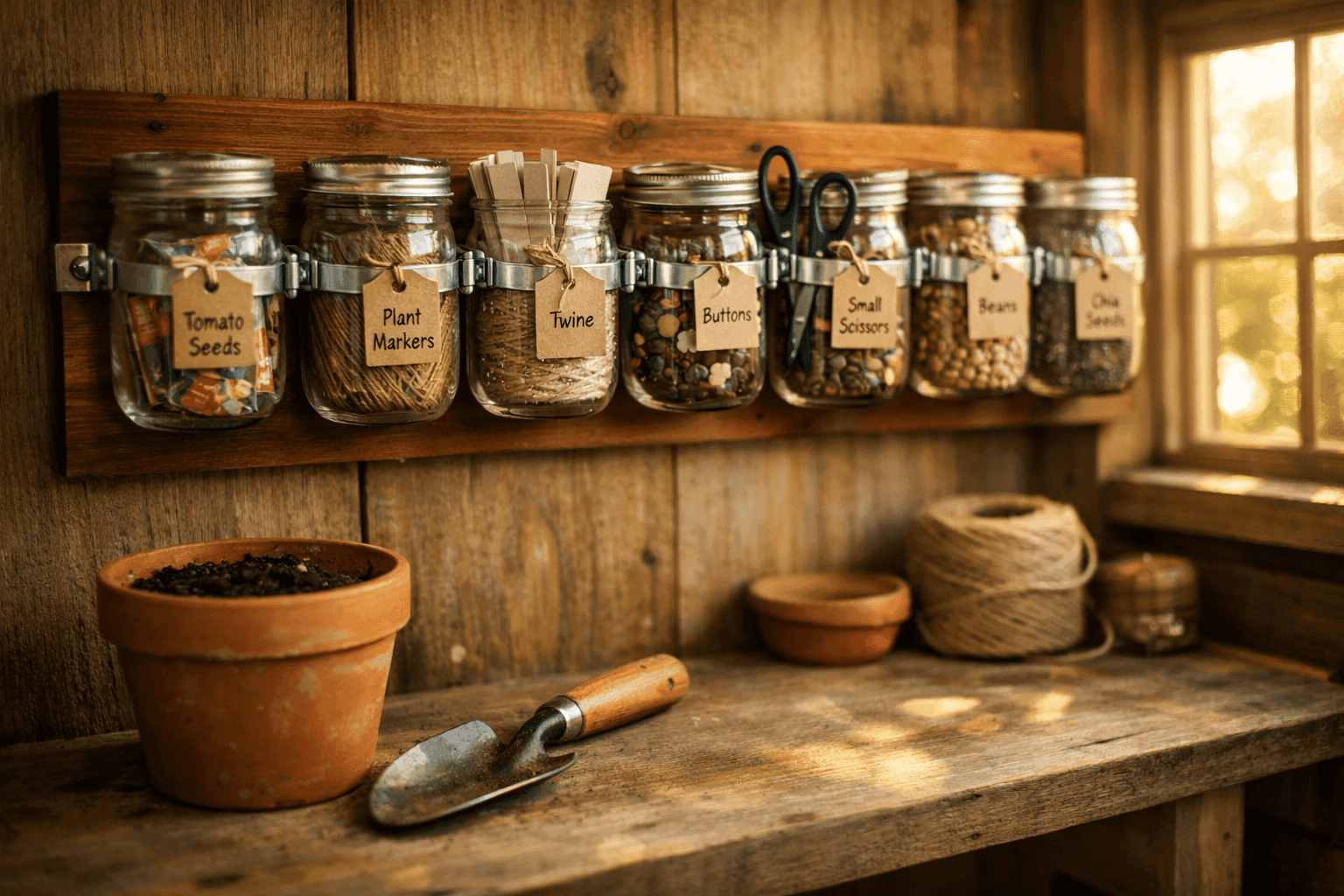
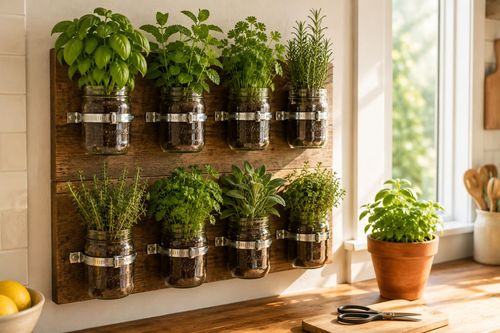
A potting bench that works for you rather than against you is one of the most underrated upgrades in the whole garden — and the difference between a frustrating surface covered in scattered supplies and a genuinely functional workspace often comes down to nothing more complicated than a board, some pipe clamps, and a row of labeled mason jars. Clear glass jars mounted at eye level mean you can see every seed packet, plant marker, and small tool at a glance without moving a single thing, which sounds minor until you realize how much time and momentum you lose every session to the low-grade rummaging that comes from supplies living in a pile. The whole project runs under $20 in materials, takes about an hour to build and mount, and turns your potting bench into the kind of organized workspace that actually makes you want to spend more time out there. It's also genuinely beautiful in that functional, working-garden way — the kind of thing that looks intentional and considered rather than merely tidy.
What You'll Need
- The Jars
- 6–10 wide-mouth mason jars in pint or half-pint size — wide-mouth openings make it easy to reach in with dirty hands and pull things out without knocking the whole jar over (~$8–10 for a pack of 12 at hardware or grocery stores)
- Half-pint jars work best for seeds, plant markers, and small hardware; pint jars hold trowels, scissors, and longer tools upright with room to spare
- Reused pasta sauce or pickle jars are a completely free alternative — wide-mouth glass jars of any kind do the job identically
- Mounting Hardware
- Pipe clamps or hose clamps sized to fit your jars — standard pint mason jars measure about 3.25 inches in diameter and take a 3.5-inch clamp (~$1–2 per clamp at any hardware store)
- Alternatively, screw the jar lids directly to the underside of a shelf and simply twist the jars on and off — a zero-clamp method that's particularly clean-looking and easy to access
- 1-inch wood screws for attaching clamps or lids to the board
- The Board
- 1x6 or 1x8 pine or cedar board cut to the width of your potting bench or wall space — a 24–36 inch length holds 6–8 jars comfortably with spacing to grab each one cleanly (~$5–8)
- Pre-cut craft wood boards from the hobby store work perfectly if you want to skip any sawing entirely (~$4–6)
- Finishing and Labeling
- Outdoor wood stain, paint, or a coat of linseed oil to weatherproof the board for shed conditions
- Adhesive chalkboard labels or kraft paper tags on twine for jar identification — chalkboard labels let you relabel as jar contents change seasonally (~$3–5 for a pack of 30)
- White paint pen or chalk marker for writing on chalkboard labels
- 2 D-ring hangers or 2-inch screws for mounting the board directly to the shed wall or bench back
- Total Cost
- $15–20 with new jars and hardware; as little as $5–8 if you reuse existing jars and have leftover lumber
How to Build It
- Inventory your supplies before building anything — pull every loose item from your potting bench surface and sort into categories: seeds, plant markers, small hardware like clips and ties, hand tools like scissors and dibbers, and anything else that lives in the work zone. This sorting step tells you exactly how many jars you need and what sizes will work best for each category, so you're building to fit your real workflow rather than guessing.
- Cut or source your board to the width that fits your bench or wall space, then sand all edges smooth with 120-grit sandpaper. Apply one coat of outdoor stain, paint, or linseed oil and let it dry fully before mounting anything — finishing a flat board takes five minutes and a mounted board with jars attached is genuinely awkward to stain neatly afterward.
- Mark jar positions along the board by setting each jar on the board face-down in its planned position and tracing around the base with a pencil. Space jars 4–5 inches apart center-to-center so there's enough clearance to grip and lift each one without knocking its neighbor. Stand back and eyeball the full layout before drilling anything — even spacing looks intentional; random spacing looks rushed.
- Attach clamps or lids at each marked position — for pipe clamp mounting, center the clamp over each mark and drive two 1-inch screws through the clamp tabs into the board face. For the lid-mount method, hold each lid centered on its mark and drive two screws directly through the lid into the board, making sure the screw heads sit low enough that the jar still threads on smoothly over them.
- Mount the board to your shed wall or potting bench back panel using D-ring hangers and wall screws, or drive 2-inch screws directly through the board face into the wall structure. Position it at a comfortable working height — eye level is ideal so you can read jar labels and reach contents without bending. Use a level across the top edge before driving the final screws, because a tilted jar board is very noticeable once the jars are loaded.
- Load and label the jars by filling each one with its assigned category of supplies, then affixing a chalkboard label or kraft tag to the front of the glass at eye height. Write contents clearly with a chalk pen or paint pen — "Tomato Seeds," "Plant Markers," "Twine," "Seed Clips" — in whatever level of detail matches how you actually think and work. Twist or set each jar into its clamp and confirm everything is secure before loading heavy items.
- Establish a one-in-one-out rule for the bench surface itself once the jars are mounted — anything that has a jar home goes in the jar, and only actively in-use items live on the bench surface during a session. This single habit is what keeps the organizational system working three months from now rather than slowly reverting to the same surface pile the jars were meant to replace.
Professional potting shed designers and serious gardeners almost always organize their jar systems by workflow sequence rather than by item type — meaning the jars are arranged left to right in the order you actually reach for things during a typical planting session, not alphabetically or by category. If you always start by grabbing a plant marker, writing a label, then reaching for seeds and a dibber, those items should live in that exact left-to-right sequence along the board. It sounds overly specific until you've spent a season working from a bench where everything is grouped logically but positioned backward relative to how you actually move — the workflow-sequenced arrangement shaves a surprising amount of reaching and pivoting out of every session, and once you've experienced it you genuinely won't go back.