Mark My Words: Hand-Stitch Fabric Bookmarks in an Hour
Fabric scraps, a needle, and a length of thread — the slow, meditative hand-stitching project that produces something beautiful and genuinely useful from nothing at all
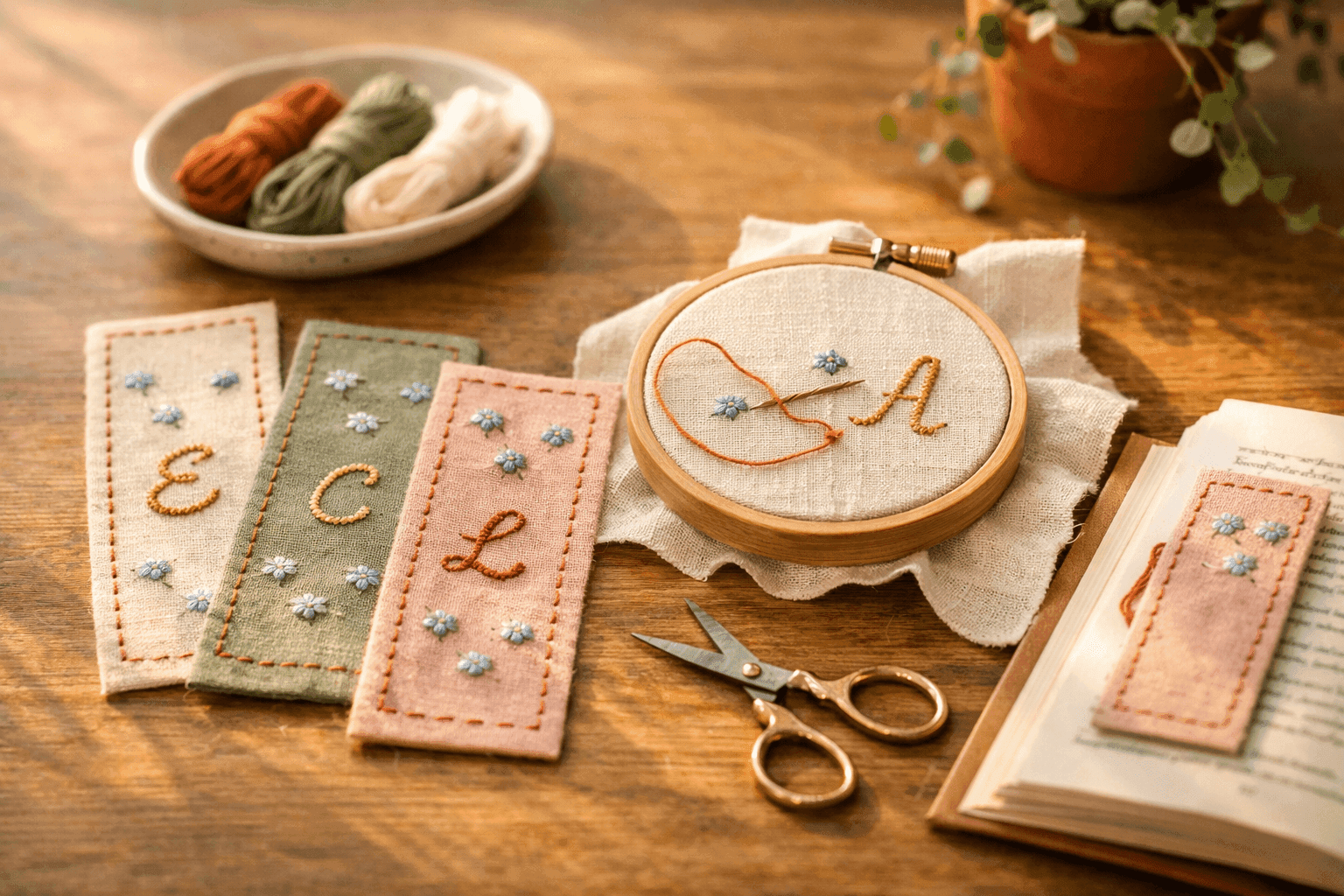
There is a specific quality of calm that comes from hand-stitching that almost no other activity quite replicates — the gentle, rhythmic repetition of needle through fabric, the soft resistance of thread pulling through layers, the way your mind quiets while your hands stay just busy enough to keep it from wandering back to the unfinished list. Slow-stitched fabric bookmarks are the ideal entry point into this kind of meditative handwork because they're small enough to complete in a single sitting, require no specialized equipment beyond a needle and thread, and produce something genuinely beautiful and useful rather than a practice piece that goes in a drawer. The basic construction takes about fifteen minutes; the decorative embroidery is where the Therapeutic Thursday magic lives — that unhurried hour of adding running stitches along the edges, embroidering your initials, or building a small pattern of lazy daisy flowers that emerges slowly under your hands while an audiobook plays or the afternoon settles into quiet. Make a collection of them for yourself, tuck one into a book you're gifting, or bundle three together as the most thoughtful bookmark gift anyone will receive this year.
What You'll Need
- Fabric
- Fabric scraps in cotton, linen, or cotton-linen blend — cut to approximately 2½ inches wide by 8 inches long, two pieces per bookmark for front and back. Cotton and linen are the ideal choices for this project: they hold a crease when pressed, accept embroidery thread beautifully, and have a pleasant hand that makes the finished bookmark feel substantive rather than limp — free from your scrap bag or ~$2–$3 for a fat quarter at a fabric store that makes six to eight bookmarks
- Choose fabrics in colors and patterns that genuinely bring you joy rather than whatever is most practical — the therapeutic value of this project comes partly from working with materials that feel beautiful to handle, and a bookmark made from fabric you love is one you'll actually use and notice every time you open your book
- Mixing a solid front with a patterned back — or two complementary solids — creates a reversible bookmark that looks intentionally designed from both sides
- Interfacing — a single layer of iron-on lightweight interfacing cut to size and fused to the wrong side of the front fabric piece before stitching — gives the finished bookmark enough body to stand upright in a book page rather than flopping over. Optional but recommended for lighter-weight fabrics — ~$3–$5 per yard at a fabric store
- Needles & Thread
- Hand sewing needles in a range of sizes — a size 7 or 8 sharp needle for the structural seaming and a size 5 or 6 crewel needle with a longer eye for embroidery thread — ~$3–$5 for a mixed pack that covers all hand sewing needs
- Standard cotton thread in a coordinating color for the structural seaming — one spool covers dozens of bookmarks — ~$2–$3
- Six-strand embroidery floss in two to four colors for the decorative stitching — DMC or Anchor brands are the most widely available and colorfast options — ~$0.75–$1.50 per skein, and one skein covers several bookmarks
- A small embroidery hoop in 4-inch size for holding the fabric taut during decorative stitching — optional but makes achieving even stitch tension significantly easier, especially for newer hand embroiderers — ~$3–$6
- Basic Stitches to Know
- Running stitch — the simplest stitch for both structural seaming and decorative borders, created by passing the needle in and out of the fabric at even intervals. The meditative quality of hand-stitching is most accessible in the running stitch because its repetitive rhythm is easy to sustain without concentration once the interval becomes consistent
- Backstitch — stronger than running stitch for the structural seam, created by stitching backward to meet the previous stitch so no gaps remain in the seam line. Use backstitch for the seaming and running stitch for the decorative borders
- Lazy daisy stitch — five or six individual loop stitches radiating from a center point to create a simple flower shape. Each petal is a single loop anchored at its tip — beautiful as scattered accents across the bookmark face
- Chain stitch — a connected series of loop stitches that creates a rope-like line ideal for lettering, initials, and curving decorative lines
- Tools & Finishing
- Sharp fabric scissors for clean cuts — the bookmark dimensions are small enough that even a slight fraying at the cut edge becomes visible in the finished piece
- An iron and ironing board — pressing the fabric before cutting, pressing the seams after turning, and pressing the finished bookmark are the three ironing steps that transform a fabric bookmark from handmade-looking to genuinely polished
- A water-soluble fabric pen for marking embroidery designs lightly on the fabric face before stitching — the marks wash out completely and allow you to plan a design without committing to it with the first stitch
- A turning tool — a chopstick, a blunt pencil, or a dedicated seam turner — for pushing the corners of the turned bookmark out to clean right angles without poking through the fabric
How to Make Them
- Cut and press your fabric pieces before threading a needle — cut two pieces per bookmark to 2½ by 8 inches, cutting along the straight grain of the fabric so the finished bookmark hangs without twisting. Press both pieces flat with a hot iron, fuse interfacing to the wrong side of the front piece if using it, and press again so the interfacing bonds completely with no bubbling or lifting at the edges. A well-pressed fabric piece is measurably easier to stitch than an unironed one — the crispness of pressed fabric keeps seam allowances consistent and produces much cleaner stitched edges.
- Mark your embroidery design before assembling — if you want to embroider the front of the bookmark, it's significantly easier to do so on a flat, single layer of fabric before the two layers are joined. Use a water-soluble fabric pen to sketch your design lightly on the right side of the front piece — your initials in chain stitch, a row of running stitches along each long edge, a scattering of lazy daisy flowers, or a simple geometric border. Mark and stitch the decorative embroidery completely before moving to the assembly step.
- Embroider slowly and without a deadline — thread your crewel needle with two strands of embroidery floss separated from the six-strand skein, knot the end, and begin. This is the therapeutic heart of the project: there is no correct speed, no right way for the stitches to look, and no outcome that constitutes failure. The value is entirely in the process — in the repetitive gentle motion, the gradual building of a pattern, the way the mind settles into a quieter register when hands are occupied with something small and beautiful. Let the stitches be slightly uneven. Let the pattern develop organically. Notice what it feels like to make something slowly, deliberately, and without urgency.
- Assemble the bookmark by placing the front and back pieces right sides together — the decorated face of the front piece touching the back piece so the decoration faces inward — pin or clip the layers together at all four corners, and hand-stitch around three sides using backstitch with a ¼-inch seam allowance, leaving one short end open for turning. Stitch the two long sides and one short end, backstitch two or three stitches at each corner to reinforce the turn points, and finish the thread securely at the end of the last seam before cutting.
- Clip the corners and turn right-side out by cutting diagonally across each sewn corner just inside the seam line before turning — this removes the bulk that would otherwise create lumpy rounded corners in the finished bookmark rather than the clean right angles that make it look carefully constructed. Turn the bookmark right-side out through the open end, using a chopstick or turning tool to gently push each corner to a clean point from the inside, working slowly and without forcing so the seam at the corner doesn't tear.
- Press the turned bookmark flat by setting the iron directly on the fabric with the embroidered front face down on a clean pressing cloth — pressing embroidery face-down on a padded surface preserves the dimensional quality of the stitches rather than flattening them under the iron weight. Roll the seam to the edge between your fingers so it sits precisely at the perimeter of the bookmark rather than hidden on the front or back face, and press firmly so the bookmark holds its shape without needing to be re-pressed every time it's removed from a book.
- Close the open end by folding the raw edges of the open short end inward by ¼ inch, pressing the fold flat, and hand-stitching closed with a ladder stitch that creates an invisible join — insert the needle into the fold of the front piece, bring it across to the fold of the back piece, insert it into that fold and bring it out a stitch length away, and continue alternating between folds until the end is fully closed. Pull the thread gently taut every few stitches to close the gap and the join will become invisible in the finished bookmark.
- Add any finishing touches — a final press, a few additional embroidery accents near the closed end if the design calls for it, or a small tassel made from leftover embroidery floss looped through one corner and knotted. Set the finished bookmark in an open book, notice how it looks and feels in your hand, and register that you made this from scraps of fabric and a length of thread in the span of a quiet afternoon. Then thread the needle for the next one, because one is never quite enough.
Textile artists and slow-stitch practitioners who teach mindfulness through embroidery and fabric work make one observation about beginning hand-stitchers that reframes the entire practice for anyone who starts and immediately feels frustrated by imperfect stitch length or tension: the irregularity is the point. Machine stitching produces perfect, identical stitches because a machine has no interior life — no wandering attention, no physical fluctuation, no moment of distraction or reflection. The slight variations in hand-stitching are a literal record of a human being present in time, and that quality — called wabi-sabi in Japanese aesthetics, the beauty of imperfection and impermanence — is precisely what makes a hand-stitched object feel categorically different from a machine-made one in the hand. A bookmark where the running stitch is slightly uneven is not a failed version of a machine-stitched bookmark. It is a document of an afternoon spent in gentle attention, and the person who receives it as a gift holds something that a machine could not have made — not because the machine lacks the technical capacity, but because the machine lacks the afternoon.