Make a Tissue Paper Fiesta Banner for Under $5
Stack, fold, snip, unfold — twelve vibrant panels on a length of twine and your porch becomes a celebration
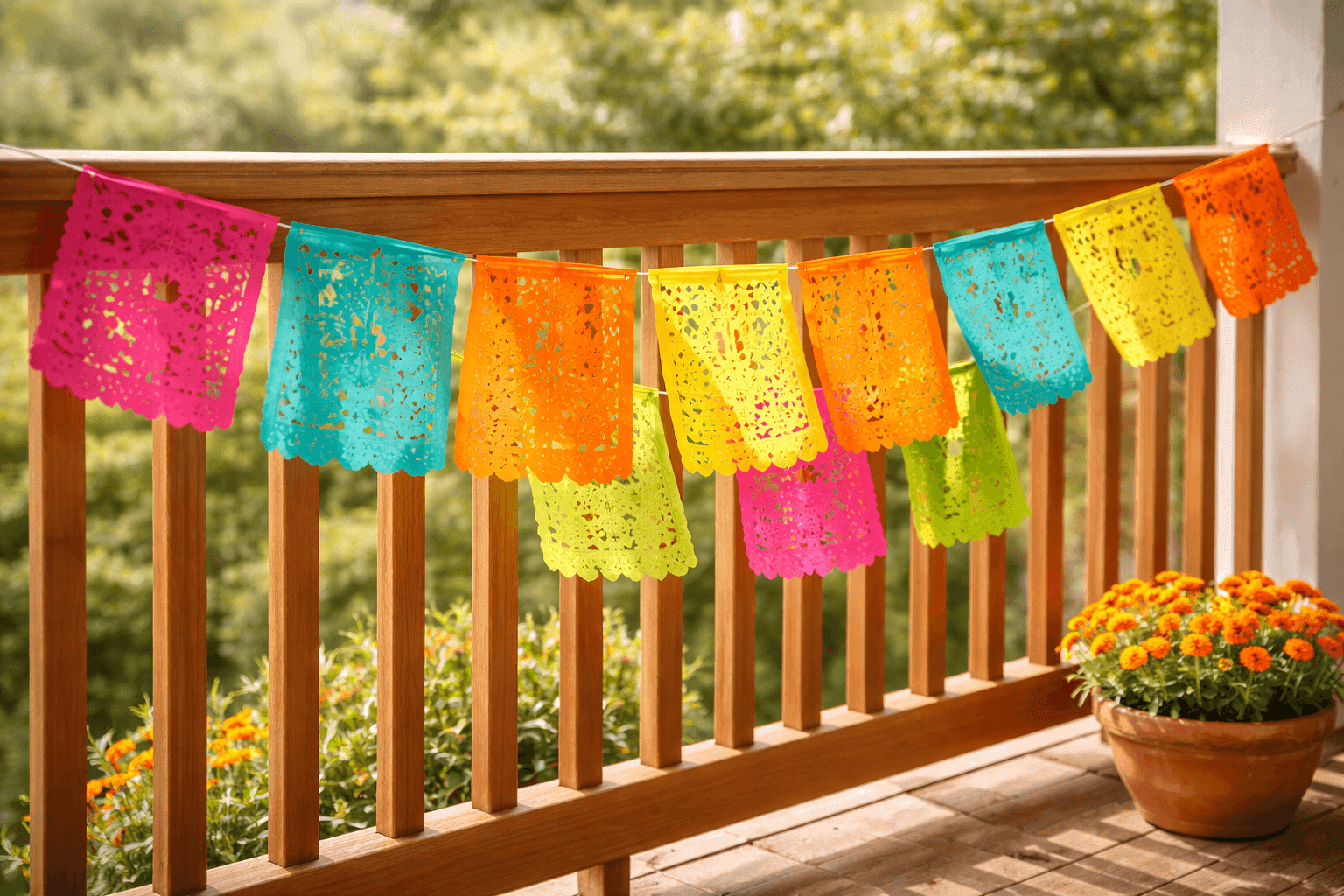
Papel picado — the traditional Mexican art of cutting intricate patterns into tissue paper — has been turning ordinary spaces into celebrations for centuries, and the dollar store version costs $5, takes an hour of satisfying scissor work, and produces a banner so genuinely beautiful that people reach out to touch the panels as they drift past in the breeze. The technique is almost absurdly simple: stack tissue paper sheets, fold accordion-style, cut patterns into the folded edges, unfold to reveal perfectly symmetrical designs that look far more deliberate and skillful than the cutting that produced them. Hot pink next to turquoise next to orange next to lime green strung across a porch railing or backyard fence creates that specific vibrant, joyful atmosphere that no store-bought decoration quite replicates — because store-bought decorations don't move the same way, catch light the same way, or feel the same way when a warm evening breeze gets into them. Five dollars. One hour. Pure fiesta.
What You Need
- Tissue paper in 4–5 vibrant colors — hot pink, turquoise, orange, yellow, and lime green are the classic fiesta palette; dollar store packs typically contain 8–10 sheets each, which is more than enough for a full banner (~$1–2 per pack)
- Sharp scissors — the single most important tool in this entire project; dull scissors drag and tear through stacked tissue layers rather than cutting cleanly, which ruins the crisp edge definition that makes the patterns look intentional
- Twine, ribbon, or thin rope, 6–8 feet — natural jute twine reads beautifully against vivid tissue colors; satin ribbon gives a more polished party look (~$1–2 for a roll)
- Glue stick or tape — for attaching the folded top edge of each panel to the twine; a glue stick gives a cleaner finish than tape tabs visible from the front
- Ruler and pencil — for marking consistent panel widths and fold lines on the first few panels until the sizing becomes intuitive
- Cutting mat or stack of magazines — to protect your work surface during cutting; tissue paper shifts on slippery surfaces and a textured mat keeps the stack stable under the scissors
How to Make It
- Stack four to five sheets of the same color tissue paper in a neat, aligned pile — working with a single color per panel keeps the cutting process clean and produces the richest, most saturated color in the finished banner. Mismatched colors within a single stack produce a muddied panel that reads as neither color when hung.
- Fold the stacked sheets accordion-style in one-inch increments across the short dimension of the paper, creasing each fold firmly as you go. Work slowly on the first panel to establish consistent fold width — uneven accordion folds produce panels where the cutout pattern is asymmetrical on one side, which is visible immediately when the panel is unfolded and hung.
- Trim the folded stack to your desired panel width if needed — a finished panel width of about six to eight inches hangs well on most banners and gives enough surface area for the cutout patterns to read clearly from a standing distance. Cut cleanly through all layers at once with a single confident scissor stroke rather than sawing back and forth through the stack.
- Cut your decorative patterns into the folded edges — the two long folded sides and the bottom short edge — using sharp scissors and confident, deliberate cuts. Triangles notched into the long edges, scallops along the bottom, and V-cuts or circle punches scattered across the folded surface all unfold into beautiful symmetrical designs. The pattern doesn't need to be planned in advance; the symmetry of accordion folding makes almost any cut combination look intentional when unfolded.
- Keep at least ¼ inch of uncut paper along the top folded edge — this is the margin that gets attached to the twine and holds the entire panel together. Cutting too close to the top edge is the single mistake that causes panels to tear away from the banner at the attachment point, especially once the tissue paper gets a little movement from the breeze.
- Unfold each finished panel carefully by opening the accordion folds one at a time rather than pulling the whole stack open at once — tissue paper tears at the cut edges under sudden tension, and a slow careful unfold preserves every delicate cut detail that a quick pull destroys. The moment of unfolding and seeing the symmetrical pattern emerge is genuinely one of the most satisfying reveals in all of paper crafting.
- Repeat for all twelve panels across your chosen colors, varying the cut patterns between panels so no two adjacent panels are identical — alternating pattern styles across the color sequence creates visual rhythm and keeps the eye moving along the full length of the banner rather than stopping at any single panel.
- Attach each panel to the twine by applying a glue stick generously to the top one inch of the panel's front face, then folding that inch over the twine and pressing firmly for ten seconds. Space panels approximately six inches apart along the twine, working from one end to the other and alternating colors so no two adjacent panels share the same hue. Hang with a generous draping swag rather than pulled taut — a swag lets the panels hang at a slight angle that catches breezes and creates the characteristic shimmering movement that makes papel picado so visually alive.
Event stylists who work with papel picado professionally always layer two banner lengths at slightly different heights rather than hanging a single strand — a front strand hung at eye level and a second strand hung eight to twelve inches behind and above it creates a sense of depth and fullness that a single banner line never achieves, and the slight offset between the two layers means the panels catch breezes independently of each other, creating a layered, rippling movement effect that looks dramatically more abundant and festive than the materials involved would suggest. The second strand costs another $5 in tissue paper and doubles the visual impact of the entire installation without requiring any additional hanging hardware.