Kneel the Deal: Build a Garden Kneeling Bench for $15
Flip it one way for a padded kneeling surface with handles, flip it the other for a low garden seat — the 90-minute build that saves your knees all season long
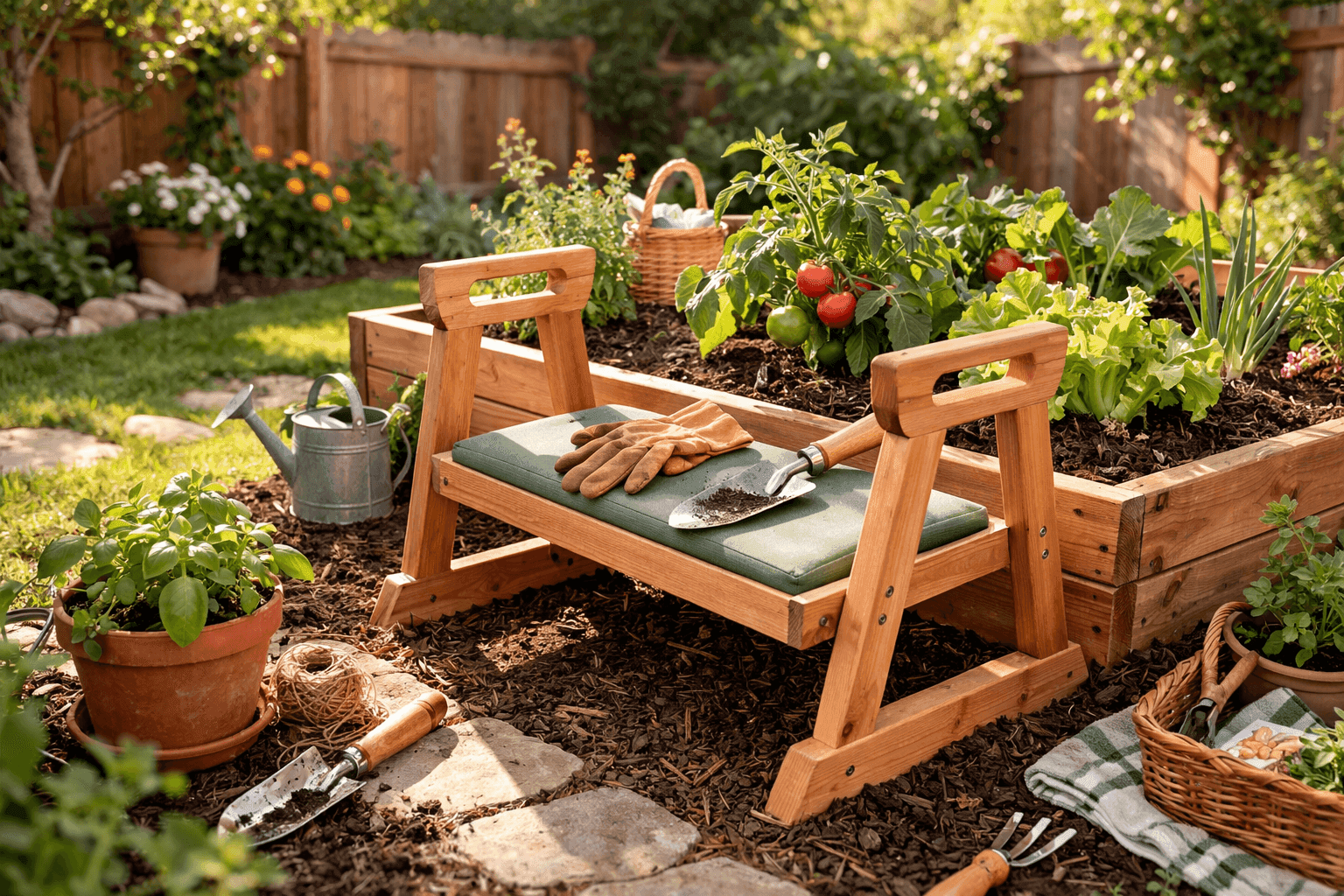
Gardening is one of the most physically demanding hobbies most people describe as relaxing — and the knees take the worst of it. Crouching, kneeling on bare soil, and trying to get back up from ground level is the part of gardening that makes otherwise enthusiastic gardeners put off tasks they'd actually enjoy doing if the physical discomfort weren't part of the equation. A dual-purpose kneeling bench solves this completely: flipped one way it's a padded kneeling surface with upright handles that let you push yourself up and down without straining your back or wrists, flipped the other way it's a low seat for weeding and planting tasks that don't require ground-level access. The build uses basic 2x8 and 1x2 lumber, takes about 90 minutes, costs $12–$18 in materials, and produces a garden tool you'll reach for every single time you work in the beds. Store-bought versions of this exact design run $40–$60 — the homemade version is structurally identical, finishes in any color you choose, and takes less time to build than it would take to drive to the store and back to buy one.
What You'll Need
- Lumber
- One 2x8x4 board for the two side pieces — cut to 18 inches each, the 2x8 width provides the stable, broad base that prevents the bench from tipping sideways when used as a kneeler or a seat — ~$6–$8
- One 1x8x2 board for the top kneeling surface — cut to 16 inches, which spans the two side pieces with a slight inset on each end for a clean finished look — ~$3–$4
- One 1x2x4 board for the two handle uprights — cut to 12 inches each, these extend above the bench height when kneeling to provide the push-up assistance that makes this bench genuinely valuable for anyone with knee or back issues — ~$2–$3
- Cedar or pressure-treated lumber for outdoor use — cedar is the premium choice for its natural rot resistance and clean workability; pressure-treated costs less and lasts just as long in wet soil contact
- Hardware
- 2-inch exterior deck screws — one small box covers the full build — ~$4–$5
- Exterior wood glue for reinforcing every joint — standard waterproof formula
- Four ⅛-inch carriage bolts with nuts and washers for securing the handle uprights to the side pieces — bolted handle joints withstand the repeated leverage forces of pushing up from a kneeling position far better than screwed joints alone — ~$3–$4 for a small pack
- Padding
- A piece of 1–2 inch foam cut to the dimensions of the top board — upholstery foam from a fabric store or a repurposed foam kneeling pad from a garden center work equally well — ~$4–$8 for a cut piece
- Outdoor fabric or heavy-duty vinyl fabric in a color that suits the garden — outdoor fabric resists UV fading and moisture and holds up to soil contact far better than indoor upholstery fabric — ~$5–$8 per half yard, which covers the kneeling surface twice over
- A staple gun with ½-inch staples for attaching the fabric — the fastest and most secure method for upholstering a flat wooden surface
- Finish & Tools
- Exterior wood stain, paint, or teak oil for weather protection — one small can covers the full bench with coats to spare — ~$6–$10
- 120 and 220-grit sandpaper — thorough edge rounding on this project is more important than almost any other build since every edge gets handled constantly in use
- Circular saw or miter saw for lumber cuts — or request cuts at the hardware store
- Drill/driver with Phillips bit, ⅛-inch drill bit for pilot holes, and a ¼-inch bit for carriage bolt holes
- Clamps — two minimum — for holding joints during glue-up
How to Build It
- Cut all pieces before assembling anything — two side pieces at 18 inches from the 2x8 stock, one top board at 16 inches from the 1x8 stock, and two handle uprights at 12 inches from the 1x2 stock. The 16-inch top board is slightly shorter than the 18-inch side pieces so it sits between the sides rather than spanning over them — this inset creates a stronger joint than a surface-mounted top and gives the finished bench a cleaner, furniture-quality silhouette from the ends.
- Sand all pieces before assembly with 120-grit paper on all faces, edges, and ends — this is the most important sanding step on a garden kneeler because comfort in use depends entirely on smooth, splinter-free surfaces that hands contact every single session. Pay particular attention to rounding the top edges of the handle uprights where palms grip during push-up and the top edges of the side pieces where wrists might contact during use — a router with a roundover bit produces a beautifully comfortable edge in seconds if you have access to one.
- Mark the top board position on each side piece before gluing anything — the top board attaches between the side pieces approximately 6 inches from the top end of each side, which positions the kneeling surface at the right height above the ground when the bench is in kneeling orientation. Mark this position on both side pieces simultaneously by clamping them together face-to-face and marking across both at once — this guarantees the top board will sit level rather than slightly higher on one side than the other.
- Assemble the top board between the two side pieces by applying exterior wood glue to both ends of the top board, positioning it between the side pieces at the marked height, clamping everything square, and driving two pre-drilled 2-inch screws through the outside face of each side piece into each end of the top board. Pre-drilling is essential in 2x8 lumber end grain — driving screws into end grain without pilot holes splits the top board end along the grain every time, which ruins the joint and the board simultaneously.
- Attach the handle uprights to the top end of each side piece using the combined glue, screw, and carriage bolt method — apply glue to the mating surfaces, clamp the 1x2 handle flush with the outside face of the side piece at the top end, drive two screws for initial alignment, then drill a ¼-inch carriage bolt hole through the full assembly and install the bolt with washers on both sides and the nut tightened firmly. The carriage bolt through the handle joint is what makes this bench safe for its most critical use — pushing up from kneeling — which puts substantial horizontal leverage on the handle joint that screws alone eventually allow to loosen.
- Final sand the assembled bench with 220-grit paper to smooth all screw heads, joint transitions, and any remaining rough spots, then do a deliberate edge-rounding pass on every handle edge, side edge, and corner that hands will contact. Set the bench on a flat surface and press firmly on each handle and on each corner of the top board to confirm the structure is completely rigid and nothing flexes, creaks, or shifts — a bench that passes this test before finishing will still pass it after a full outdoor season of use.
- Apply finish to all surfaces including the underside and the end grain of every board — end grain absorbs moisture faster than any other surface and is where outdoor wood deterioration almost always begins, so sealing it thoroughly is the most important finishing step for longevity. Two coats of exterior stain or teak oil with full dry time between coats, and a third coat on the end grain specifically, produces a bench that sheds rain and resists the soil moisture contact it will experience every gardening session for years.
- Add the foam padding once the finish has cured for 24 hours — cut the foam to match the top board dimensions, center it on the board, lay your outdoor fabric face-down on a flat surface, place the foam-topped board face-down on the fabric, pull the fabric taut over each edge, and staple firmly to the underside of the board every 2–3 inches around the full perimeter. Pull fabric corners taut and fold neatly before stapling rather than bunching them, which produces hospital-corner-quality wrapped edges that look clean and hold up to outdoor use without unraveling. Flip the bench to kneeling orientation, kneel on it once to test the padding and handle height, and take it outside where it will spend the rest of the gardening season making every hour in the beds more comfortable than the last.
Occupational therapists who work with gardeners managing arthritis, knee replacements, and chronic back pain recommend one modification to the standard kneeling bench design that dramatically increases its usefulness for anyone with limited grip strength or wrist pain: widening the handle uprights from 1x2 to 1x4 stock and rounding all four edges with a router or sandpaper to create a broader, more comfortable gripping surface. A 1x2 handle edge concentrates push-up force on a narrow strip of palm that fatigues quickly; a rounded 1x4 handle distributes that force across a wider surface that feels significantly more comfortable through many repetitions over a long gardening session. The other modification worth making if building this for anyone with balance concerns: cutting the side pieces to 22 inches rather than 18 increases the bench's base footprint and reduces its tendency to rock sideways on uneven garden soil, which is where most kneeling bench accidents occur. Both modifications add about $2 to the material cost and fifteen minutes to the build time — a reasonable investment for a bench that will be used daily through a full growing season.