Harvest & Hang: Build Your Own Herb Drying Racks
Skip the expensive dehydrator — a $15 screen frame and an hour of building is all you need to preserve your herb harvest naturally
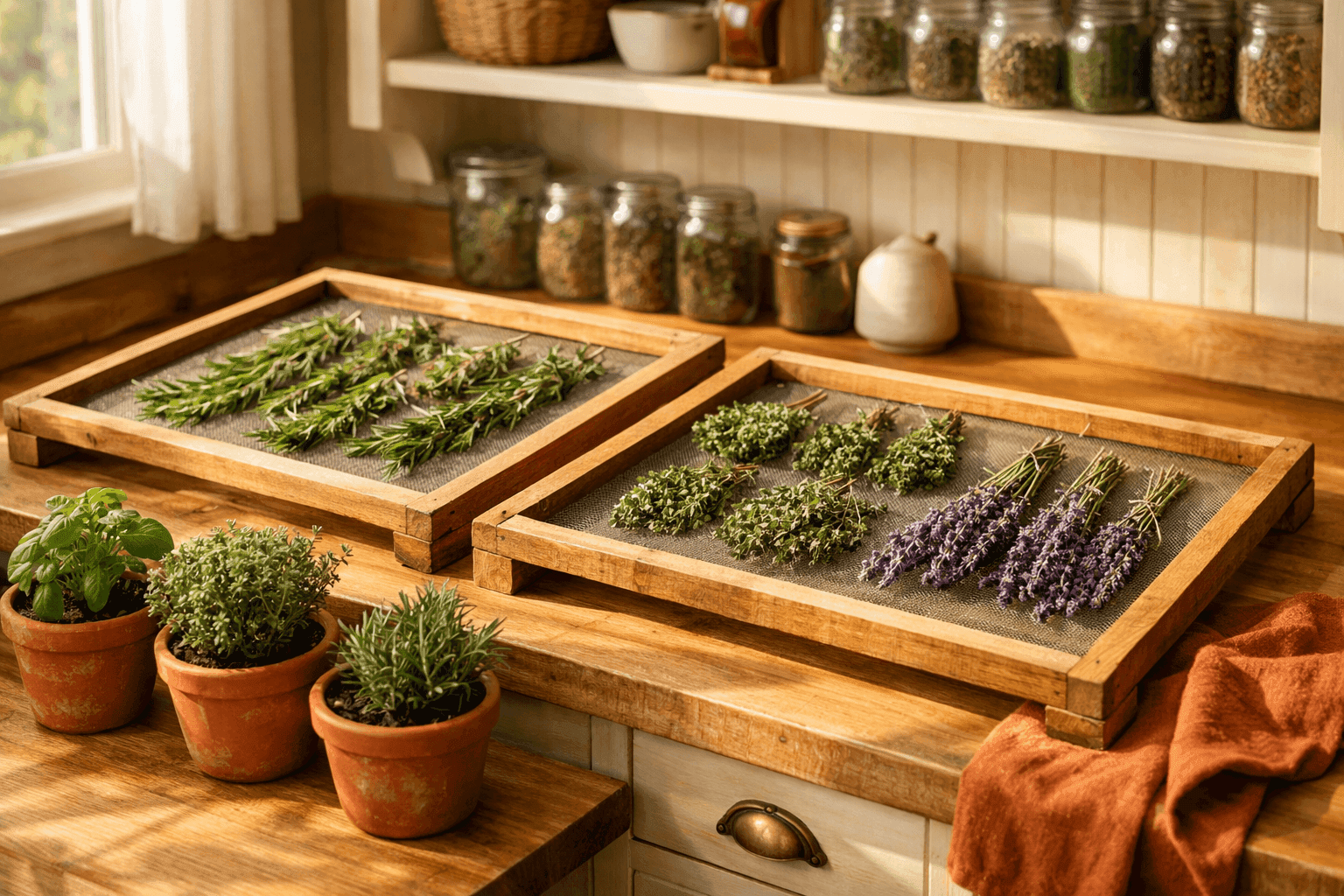
If you've ever grown more herbs than you can possibly use fresh — and any gardener with a thriving basil plant or a rosemary bush that survived winter absolutely has — then you already know the frustration of watching a gorgeous harvest go to waste because you didn't get around to preserving it in time. A mesh-screen herb drying rack solves that problem permanently, and building one takes about an hour and costs somewhere between $15 and $25 depending on the size you make. Unlike hanging bundles, a flat screen rack gives herbs proper airflow on all sides, which means faster, more even drying and dramatically better flavor retention than anything you'd get from a microwave or a low oven. Stack a few racks and you can dry an entire season's worth of thyme, oregano, lavender, chamomile, or rosemary in the same footprint as a single cookie sheet. Once you have these in your kitchen or pantry, you'll use them every single harvest season for years.
What You'll Need
- Frame Materials
- Four pieces of 1x2 common board or furring strip per rack, cut to your desired size — a 12x16 inch rack is a great starter size — ~$4–$6 total per rack at a hardware store
- OR repurpose an old picture frame, cabinet door frame, or wooden embroidery hoop for a zero-cost base
- Screen Material
- Fiberglass window screen mesh (food-safe and rust-proof) — sold by the yard at hardware stores, ~$4–$6 per yard (makes 2–3 racks)
- OR stainless steel mesh for a more durable, professional finish — ~$8–$12 per yard
- Avoid aluminum mesh — it can react with acidic herbs and leave a metallic taste
- Fasteners
- Heavy-duty staple gun with ½-inch staples — the single most important tool for tight, wrinkle-free mesh
- 1¼-inch wood screws or brad nails for corner joints — ~$3–$4 for a small box
- Wood glue for extra joint strength (optional but recommended)
- Finishing & Stacking
- Food-safe beeswax or mineral oil finish for sealing the wood (avoid varnish or paint near food)
- Four small wooden spools, wine corks, or ¾-inch wood scraps as feet to elevate stacked racks for airflow
- Small screw eyes and twine if you prefer hanging display racks over stacking
- Tools
- Miter saw, hand saw, or have the hardware store make your cuts
- Scissors or utility knife for trimming mesh
- Square or right-angle clamp for keeping corners true
- Sandpaper, 120 and 220 grit, for smoothing frame edges
How to Build It
- Cut your 1x2 boards to length — two pieces at your desired width and two at your desired depth — then sand all four pieces with 120-grit paper to remove splinters and rough edges that could snag the mesh or scratch your hands during herb loading. If you're having the hardware store make the cuts, bring a written list of exact measurements so nothing gets lost in translation.
- Assemble the frame by applying a small amount of wood glue to each corner joint, then driving two 1¼-inch screws through the end pieces into the side pieces to create a flat, square rectangle. Use a speed square or right-angle clamp to confirm the frame is perfectly square before the glue sets — a racked frame will rock on a flat surface and never stack cleanly.
- Sand the assembled frame again with 220-grit paper to smooth any rough spots around the screw heads and joints, then wipe off all sawdust with a slightly damp cloth and let it dry completely before finishing. This is the step most people skip that makes the difference between a rack that looks handmade and one that looks hand-crafted.
- Finish the wood with a thin coat of food-safe mineral oil or beeswax, rubbing it in with a clean cloth and letting it absorb for 20–30 minutes before buffing off the excess. This seals the wood against moisture from wet herbs and keeps untreated wood from absorbing herb oils and odors that transfer to the next batch you dry.
- Cut your mesh screen about 1 inch larger than the frame on all sides, giving yourself enough overhang to grip and pull taut while stapling. Lay the mesh flat on top of the frame and staple the center of one long side first, then pull firmly across to the opposite center and staple there — this center-out method prevents the wavy, sagging mesh that ruins airflow.
- Work outward from those center staples toward the corners, pulling the mesh snug with each staple placement and spacing staples about every inch for a drum-tight surface. Do the two short ends last using the same center-out method, and fold the corner mesh neatly like wrapping a gift before stapling the final corners down flat.
- Trim any excess mesh flush with the outer edge of the frame using sharp scissors or a utility knife, then run a finger firmly across every staple to make sure none are raised above the mesh surface — a protruding staple will snag herb stems and scratch hands every single time. Add a second row of staples over the trimmed edge if any mesh looks loose.
- Attach feet to the bottom corners by hot-gluing or screwing four wine corks, wooden spools, or small wood squares to raise the rack about ¾ inch off the surface — this gap is what allows airflow under the herbs and makes stacking multiple racks possible without the upper rack smothering whatever is drying below it. Set your first herb harvest on the finished rack within 30 minutes of cutting for best flavor and color retention.
The biggest mistake home herb dryers make is treating all herbs the same — but drying conditions that work perfectly for rosemary will turn delicate basil black and flavorless. Woody herbs like thyme, oregano, rosemary, and sage love warm, dry air and can handle a spot near a sunny window or above a radiator where temperatures run 70–85°F. Tender, high-moisture herbs like basil, cilantro, and mint need cooler air with slightly more humidity and should never go in direct sun, which bleaches their color and destroys volatile oils faster than the moisture can escape. Build two rack sizes — a larger one for woody herbs spread in a single layer and a smaller, shallower rack for tender herbs — and label each with a small luggage tag noting the herb name and harvest date. Properly dried herbs stored in airtight glass jars away from direct light will hold their flavor for 12–18 months, which is dramatically better than anything sitting on a grocery store shelf.