Even Keeled: Fix Uneven Cabinet Doors in 10 Minutes
Three screws on a modern cup hinge control every direction a cabinet door can move — here's exactly which one to turn and how far to make your kitchen look professionally installed
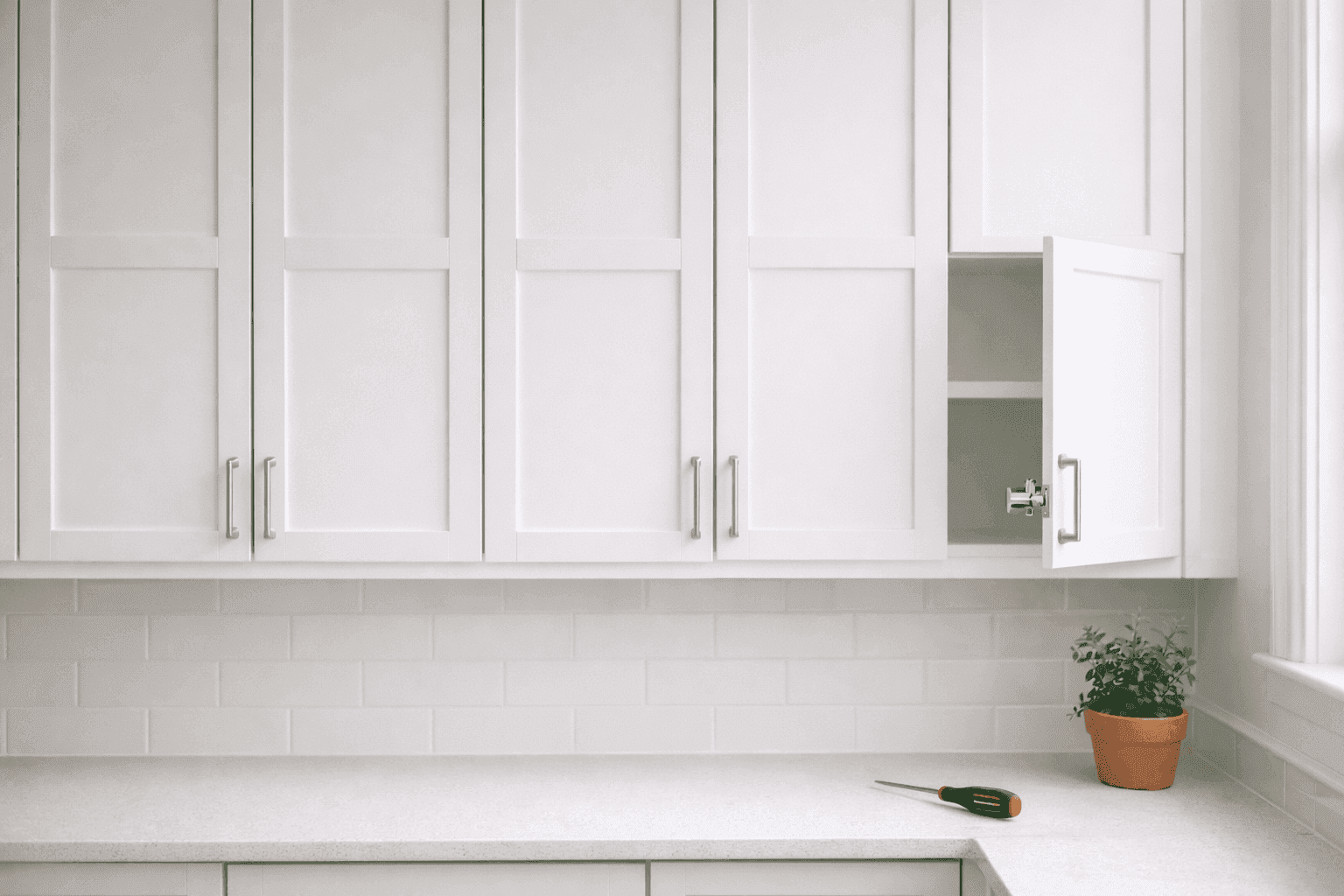
Crooked cabinet doors are one of those kitchen details that you stop consciously noticing after a while but never actually stop seeing — the gap that's wider on one side than the other, the door that sits a millimeter higher than its neighbor, the one that sticks out slightly further than the rest of the row. They're not structural problems, they're alignment problems, and modern European-style cup hinges — the kind installed on virtually every kitchen cabinet built in the last thirty years — have three dedicated adjustment screws that control every direction a door can move. Side to side, up and down, in and out — three screws, three axes, total control over exactly how the door sits in its opening. Five to ten minutes per door, a single Phillips screwdriver, and the patience to make quarter-turn adjustments and check after each one is genuinely all this fix requires. This is the Fix-It Friday project that makes a kitchen look like it was installed by someone who knew what they were doing — and takes less time to complete than it does to notice the problem every morning while making coffee.
What You'll Need
- Tools
- A Phillips #2 screwdriver — the adjustment screws on virtually every European cup hinge are Phillips head, and a manual screwdriver gives more controlled, precise quarter-turn adjustments than a power drill that can overshoot the target position in half a second
- A flashlight for examining hinge screw positions inside the cabinet — the mounting plate and adjustment screws sit in the shadow of the door interior and are difficult to see clearly without direct light
- A level — a small torpedo level or even a level app on your phone — for confirming a door is truly vertical after adjustment rather than just visually straighter than it was before
- A tape measure for checking gap consistency — measuring the gap at the top and bottom of a door confirms whether the alignment is even rather than relying on visual assessment that the eye is surprisingly bad at making accurately on small distances
- Understanding Your Hinge Type
- Modern European cup hinges — by far the most common type in kitchens built or renovated since the 1990s. Identified by the round cup that sits inside a drilled hole in the door interior and a rectangular mounting plate screwed to the cabinet interior wall. These have all three adjustment screws and are what this guide addresses
- Older traditional butt hinges — the flat rectangular hinges visible on the outside of the door on older or period-style cabinetry. These have no adjustment screws and require the toothpick-and-re-drill method for repositioning
- Confirm which type you have before gathering tools — open a cabinet door and look at the hinge. If you see a round cup attached to the back of the door connecting to a metal arm with visible screws, you have adjustable European hinges. If you see flat rectangular plates on the door face and frame, you have traditional hinges
- For Older Non-Adjustable Hinges
- Round wooden toothpicks for filling stripped or mispositioned screw holes — ~$2–$3 for a box that handles many repairs
- Wood glue for bonding the toothpicks in the filled holes — standard PVA or carpenter's glue works perfectly
- A sharp utility knife or flush-cut saw for trimming toothpicks flush with the cabinet surface after the glue cures
- The original hinge screws — the same ones removed during the repair — for re-driving into the filled holes once the glue cures
- Reference Points
- A consistent target gap measurement before beginning — standard cabinet door gaps run 1/16 to ⅛ inch between adjacent doors and between the door and the cabinet frame. Knowing your target gap measurement before adjusting gives you a specific number to aim for rather than just "looks better than it did"
- A reference door that's correctly aligned to use as a visual benchmark — if one door in a row is correctly positioned, use it as the standard against which all other doors in the run are adjusted
How to Fix It
- Diagnose before touching a single screw — close all the cabinet doors in the run and observe the gaps carefully from directly in front at eye level. Note specifically which gap is uneven (too wide on the left, too narrow on the right), whether the door sits higher or lower than its neighbor, and whether it protrudes further from the cabinet face than adjacent doors. Identifying the exact problem and its direction before starting means you turn the correct screw in the correct direction on the first adjustment rather than experimenting through all three screws until something improves.
- Locate the three adjustment screws on the hinge by opening the door and examining the hinge arm — the long metal arm that connects the cup in the door to the mounting plate on the cabinet wall. The screw positions vary slightly by hinge manufacturer but follow a consistent pattern: the screw closest to the cabinet wall on the mounting plate controls side-to-side movement, the screw on the mounting plate closest to the hinge arm controls up-and-down movement, and the screw on the hinge arm itself closest to the door controls depth — how far in or out the door sits from the cabinet face.
- Fix side-to-side alignment first if the door gap is wider on one side than the other — loosen the side-to-side screw on the mounting plate slightly, shift the door in the direction that narrows the wider gap, and re-tighten the screw. Make one quarter-turn adjustment at a time, close the door to check the gap, and repeat until both sides of the door show an equal gap. Do this adjustment on both hinges simultaneously if the door has two — adjusting only one hinge creates a twisted door that's worse than the original misalignment.
- Fix vertical alignment second if the door sits higher or lower than its neighbors — locate the up-and-down adjustment screw on the mounting plate and turn it in the direction that moves the door toward the correct height. Up-and-down adjustment is typically the most satisfying of the three because the movement is visible and immediate, and getting a door to sit at exactly the same height as its neighbor across a full row of cabinets produces the single most impactful improvement to the overall appearance of the kitchen.
- Fix depth alignment last if the door protrudes further than adjacent doors or sits recessed behind them — the depth screw is the one on the hinge arm closest to the door body, and turning it clockwise typically pushes the door further from the cabinet face while counterclockwise pulls it in. Depth alignment is the subtlest of the three adjustments and often requires the smallest correction — even a half-turn of the depth screw produces a visible change in how a door sits relative to its neighbors, so make smaller adjustments here than you think you need and check after each one.
- Work one door at a time from left to right across the full cabinet run — fix each door completely before moving to the next rather than making one type of adjustment across all doors simultaneously, which makes it difficult to track which corrections have been applied where and often results in doors that were improved being nudged back out of alignment when adjacent doors are adjusted. Close every door in the run and check the overall alignment after completing each individual door to catch any new inconsistencies before moving on.
- For traditional hinges with stripped holes — remove the hinge screw, push two to three toothpicks into the stripped hole with a dab of wood glue on each, let the glue cure for at least two hours, then trim the toothpicks flush with the cabinet surface using a utility knife. The wood glue and toothpick material fills the enlarged hole and gives the screw something solid to grip when re-driven at the same or a very slightly adjusted position — this repair restores full screw holding strength and is more permanent than any commercial stripped hole repair product.
- Final check the entire run from the viewing distance where the kitchen is normally seen — step back five to six feet and look at all the cabinet doors as a unified facade. Minor alignment variations that were invisible at close range sometimes become apparent from this distance, and the reverse is also true — small imperfections that seemed significant up close often disappear entirely at normal viewing distance. Make any final micro-adjustments from the close inspection position, then step back for a final overall check before declaring the project done and putting the screwdriver away.
Professional kitchen installers who fit custom cabinetry for a living make one observation about cabinet door alignment that reframes the whole adjustment process: the goal is never perfect mathematical uniformity but optical uniformity — the appearance of evenness rather than the measurement of it. The human eye perceives gaps differently depending on the surrounding context, which means a door that measures perfectly even at 3/32 of an inch on all four sides can look uneven if the countertop below it has a slight visual line that the eye reads against the door gap. The adjustment standard professionals actually use is closing all the doors, stepping back to normal viewing distance, and asking whether the doors read as a unified, even surface — not measuring whether every gap is identical to the millimeter. The other insight that dramatically speeds up the adjustment process: always adjust the hinge screws on both hinges of a door in the same direction and by the same amount simultaneously rather than one at a time. A door with two hinges behaves as a rigid panel — adjusting one hinge independently introduces twist into the door that both hinges then have to compensate for in subsequent adjustments, creating a back-and-forth correction cycle that takes three times as long as making matched adjustments on both hinges from the start.