Electrical Work You Can Actually Do Yourself (Safely)
No electrician degree required — just respect for the off switch
Electricity is the home improvement topic that intimidates people the most — and honestly, some of that fear is healthy. There are absolutely electrical jobs that require a licensed electrician: panel upgrades, new circuit runs, anything that involves opening the breaker box beyond flipping a switch. But replacing an outlet, installing a dimmer, swapping a ceiling fan, or adding under-cabinet lighting? Those are firmly in DIY territory, and they're not complicated once you understand the one rule that matters above all others: turn the power off, verify it's off, and don't skip that step.
The Golden Rule: Always Verify Power is Off
Flip the breaker, then use a non-contact voltage tester ($15–$20 at any hardware store) to confirm the outlet or fixture is actually dead before you touch any wires. Breakers are sometimes mislabeled in older homes, and that $15 tester is the difference between a safe repair and a very bad day. This is non-negotiable — do it every single time, even when you're sure.
Replacing an Outlet
Outlets wear out. If yours is loose, discolored, or has stopped holding plugs securely, swap it. Turn off the breaker, verify with your tester, unscrew the cover plate, pull the outlet out from the box, and take a phone photo of the wiring before disconnecting anything.
Most outlets have three wires: black (hot) to the brass-colored screw, white (neutral) to the silver screw, and bare copper or green (ground) to the green screw. Connect the new outlet the same way, push it back into the box, replace the cover plate, restore power. The whole job takes 15 minutes. While you're at it, if the outlet is near a sink, bathroom, garage, or outdoor area and doesn't have a test/reset button on it — replace it with a GFCI outlet. Code requires them in those locations and they're a genuine safety upgrade.
Installing a Dimmer Switch
This is one of the highest-impact low-effort upgrades in a home — dimmable lighting transforms the feel of a room. The process is nearly identical to replacing an outlet.
One important check first: make sure your bulbs are compatible. Most modern LED dimmers specify which bulb types they work with on the packaging — using an incompatible combination causes flickering or buzzing. Also verify whether your switch is a single-pole (controls lights from one location) or 3-way (controls from two locations) — you need a dimmer rated for the correct configuration. Beyond that, the wiring swap is straightforward and most dimmers come with clear diagrams in the box.
Installing a Ceiling Fan
Ceiling fans are one of the best comfort upgrades in a home — they make rooms feel 4–8 degrees cooler in summer and help circulate warm air in winter. Replacing an existing ceiling light with a fan is fully DIY-able; adding a fan where there's no existing fixture involves running new wiring and is a job for an electrician. For a swap: turn off power, remove the existing light, and check that the ceiling box is fan-rated (it must say "acceptable for fan support" — a standard light box is not strong enough and will fail over time). Install the fan's mounting bracket, connect wires matching colors to colors, and follow the specific fan's assembly instructions for the canopy and blades. The job takes 45–90 minutes depending on the fan model.
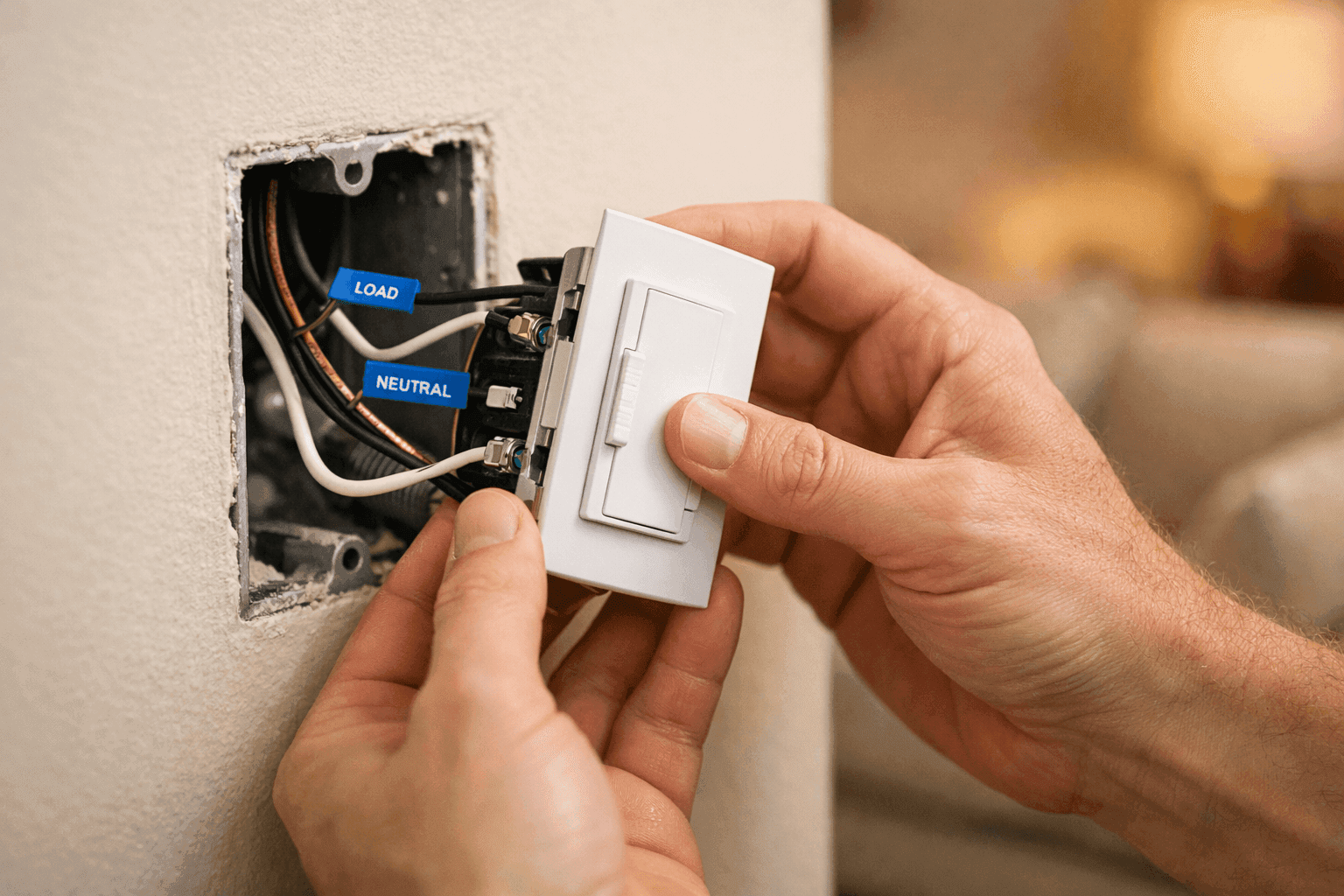
Electricians use a simple trick to keep wiring organized: before disconnecting anything, wrap a small piece of masking tape around each wire and label it with a marker (hot, neutral, ground). This takes 30 seconds and eliminates any chance of confusion when reconnecting, especially on fixtures with multiple wires. Also, always push wires firmly into wire connectors (wire nuts) and give them a tug to verify they're seated — a loose connection is the source of most electrical problems homeowners create for themselves.