Dollar Store Vertical Herb Garden for Under $10
A wire grid, six small pots, and zip ties — fresh herbs at arm's reach all summer for next to nothing
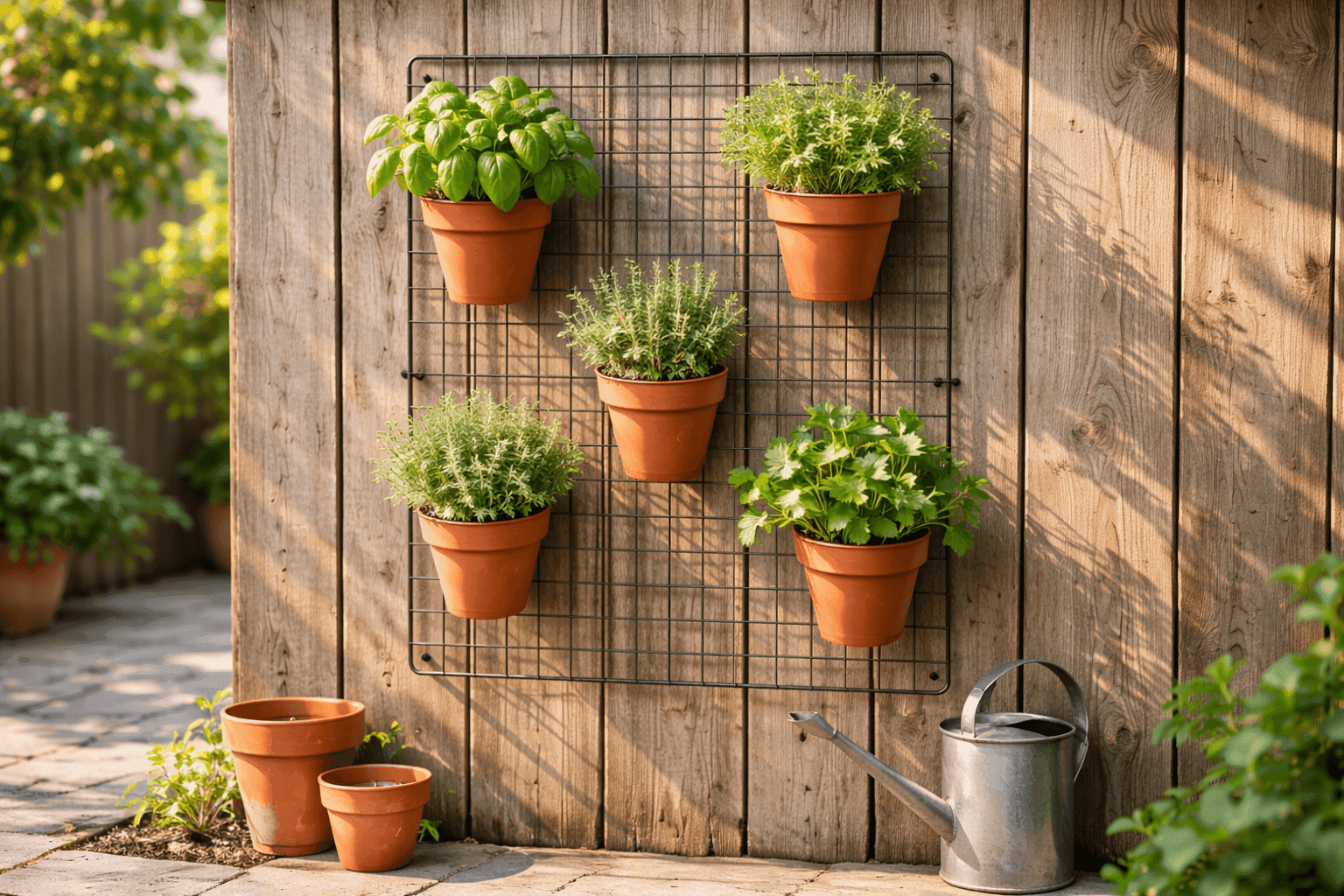
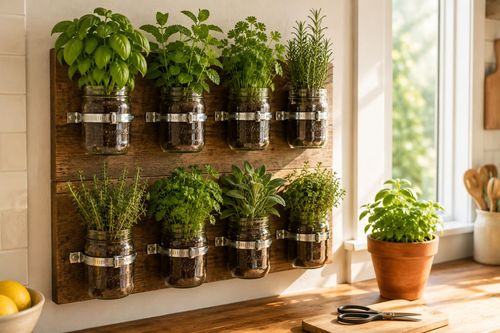
If your patio, balcony, or back fence has been doing absolutely nothing decorative all summer while you pay grocery store prices for fresh herbs every single week, this is the project that fixes both problems at once for under $10. A wire grid from the dollar store mounted vertically on any fence, wall, or railing becomes the structure for six small terra cotta pots wired at varying heights — basil at eye level, thyme tucked in beside it, mint contained safely in its own pot where it can't take over everything else. The whole setup costs a fraction of the pre-made vertical planters that do exactly the same job for $40 or more, it fits in spaces too narrow for any conventional container garden, and the visual effect of terracotta pots clustered at different heights against a fence or wall is genuinely charming in a way that a straight row of pots on a railing never quite achieves. Fresh herbs three steps from your kitchen door, built in an afternoon for the cost of a single bunch of grocery store basil.
What You Need
- Wire cooling rack, metal locker grid, or small wire shelf panel — look in the kitchen, organization, or back-to-school sections of any dollar store; aim for at least 12×16 inches for good pot capacity (~$1–2)
- Terra cotta pots, 3–4" size, qty 4–6 — the dollar store often carries these in multipacks; this size fits the grid scale and dries out at a manageable rate (~$1–2 for a pack)
- Zip ties, heavy duty, qty 20–30 — for mounting the grid to the fence or railing and securing each pot; the heavier gauge the better for outdoor use (~$1–2 for a pack)
- Thin gauge wire or additional zip ties — for threading through each pot's drainage hole and around the grid wires to hold pots level and secure under the weight of wet soil
- Potting mix — a small bag is sufficient for six 3-inch pots; avoid garden soil, which compacts in small containers and drowns roots (~$4–6 for a small bag)
- Herb seedlings or seeds — basil, parsley, thyme, cilantro, oregano, and chives all thrive in small pots; keep mint in its own dedicated pot as it spreads aggressively and will crowd out everything it touches (~$2–4 per seedling from a garden center)
- Command hooks or zip ties — for mounting the grid to a wall, fence, or railing without permanent hardware
How to Build It
- Choose your mounting location before anything else — the spot needs a minimum of six hours of direct sunlight daily for most culinary herbs to produce well, and it needs to be genuinely convenient to your kitchen door so you actually use it. A beautiful vertical herb garden on the far side of the yard that requires a trip in bare feet through wet grass gets harvested approximately never.
- Mount the wire grid to your fence, wall, or railing using heavy-duty zip ties threaded through the grid wires and around fence boards or railing balusters, or Command hooks rated for outdoor use if you're working on a wall surface without easy tie-through points. Pull each zip tie as tight as it will go — a grid that shifts and sags under the weight of wet soil and pots will pull free from the fence within a season.
- Plan your pot arrangement on the grid before attaching anything, holding each pot in position and stepping back to assess the layout. A staggered or clustered arrangement at varying heights reads as intentional and designed; a straight grid of evenly spaced pots reads as functional but visually flat. Group your tallest-growing herbs — basil, parsley — at mid to upper positions, and compact growers like thyme and oregano toward the lower corners.
- Attach each pot to the grid by threading a length of wire or a zip tie through the drainage hole in the pot base and looping it securely around two grid wires below the pot to create a cradle that supports the weight of filled soil. Add a second wire or zip tie around the pot's upper rim and the grid wires behind it to prevent the pot from tipping forward — a pot secured only at the base will lean progressively outward as the soil weight shifts.
- Fill each secured pot with potting mix to within half an inch of the rim, firming gently to eliminate air pockets without compacting the soil. Filling pots after they're attached to the grid is significantly easier than filling them first and then trying to lift and wire a heavy pot into position overhead.
- Plant one herb seedling per pot, settling the root ball into the center of the pot and firming soil around it so the crown of the plant sits just at soil level — planted too deep and the stem rots, planted too shallow and the roots dry out before the first watering. Water each pot immediately and thoroughly after planting until water drains from the base.
- Water daily in warm weather — small terra cotta pots in a vertical arrangement dry out significantly faster than ground-planted herbs or large containers, and a pot that dries completely even once will set back a young herb seedling by a full week of recovery time. Press your finger an inch into the soil each morning; if it feels dry at that depth, water immediately.
- Harvest regularly and from the top of each plant rather than stripping lower leaves — cutting the growing tips encourages each herb to branch outward into a bushier, more productive plant rather than bolting upward toward seed. The more you harvest, the more each plant produces, which is the single growing principle that turns a small vertical herb garden into a genuinely abundant one.
Market gardeners who grow culinary herbs commercially in small-space vertical systems always position their highest water-demand herbs — basil and cilantro — at the lowest points on the grid and their most drought-tolerant herbs — thyme, oregano, and rosemary — at the highest positions. Water naturally migrates downward through a vertical arrangement, so the bottom pots receive incidental moisture from the pots above during watering while the top pots dry out most quickly. Matching each herb's water needs to its position on the grid means you can water the whole system in a single pass rather than individually managing each pot — a small design decision that makes the difference between a vertical garden that thrives with minimal effort and one that requires constant individual attention to keep from losing plants to drought stress.