Cork It: Turn Wine Corks into Charming Garden Markers
A wine cork, a bamboo skewer, a paint pen, and five minutes per marker — the free garden label that looks intentionally rustic and outlasts every paper stake in the garden
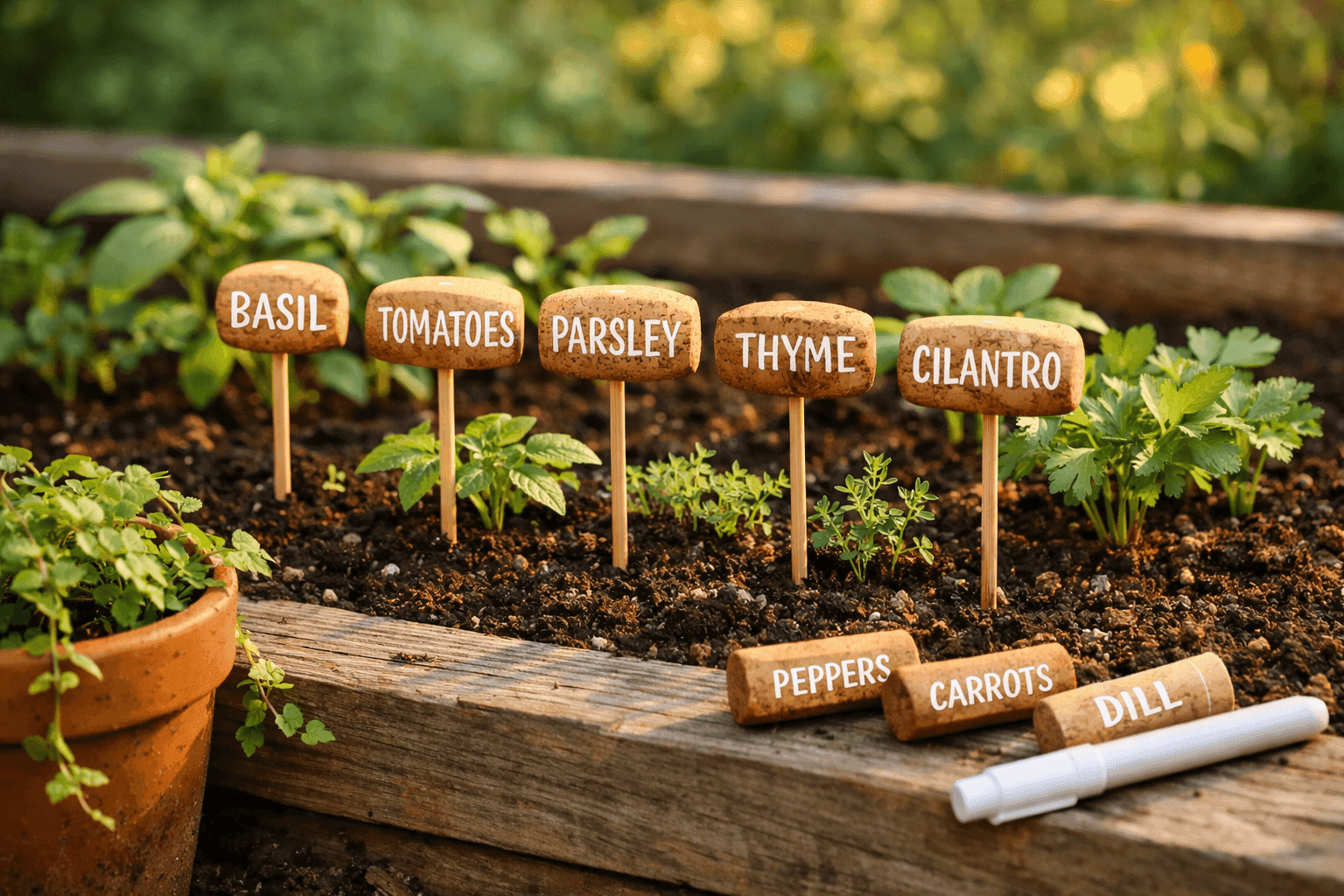
Every gardener has experienced the slow deterioration of the paper plant stakes that come with nursery starts — they survive the first week, go limp after the second rain, and by mid-June have either fallen over or become completely illegible at the exact moment you most need to know which unlabeled row is the cilantro and which is the Italian parsley. Wine cork markers are the permanent, weather-resistant, genuinely charming alternative that costs nothing if you've been saving corks, a few dollars if you buy a bag at a craft store, and about five minutes per marker from writing to stake installation. The natural cork texture holds paint pen lettering beautifully, seals completely with a coat of clear acrylic spray, and sits in the garden all season looking like a deliberate design choice rather than a makeshift label. Make a set for your own beds, bundle extras with garden twine as a gift for a gardening friend, and never lose track of what's growing in which row again.
What You'll Need
- The Corks
- Natural wine corks saved from bottles — one per plant label needed. Natural cork absorbs paint pen and acrylic paint beautifully and takes the bamboo skewer without splitting; synthetic plastic corks require a pre-drilled hole for the skewer and don't absorb paint as evenly
- Bags of mixed wine corks at craft stores like Michaels or Hobby Lobby for anyone who needs a larger quantity than their wine collection has provided — typically ~$4–$6 for a bag of 30–50 corks, which covers an entire vegetable garden with extras for gifting
- Champagne corks as an eye-catching alternative — their wider, mushroom-shaped profile displays lettering on a larger face and makes a distinctly different visual statement in the garden compared to standard cylindrical wine corks
- Lightly sand any cork with a very rough or irregular surface using 220-grit paper before writing on it — a smooth, even surface produces cleaner, more legible lettering than a pitted or fibrous cork face
- Writing Tools
- A Posca paint marker or Sharpie Oil-Based paint pen in white or black — white shows up beautifully on the natural tan cork surface and is the most legible option from a standing garden height; black provides better contrast on lighter or newer corks — ~$2–$4 per marker at craft stores
- A fine-tip paint marker produces cleaner, more readable lettering on the small cork surface than a medium or broad tip — the narrower the tip, the more letter detail fits on the available cork face
- A small round brush with acrylic craft paint as an alternative to a paint marker — slightly more time-consuming but allows full color freedom and the ability to add small illustrations like a tiny tomato or basil leaf beside the plant name
- Practice the plant names on paper before writing on the cork — the cylindrical cork surface requires slightly adjusted hand positioning compared to writing on a flat surface, and a practice pass eliminates the frustration of a misspelled or crooked label on a cork that's now committed to permanent marker
- Stakes
- Bamboo skewers — the easiest and most widely available staking option, inexpensive in large packs and the right diameter to push firmly into a natural cork without pre-drilling — ~$2–$3 for a pack of 100 at a grocery or dollar store. The pointed end goes into the soil; the blunt end pushes into the cork bottom
- Wooden chopsticks as a free alternative staking option if you have a collection accumulating in a kitchen drawer — similar diameter to bamboo skewers, longer than most skewers for deeper soil insertion, and completely free
- Sturdy straight twigs collected from the garden or yard as the most rustic and fully zero-cost staking option — trim to a consistent length with garden shears and sharpen one end to a point with a utility knife for easy soil insertion
- A small hand drill or awl for pre-drilling the hole in any cork that splits when the skewer is pushed in directly — a ⅛-inch pilot hole prevents splitting and makes skewer insertion clean and controlled rather than forceful
- Sealing & Finishing
- Clear acrylic spray sealer — a light coat over the written cork surface locks the paint pen lettering permanently and prevents moisture from slowly degrading the ink over a full outdoor season — ~$6–$8 per can that covers many dozens of markers. Apply in a well-ventilated area or outdoors
- Brush-on Mod Podge Outdoor as an alternative sealer — apply a thin coat with a small brush over the lettered cork surface, let dry fully, and the waterproof finish is comparable to spray sealer with no overspray concerns
- Garden twine for bundling finished markers in sets of five or six for gifting — tie a simple bow around the bundle and tuck a small seed packet inside the twine for a genuinely lovely gardening gift
How to Make Them
- Plan your full marker set before writing on a single cork — list every plant that needs a label and count out one cork per plant before opening any marker. Planning the complete set first means you have the right number of corks, can plan consistent lettering style across the full set, and notice immediately if you're short any corks before writing half the set and then waiting days for a craft store run to finish the other half.
- Write on the flat end face of the cork rather than the curved cylindrical side — the circular end face of a wine cork provides a larger, flat writing surface that's visible from above when the marker is pushed into the soil, making plant identification as easy as looking down at the garden rather than bending to read a label on the side. Write the plant name in capital letters centered on the end face, using the full diameter of the circle as your writing space.
- Alternatively write on the cylindrical side for longer plant names that don't fit the end face — orient the cork horizontally with the curved side facing you and write along the length of the cylinder in capital letters. Side-written markers display the plant name when viewed from the front at a slight downward angle, which works well in raised beds and container gardens where you approach plants from the side rather than looking straight down.
- Add small illustrations beside the plant name if you'd like — a simple three-circle tomato, a five-petal flower, a small leaf outline — using a fine-tip paint marker or a size 0 brush with acrylic paint. These don't need to be precise botanical illustrations; a recognizable symbol beside the text makes the marker immediately identifiable from a distance even before reading the lettering, which is useful when your hands are full of seedlings at transplanting time and you need to identify the right row fast.
- Let the lettering dry completely for at least 30 minutes before applying sealer — paint pen and acrylic paint both appear dry quickly but take longer to fully cure, and applying spray sealer over paint that hasn't finished curing creates a reaction that smears the lettering or produces a cloudy finish over the writing. A 30-minute minimum dry time before sealing prevents both problems with no downside beyond the brief wait.
- Apply a light coat of clear acrylic sealer over the lettered surface of each cork — hold the spray can 8–10 inches from the cork surface and apply a single thin coat that just covers the surface without runs or pooling in the cork texture. One thin coat is sufficient for a single season; a second coat applied after the first dries completely produces a more durable seal for markers intended to be reused across multiple growing seasons.
- Insert the stake into the cork bottom once the sealer is fully dry — hold the cork firmly and press the blunt end of the bamboo skewer into the center of the cork bottom with a firm, steady pushing motion rather than a hammering action that splits the cork. The skewer should enter about ½ inch into the cork and hold without rotating freely — a skewer that rotates means the cork hole is slightly too large and needs a drop of strong glue to bond the skewer in place permanently before installation.
- Install markers in the garden by pushing the skewer point firmly into the soil directly beside each plant — push deep enough that the cork sits 2–3 inches above the soil surface where it's clearly visible without being so low that it gets covered by plant growth as the season progresses. Check marker legibility from normal standing height before finalizing placement — a marker that requires bending to read provides most of its value only at the beginning of the season when seedlings are small enough to read around, rather than throughout the full growing season when it matters most.
Garden designers who create kitchen gardens and potager-style vegetable gardens for editorial and residential clients use a labeling consistency principle that transforms a functional garden marker into a cohesive design element: every marker in a garden should use the same lettering style, the same ink color, and the same stake height above the soil. A garden where all the cork markers sit at the same height, written in the same white paint pen in the same capital block lettering, reads as intentionally designed — the markers become a repeated element that adds rhythm and coherence to the garden layout the same way consistent edging or uniform pot styles do. A garden where markers are at random heights, written in different colors and different handwriting styles, reads as functional but unstyled regardless of how attractive each individual marker is. This single consistency principle — same height, same color, same style — costs nothing extra and takes no additional time once you've committed to it, and it's the difference between a garden that looks like it was planted with care and one that also looks like it was designed with intention.