Cool Running: Clean Your Fridge Coils in 15 Minutes
The 15-minute twice-a-year maintenance task that lowers your energy bill, prevents costly breakdowns, and adds years to the most expensive appliance in your kitchen
Your refrigerator is running right now — and if you haven't cleaned the condenser coils in the past year, it's working significantly harder than it needs to, using more electricity than it should, and shortening its own lifespan in the process. Condenser coils release the heat that the refrigerator pulls out of its interior, and when they're coated in a layer of dust, pet hair, and kitchen debris — which happens gradually and invisibly over months — they can't release that heat efficiently. The compressor compensates by running longer and harder, which drives up your energy bill and accelerates the wear that eventually causes the kind of breakdown that costs $300 to $500 to repair or requires a full replacement. Cleaning the coils takes fifteen minutes, requires either a $6 coil brush or a vacuum you already own, and should happen twice a year as standard kitchen maintenance. This is the Sunday Spruce-Up that requires the least effort, costs the least money, and delivers the most concrete long-term return of anything on this list — and almost nobody does it.
What You'll Need
- The Cleaning Tool — Choose One
- A refrigerator coil cleaning brush — a long, narrow, flexible brush specifically designed to reach between coil fins and along the length of the coil array without bending the fins — ~$6–$10 at any hardware store. This is the ideal tool and worth owning if you plan to do this maintenance regularly
- A vacuum cleaner with a narrow crevice attachment or a soft brush attachment — works well for accessible coils and is the right tool for vacuuming up debris after the coil brush loosens it
- Both tools together is the most effective approach — the coil brush dislodges compacted dust from between the fins, the vacuum immediately removes it before it settles back onto the coils or the floor
- Safety & Prep
- Access to the breaker box or the refrigerator's power cord — the fridge must be unplugged or its breaker switched off before cleaning coils, no exceptions. Working on or near live electrical components in an appliance is not a maintenance task, it's a safety risk
- A flashlight for examining the coil area before and after cleaning — coils are in dark, low-access locations and confirming you've actually removed the debris requires being able to see it clearly
- A helper for pulling the refrigerator away from the wall if your model has back-mounted coils — a full-size refrigerator weighs 200–300 pounds and should never be pulled by a single person without someone steadying it
- For Bottom-Mounted Coils
- The kick plate removal is typically tool-free — most snap off by pulling the bottom corners forward — but have a flathead screwdriver available in case yours is secured with screws
- Knee pads or a folded towel for kneeling — the coil cleaning position for bottom-mounted units requires working at floor level for 10–15 minutes and knee pads make a genuine difference in comfort
- A damp cloth for wiping down the kick plate and the floor area beneath the fridge while it's accessible — pet hair and kitchen grease accumulate there in quantities that are genuinely alarming the first time you look
- For Back-Mounted Coils
- Furniture sliders placed under the refrigerator feet before pulling — these allow a single person to slide a heavy refrigerator without scratching the floor and without the dangerous lurching that comes from trying to drag it directly — ~$6–$10 for a set
- A tape measure for confirming 2–3 inches of clearance between the coil panel and the wall when pushing the fridge back — insufficient clearance restricts airflow and partially negates the benefit of the cleaning
How to Do It
- Locate your coils before unplugging anything — check the back of the refrigerator for a panel of coils mounted vertically, or look at the front bottom for a kick plate that conceals a horizontal coil array underneath the unit. Newer refrigerators almost universally have bottom-mounted coils behind a kick plate; older models from the 1990s and early 2000s more commonly have back-mounted coils. Confirming coil location before you start means you know whether this is a floor-level kick plate job or a pull-the-fridge-from-the-wall job — and you can gather the right tools accordingly.
- Unplug the refrigerator or turn off its breaker before touching anything — pull the power cord from the outlet if it's accessible, or locate the refrigerator's circuit on your breaker panel and flip it off if the cord is behind the unit. This is the non-negotiable first step that most people skip because the coils are not the same as electrical components and the risk feels theoretical — but a running compressor cycling on unexpectedly while you're working near moving components beneath the unit is a real hazard that unplugging completely eliminates.
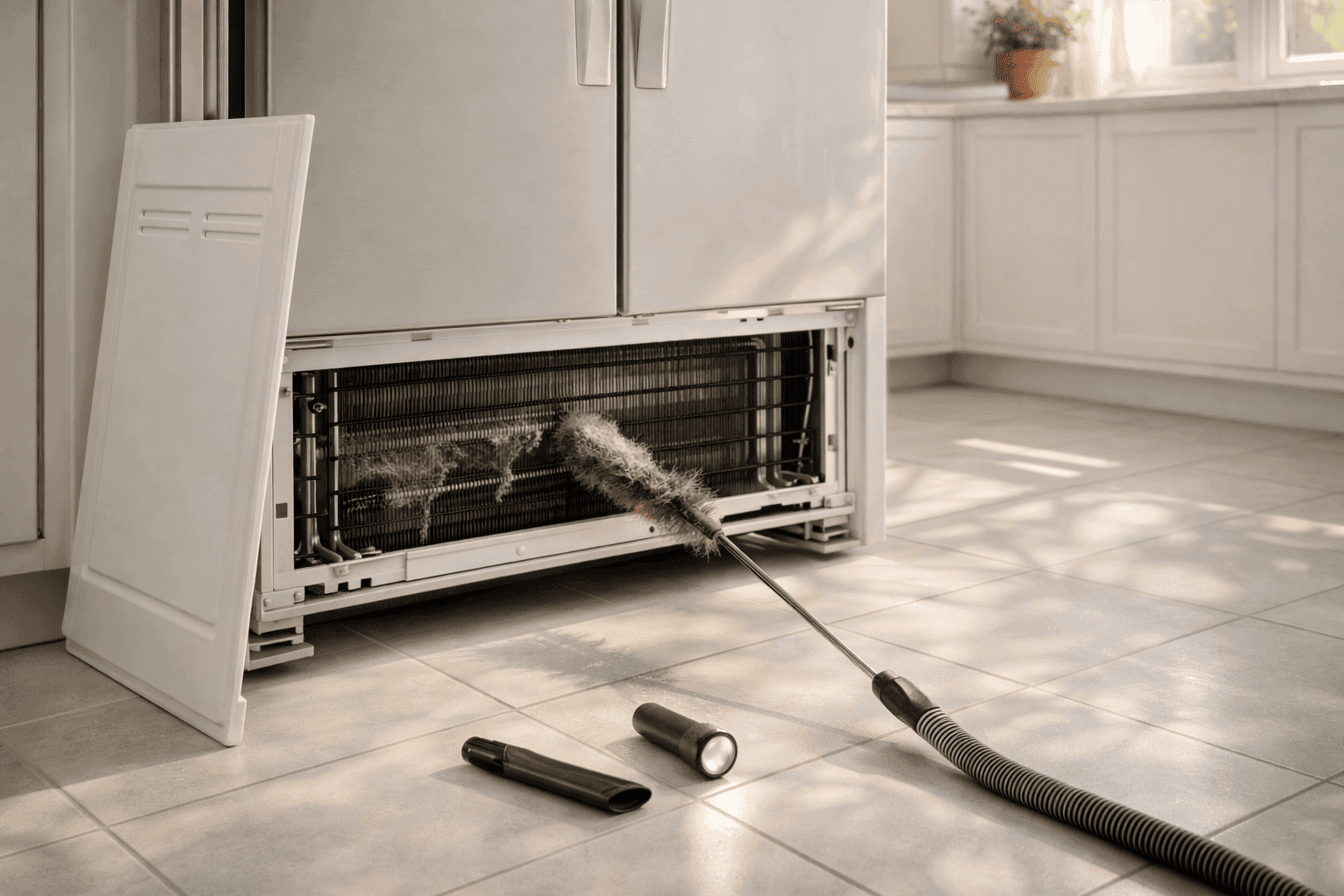
- Access the coils — for bottom-mounted coils, pull the kick plate straight toward you from both bottom corners simultaneously until it unclips cleanly from its mounting tabs, set it aside, and shine your flashlight into the space beneath the unit to assess the actual debris situation before inserting the brush. For back-mounted coils, place furniture sliders under the front feet, have your helper steady the unit, and pull the refrigerator straight forward until the back panel is fully accessible — typically 18–24 inches from the wall.
- Brush the coils gently and thoroughly using your coil brush — insert it between the coil fins and move it in long strokes along the length of the coil array, working systematically from one side to the other and from front to back so you cover the full surface area rather than just the most accessible front section. Gentle is the operative word — the aluminum fins between the coil tubes bend easily and a bent fin reduces airflow through the coil array, so use firm but controlled strokes rather than aggressive scrubbing that puts lateral force on the fin edges.
- Vacuum all loosened debris immediately using the crevice attachment, working along the full length of the coil array to pull up the dust, pet hair, and lint that the brush dislodged before it settles back onto the coils or migrates further into the unit's mechanical components. Extend the vacuum beyond the coil area to clean the floor space beneath the unit and the area immediately around the compressor — this is where the densest accumulation lives in most kitchens, and it's accessible only when the kick plate is off or the fridge is pulled away from the wall.
- Wipe down the kick plate and surrounding floor with a damp cloth while everything is accessible — the floor under and behind a refrigerator accumulates a combination of kitchen grease, dust, and pet hair that is genuinely impressive in its density and completely invisible during normal kitchen cleaning. Returning a clean kick plate to a clean floor space under a refrigerator with clean coils is the kind of thorough maintenance that extends appliance life and keeps the kitchen genuinely clean rather than just looking clean.
- Replace the kick plate or reposition the refrigerator — for bottom-mounted coils, align the kick plate tabs with their mounting slots and press firmly until it snaps back into place evenly across the full width. For back-mounted coils, push the refrigerator back toward the wall until the back panel sits 2–3 inches from the wall surface and confirm with a tape measure before finalizing the position — the clearance gap is what allows the heat-dissipating airflow around the coil panel that makes the whole cleaning worthwhile.
- Restore power and set a maintenance reminder — plug the refrigerator back in or flip the breaker back on, listen for the compressor to cycle on normally within a few minutes, and set a phone reminder or a calendar note for six months from today to do this again. Twice-yearly coil cleaning is the maintenance interval that appliance repair technicians cite most consistently as the difference between refrigerators that reach their 15–20 year design lifespan and ones that require a compressor replacement or full unit replacement at 8–10 years — a $6 brush used twice a year is the entire investment that protects a $1,000–$2,000 appliance.
Appliance repair technicians who service residential refrigerators across a full career make one observation about coil cleaning that reframes the whole task from optional maintenance to meaningful investment: the refrigerator models that consistently reach and exceed their rated lifespan in the service calls they never have to make are almost always ones in households where the coils get cleaned regularly. The compressor is the single most expensive component in a refrigerator to replace — typically $200–$400 in parts alone plus labor — and it's the component most directly stressed by dirty coils forcing it to run longer cycles at higher temperatures than it was designed for. While the kick plate is off and the flashlight is out, take an extra two minutes to check the condition of the door gaskets — the rubber seals around every door edge — by closing the door on a single sheet of paper and trying to pull it out. A gasket in good condition grips the paper firmly; a gasket that lets the paper slide out freely is leaking cold air constantly and driving up your energy bill just as effectively as dirty coils. A replacement door gasket costs $20–$40 and is one of the most cost-effective refrigerator maintenance investments available — and you'd never think to check it if you weren't already on the floor with a flashlight doing the coil cleaning you came here to do.