Clean Sweep: Organize Cleaning Supplies into Caddies
Three caddies, one per floor, each stocked with everything needed to clean that level — the $40 setup that cuts weekly cleaning time almost in half
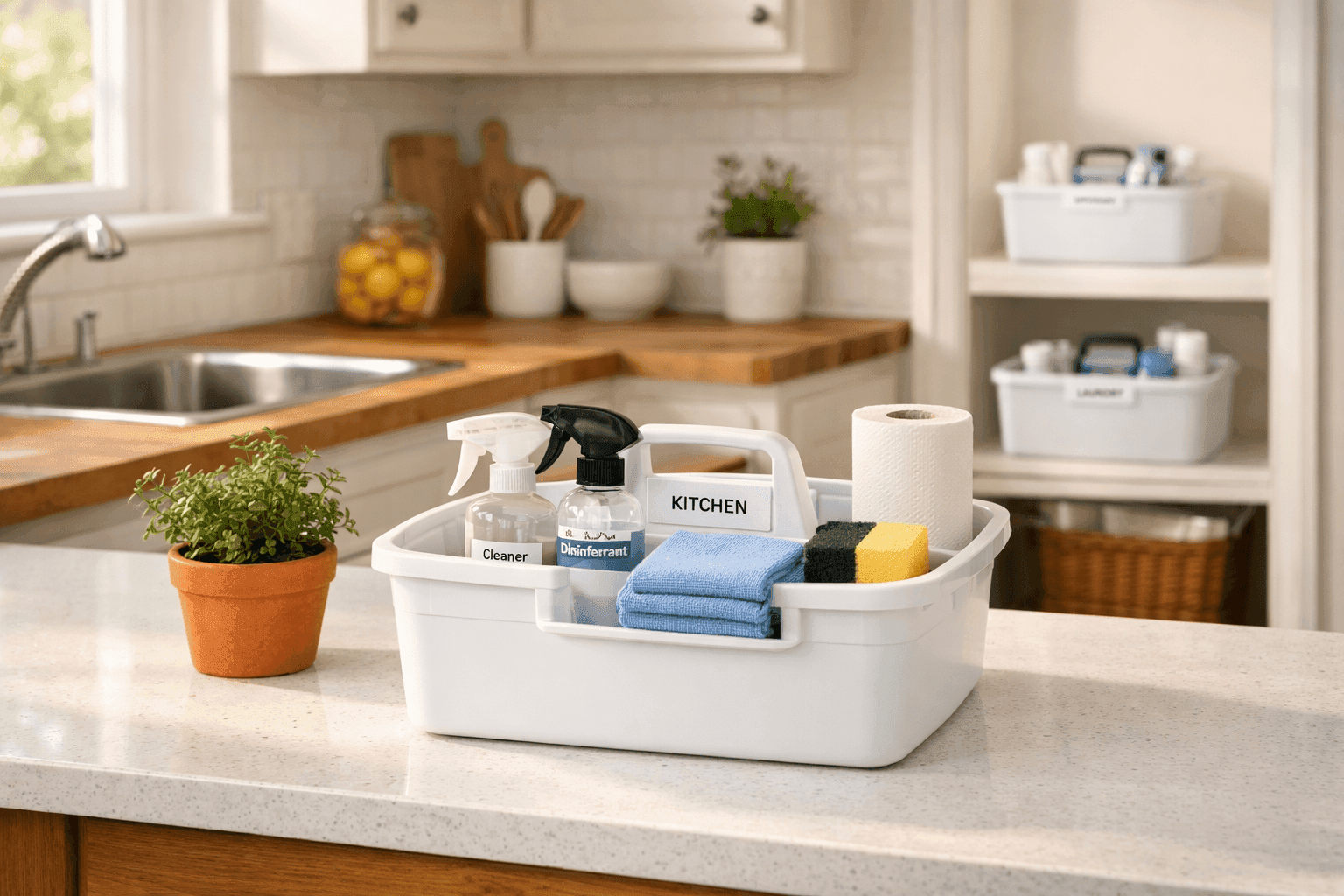
The ten minutes you spend hunting for cleaning supplies before every cleaning session doesn't sound like much until you multiply it by fifty-two weeks and realize you've spent the equivalent of an entire workday each year just looking for the glass cleaner. The fix is straightforward enough to feel almost too simple: three cleaning caddies, one per floor, each stocked with its own complete set of cleaning essentials so every surface in the house is cleanable from a caddy that's already on that floor. No backtracking, no trips to another closet, no discovering mid-bathroom that the scrubbing sponge is two floors away. The setup costs about $40 including the caddies and the duplicate supplies, takes an hour to put together, and the return on that investment begins the very first time you clean after setting it up. This is one of those organizational changes that sounds almost embarrassingly simple but produces a genuinely dramatic reduction in both the time and the psychological resistance that makes people put off cleaning longer than they should — and both of those outcomes are worth far more than $40.
What You'll Need
- The Caddies
- Three plastic cleaning caddies with a handle and divided interior compartments — one per floor or one per cleaning zone in your home. Dollar store caddies at ~$1.25–$5 each work perfectly; so do the slightly more structured versions at Target or Amazon for ~$8–$12 each if you prefer something more durable
- Choose caddies that fit comfortably under a sink, in a bathroom cabinet, or on a laundry room shelf — measure your storage space before buying if you're not sure, since a caddy that's too tall to fit under the sink defeats the entire purpose of keeping it in that zone
- Identical caddies in the same color look intentional and make it easy to confirm at a glance that everything is back in its caddy after cleaning — different colored caddies per floor is an equally valid approach that makes it immediately clear which caddy belongs where if someone puts one back in the wrong location
- The Core Supply List — Duplicate for Each Caddy
- All-purpose cleaner spray — the single most-used product in any cleaning caddy, covering countertops, appliance exteriors, cabinet faces, and most hard surfaces — buy in bulk and decant into small labeled spray bottles to keep caddy weight manageable — ~$3–$5 per full-size bottle
- Glass and mirror cleaner — a separate product from all-purpose cleaner produces streak-free results on windows and mirrors that all-purpose cleaners rarely match — ~$3–$4 per bottle
- Bathroom cleaner or disinfectant spray — specifically formulated for toilets, sinks, and tile grout. Keeping this in the bathroom-floor caddy means bathroom cleaning never requires a separate trip for the dedicated bathroom product — ~$3–$5 per bottle
- Three to four microfiber cloths per caddy — one for general surfaces, one dedicated to glass and mirrors, and one or two for bathroom surfaces. Microfiber cloths clean more effectively with less product than paper towels and last hundreds of washes — ~$8–$12 for a pack of 12 that stocks all three caddies
- One scrubbing sponge with a soft face and an abrasive back for surface scrubbing — replace monthly or when it starts to smell — ~$2–$3 for a multi-pack
- A small roll of paper towels or a folded stack for tasks where disposable is genuinely preferable — sticky spills, bathroom deep-cleans, anything you'd rather throw away than put in the laundry
- Optional Zone-Specific Additions
- Kitchen caddy extras: dish soap, a degreaser for stovetop and range hood, stainless steel cleaner for appliances, a small scrub brush for grout lines and sink drain areas
- Bathroom caddy extras: toilet bowl cleaner and a toilet brush holder that mounts on the inside of the cabinet door, grout brush, pumice stone for toilet rings
- Bedroom/living area caddy extras: wood furniture polish, a lint roller, a small duster for baseboards and blinds, a fabric freshener spray
- Labeling & Organization
- A label maker or adhesive labels and a marker for labeling each caddy with its zone — KITCHEN, UPSTAIRS, DOWNSTAIRS — so anyone in the household returns it to the correct storage location after use
- Small adhesive hooks inside cabinet doors for hanging spray bottle trigger handles — this keeps bottles upright and prevents them from tipping and leaking inside the caddy during storage
- A small laminated card with the weekly cleaning checklist for each zone tucked into each caddy — having the task list with the supplies eliminates the mental load of remembering what needs to be done in each area
How to Set It Up
- Audit every cleaning product in the house before buying anything — gather every spray, cloth, sponge, and scrubber from every closet, cabinet, and under-sink space in the entire home and lay it all out in one place. This audit almost always reveals duplicate products you forgot you owned, products that are nearly empty and need replacing, products that have been superseded by better alternatives, and several products you bought once for a specific task and never used again. Consolidating the full picture before setting up the system means you buy only what you actually need rather than duplicating products you already have in abundance.
- Define your cleaning zones based on how your home actually gets cleaned rather than a theoretical floor plan — most homes with two floors clean most efficiently with a kitchen caddy, an upstairs bathroom caddy, and a general living area caddy, but a single-floor home might be better served by a kitchen caddy, a bathroom caddy, and a bedroom/common area caddy. The zone definition that cuts your cleaning time most is the one based on where you currently spend the most time backtracking for supplies, not the one that sounds most logical on paper.
- Stock each caddy with the full core supply list before adding zone-specific extras — all-purpose cleaner, glass cleaner, bathroom disinfectant, microfiber cloths, and a scrubbing sponge are the non-negotiable contents of every caddy regardless of zone. Adding zone-specific products before confirming the core list is complete produces caddies that are well-stocked for one type of cleaning but missing basics for another, which recreates the hunting behavior the system is designed to eliminate.
- Decant bulk cleaning products into smaller bottles if you buy in bulk to save money — a 32-ounce spray bottle of all-purpose cleaner is awkward to store in a caddy and far heavier than necessary for a single cleaning session. Decant into small 12–16 ounce labeled spray bottles that fit comfortably in the caddy, keep the large bulk containers under one central sink for refilling, and label every decanted bottle clearly with its contents and the date decanted. A caddy that's light enough to carry easily with one hand gets used far more consistently than one that requires two hands and feels like hauling a toolbox.
- Assign and label each caddy to its zone immediately — don't wait until the caddies are fully stocked to add the zone labels, because an unlabeled caddy that gets used once before the labels are added tends to end up in the wrong location and stays there. Label the caddy and its storage location simultaneously so the return destination is unmistakable to every person in the household who uses it, including guests and anyone who helps with cleaning occasionally and won't remember the verbal explanation of where each caddy lives.
- Store each caddy at the point of first use in its zone — the kitchen caddy under the kitchen sink where cleaning starts, the upstairs caddy in the first bathroom you encounter on that floor, the living area caddy in the most central closet or cabinet in that zone. The storage location that makes the caddy feel instantly accessible when you decide to clean — not the most organized location or the most out-of-the-way location — is the one that actually gets used consistently rather than being retrieved and returned as an extra step that slowly erodes the habit.
- Create a restocking routine by checking each caddy monthly for products running low — the system breaks down the first time you reach for the glass cleaner mid-cleaning and find an empty bottle. A quick monthly caddy check that takes three minutes per caddy prevents that breakdown and keeps the system functioning at full efficiency indefinitely. Add a recurring monthly phone reminder labeled "check caddies" on the same day you pay bills or do another routine monthly task so it becomes a habit rather than a thing you mean to do when you remember.
- Do a test clean with the new system immediately after setup — pick one zone and clean it completely using only the newly stocked caddy, noting any product or tool that you reached for and didn't find. Add whatever was missing to that caddy and the same addition to the others if it's a core product, and adjust the zone-specific contents of each caddy based on what the test clean revealed about the specific surfaces and tasks in that area. A system that gets tested and refined on day one performs significantly better from week two onward than one that's assembled once and used as-is without any calibration.
Professional house cleaners and home organization specialists who manage multiple properties consistently make one observation about cleaning caddy systems that most homeowners set up and then gradually abandon: the system fails not from any flaw in the organization logic but from a single missing habit — returning every item to the caddy immediately after use rather than setting it down on the nearest surface and intending to return it later. A microfiber cloth left on the bathroom counter after cleaning, a spray bottle left on the kitchen counter after wiping down the stovetop, a sponge left in the sink — each one seems trivial in isolation but collectively they dismantle the system within a few weeks as products migrate away from their caddies and the backtracking behavior the system eliminated gradually returns. The solution is treating caddy return as part of the cleaning task itself rather than a separate step: the task isn't complete until the product is back in the caddy, the same way the task isn't complete until the surface is wiped dry. Building this return habit into the first few cleaning sessions using the new system — consciously and deliberately returning each item before moving to the next task — takes about three cleaning sessions to become fully automatic, after which the system maintains itself with no conscious effort at all.