Build an A-Frame Cucumber Trellis for $25
Ninety minutes, a handful of furring strips, and your cucumber harvest doubles
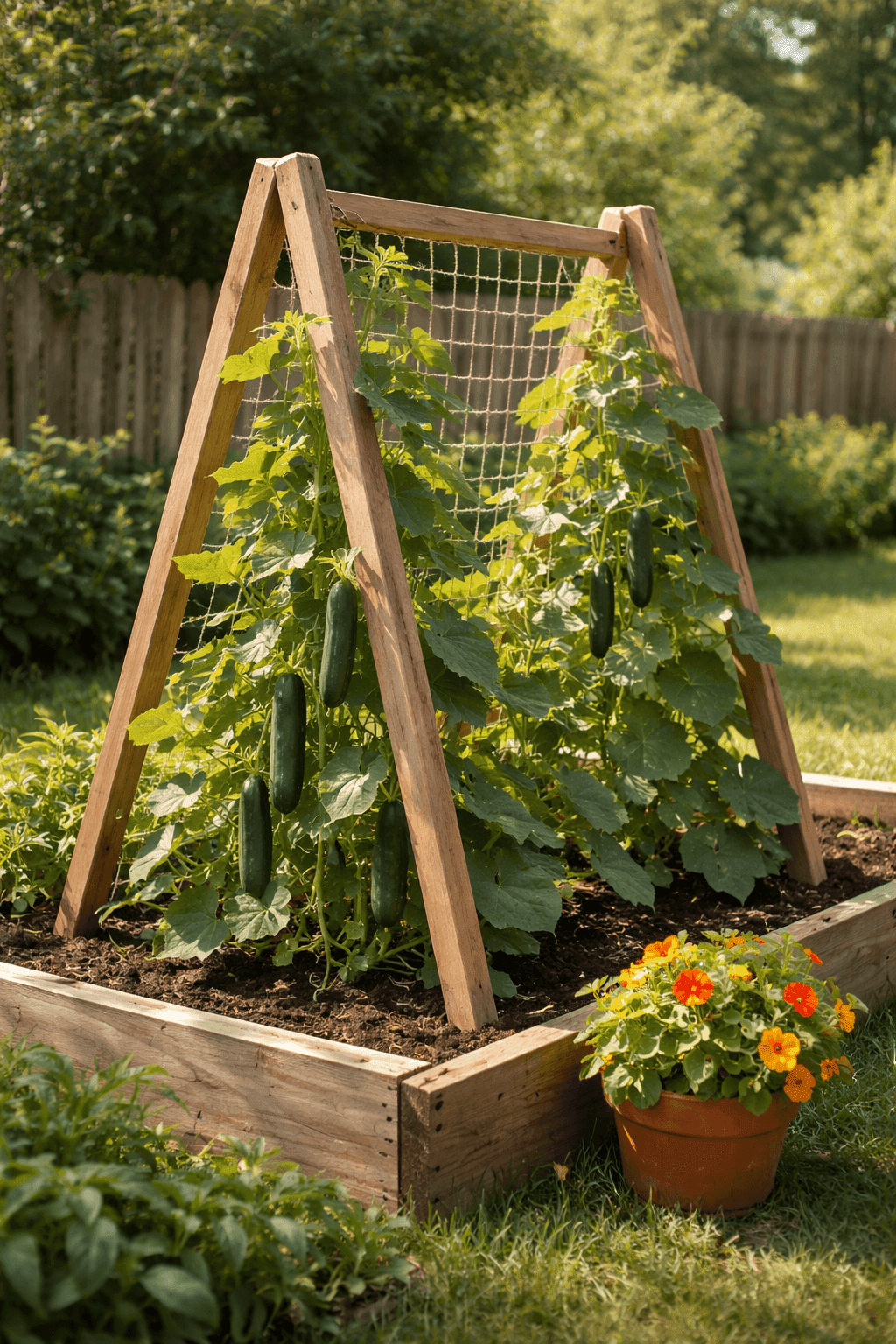
If you've ever found a cucumber the size of a baseball bat hiding under a leaf canopy, you already know exactly why this project exists. Growing cucumbers flat on the ground is a one-way ticket to rot, pest damage, and fruits that go from perfect to compost-bound while you weren't looking — and the fix is a simple A-frame trellis that costs $25 in materials and takes ninety minutes to build. Two ladder frames hinged at the top with a single bolt, jute netting strung across each side, and your cucumbers climb on their own, hang straight, and become impossible to miss at harvest time. The folding hinge means the whole structure breaks down flat for winter storage, so this isn't a one-season investment — it's a permanent upgrade to the way you grow. Build one this weekend and you'll be building a second one before the season's out.
What You Need
- Furring strips, 1×2"×8', qty 8 — the structural backbone of both ladder frames (~$12–14 total at any home center)
- Jute netting, 4'×8' roll — natural fiber, biodegradable, and the surface cucumbers grip most readily (~$8–10)
- Carriage bolt, ¼"×3", with nut and two washers — this single bolt is the hinge point that makes the whole structure fold (~$1–2)
- 1¼" exterior screws, qty ~40 — for assembling the ladder rungs to the side rails
- Staple gun with ½" staples — for attaching jute netting to the finished frames
- Drill with bits — for pilot holes and the hinge bolt hole
- Handsaw or miter saw — for cutting rungs to length
- Measuring tape, pencil, speed square
How to Build It
- Cut your furring strips to length: four side rails at 6 feet each (two per frame) and ten rung pieces at whatever width suits your bed — 36 to 48 inches works well for most raised beds. Mark and cut all pieces before you start assembling so the build flows without interruption.
- Lay two side rails flat and parallel on the ground, 36–48 inches apart, and position five rungs evenly across them with the first rung flush at the bottom and the remaining four spaced roughly every 12 inches up the frame. Use a speed square to confirm every rung is perpendicular to the rails before fastening — a racked frame won't stand straight.
- Pre-drill pilot holes at every rung-to-rail junction, then drive two exterior screws through the rail face into each rung end. Pre-drilling is the step most people skip, and it's what prevents furring strips from splitting at the connection points.
- Repeat the assembly process for the second frame so you have two identical ladder panels. Set them side by side and confirm they match before moving on.
- Drill a ¼-inch hole centered through the top rail of each frame, then overlap the two top rails and align the holes. Thread the carriage bolt through both rails with a washer on each side, add the nut, and tighten just enough to allow the frames to pivot — too tight and the hinge binds, too loose and the structure won't hold its angle. This bolt is the single most consequential joint in the entire build.
- Open the A-frame to your desired angle — roughly 45 degrees per side works well for most garden beds — and stand it in position. The spread of the feet determines stability, so wider is better if your bed allows it.
- Cut jute netting to fit each frame face and staple it taut across the rungs and rails, starting at the bottom and working upward. Keep the netting under even tension as you go — loose spots become the areas where vines bunch up rather than spreading across the surface.
- Plant cucumbers along both sides of the base and guide the first few tendrils toward the netting by hand. Within a week they'll find it themselves, and from there the trellis does the work.
Commercial cucumber growers orient their trellises on a north-to-south axis so both faces receive direct sunlight at different points in the day rather than one side living permanently in shade. For home gardeners, this single positioning decision can meaningfully increase yield from the same number of plants — shaded fruit develops more slowly, sizes unevenly, and is far more prone to the bitter flavor that makes people think they don't like cucumbers. If your bed orientation doesn't allow a true north-south run, even a slight angle away from east-west is worth the adjustment.