Build a Wooden Garden Obelisk for $15
Two hours, a handful of lumber, and your garden gets the kind of vertical structure that makes everything around it look more intentional
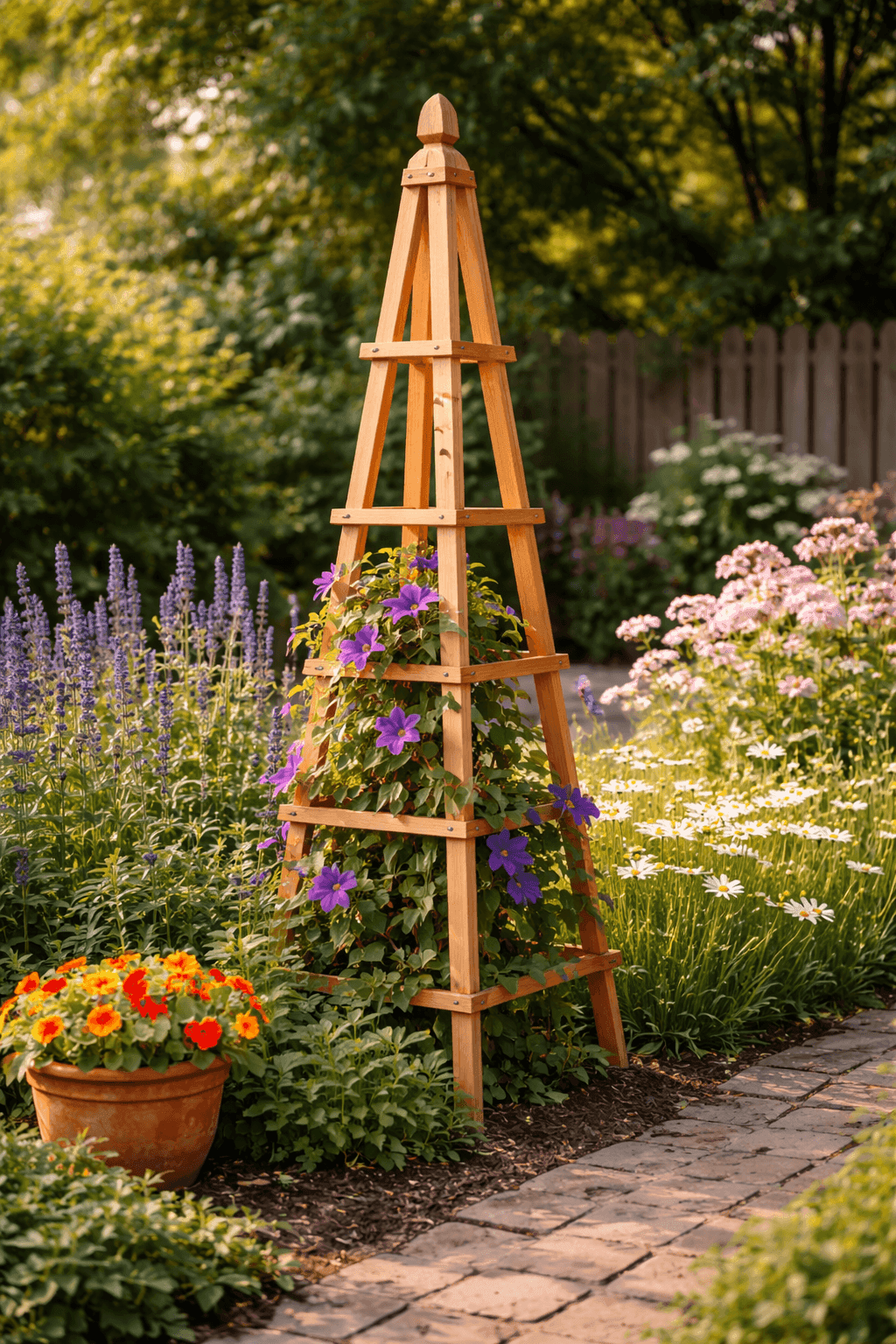
A garden obelisk does something that almost no other single element can do for a planting bed: it adds vertical height, architectural structure, and a focal point all at once, and it does it whether or not anything is climbing it yet. The classic tapered pyramid shape has appeared in formal and cottage gardens for centuries because it works with essentially every planting style — push it into a rose bed, train clematis up its sides, let morning glories scramble freely through its crosspieces, or simply let it stand as a structural accent while perennials fill in around its base. Garden centers charge $60, $80, even $120 for obelisks with this kind of presence, and the lumber version you build yourself costs $15 and takes two hours of satisfying, straightforward woodworking to produce. Cedar and redwood resist decay naturally and can go straight into the ground without treatment; pine needs a coat of exterior stain or sealer but costs even less. Either way, this is one of those builds where the finished piece looks considerably more expensive and considered than the materials or the time invested would suggest.
What You Need
- 1×2 lumber, 8-foot lengths, qty 4 — cedar or redwood for natural rot resistance; pine is less expensive but needs sealing before ground contact (~$10–14 total depending on species)
- 1×2 lumber offcuts for crosspieces — you'll cut graduated lengths of 18", 15", 12", and 9" from remaining material; one additional 8-foot length covers all crosspieces comfortably (~$3–4)
- Exterior wood screws, 1¼" and 1⅝" — for securing crosspieces to uprights; two lengths cover different joint thicknesses cleanly (~$4–5 for a small box)
- Drill with driver bit and small pilot bit — pre-drilling every joint is non-negotiable on 1×2 lumber, which splits at screw entry points without a pilot hole
- Miter saw or handsaw — for cutting uprights to length and crosspieces to their graduated widths
- Measuring tape, speed square, and pencil — for marking consistent crosspiece spacing on both upright pairs
- Sandpaper, 120-grit — for smoothing cut ends and any rough grain before finishing
- Exterior wood stain, sealer, or paint — optional for cedar; essential for pine going into ground contact (~$8–12 for a small can)
- Clamps, qty 2–4 — for holding crosspieces in position while you drill and drive screws
How to Build It
- Cut all your pieces before assembly begins — four uprights at 6 feet each, and crosspieces at 18", 15", 12", and 9" for each of the four sides of the obelisk, giving you sixteen crosspieces total. Cutting everything first means the build flows without interruption and you can confirm all pieces are correctly sized before any screws go in.
- Lay two uprights flat and parallel on your work surface, positioning the bottom ends 18 inches apart and allowing the tops to angle inward until they meet or nearly meet — the natural taper of the obelisk shape. Use clamps or have a helper hold this geometry steady while you work; the angle tends to shift during assembly if nothing holds it in place.
- Mark crosspiece positions on both uprights simultaneously using a measuring tape and square — spacing crosspieces every 10 to 12 inches up the length of the uprights gives a classic obelisk proportion. Marking both uprights at the same time from the same reference point is what ensures your crosspieces run level rather than climbing diagonally across the finished panel.
- Attach crosspieces to both uprights starting at the bottom with the 18-inch piece and working upward through 15", 12", and 9" at the top, pre-drilling a pilot hole at every junction before driving a 1¼" exterior screw. Pre-drilling is the single step that prevents the splitting that ruins 1×2 lumber at screw entry points — skip it on even one joint and the wood cracks through the face.
- Repeat the entire panel assembly for the second pair of uprights so you have two identical ladder-shaped side panels. Lay them side by side and compare before moving on — any crosspiece that's visibly off-level or misaligned is far easier to correct now than after the four-sided structure is assembled and standing.
- Stand both panels upright facing each other and hold them in position with clamps or a helper while you attach the connecting crosspieces on the two remaining open sides — again using graduated lengths from 18" at the bottom to 9" near the top, pre-drilling and screwing at every joint. The structure becomes self-supporting and rigid once at least two connecting crosspieces are in place on each open side.
- Sand all cut ends, sharp edges, and any rough grain with 120-grit paper once the full obelisk is assembled. Smooth edges matter both for the finished look and for the vines that will eventually twine through the crosspieces — rough splinters snag and damage delicate climbing stems in ways that accumulate over a season.
- Finish with exterior stain or sealer if using pine, or leave cedar and redwood natural if you prefer the weathered silver-gray they develop over time. Push the four leg ends 6 to 8 inches into garden soil, positioning the obelisk where it will receive the sun exposure your chosen climbing plant requires, and plant one climber at each base leg for the fullest coverage by midsummer.
Garden designers who work with structural plant supports always install obelisks in odd-numbered groupings of three or five rather than singly or in pairs — a trio of obelisks at graduated heights (6 feet, 5 feet, 4 feet) planted with the same climbing variety creates a rhythmic vertical accent that reads as a designed composition rather than a single feature, and draws the eye along the length of a border rather than stopping it at one point. The cost difference between one obelisk and three is minimal when you're building your own from lumber, and the visual impact difference between a single obelisk and a considered grouping is significant enough that professional garden designers almost never place them alone.