Build a Garden Tool Organizer in 90 Minutes for $12
Everything off the floor, everything visible, everything exactly where you left it
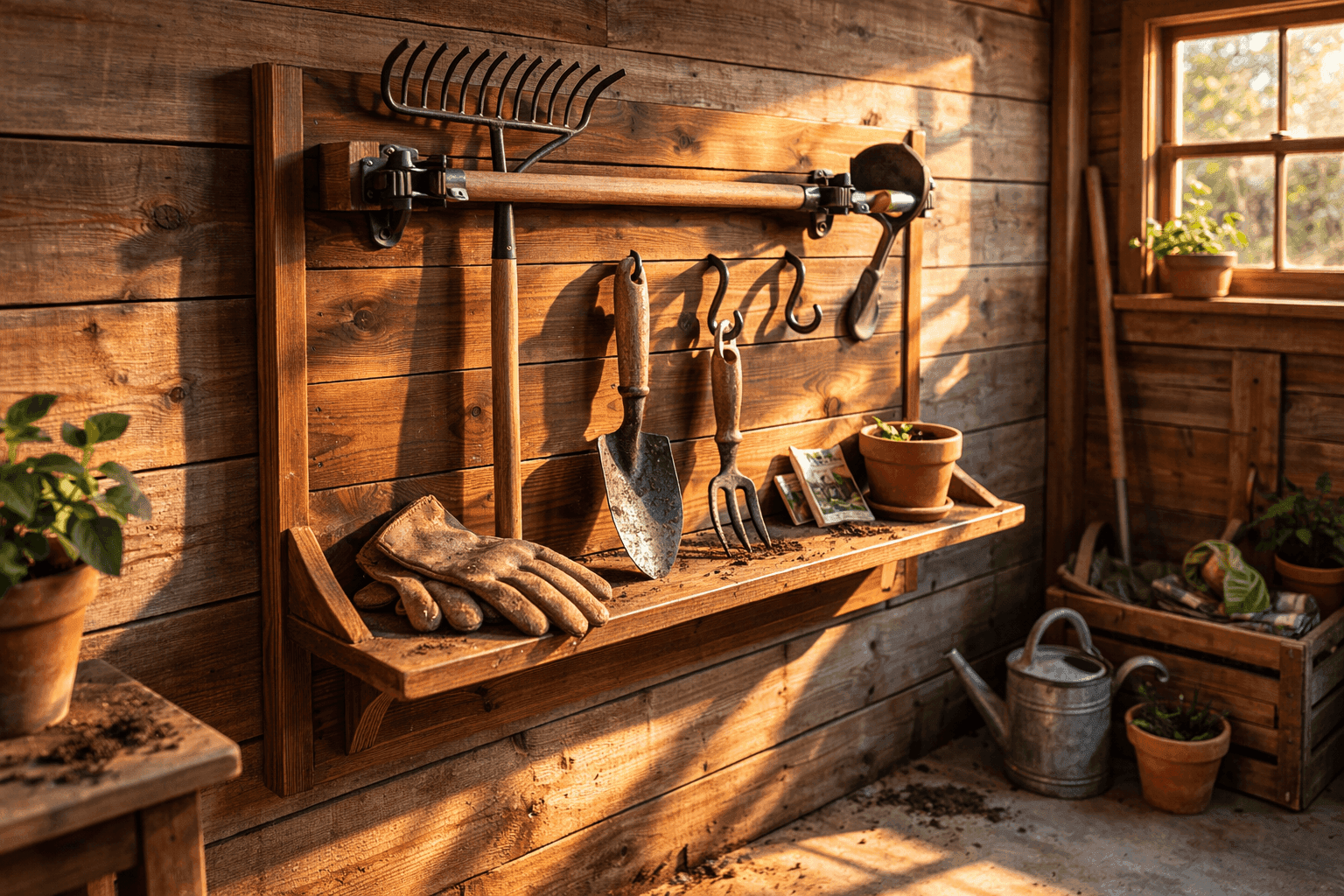
Tools leaning against a shed wall have a talent for ending up on the floor — usually right before you need them, always at the worst possible moment in the middle of a project. A wall-mounted organizer that keeps every rake, shovel, trowel, and hoe in its own dedicated spot doesn't just solve the lost-tool problem; it fundamentally changes how you move through your garden space by making the right tool available in five seconds flat rather than five minutes of hunting. This is a genuine beginner woodworking project — straight cuts only, no complicated joinery, no special jigs — and the whole build runs about 90 minutes from the first measurement to the last mounting screw. At $10–15 in lumber and hardware, it costs less than a single replacement tool, and it pays that investment back every single time you walk into your shed and immediately grab what you need.
What You'll Need
- Lumber
- 1x8 pine or cedar board, 24–36 inches long depending on your tool count — cedar holds up better in humid shed environments; one 8-foot board gives you enough to cut the backboard and bottom shelf from a single piece (~$8–12)
- 1x4 board for the bottom shelf, cut to match the backboard width — or rip a section from the leftover 1x8 if you have it
- Tool Holders (mix and match for your tool set)
- Spring-loaded tool clips for long-handled tools like rakes, shovels, and hoes — rated for the handle diameter of your tools, typically 1.25–1.5 inches (~$2–4 for a two-pack)
- Large cup hooks, 1.5–2 inch size, for hanging hand trowels, cultivators, and small tools by their hanging holes (~$2–3 for a pack of 6)
- 1.5–2 inch spade bit for drilling handle-through holes as an alternative to clips for larger-diameter handles
- Hardware
- 2-inch exterior wood screws for attaching the shelf to the backboard
- Two D-ring hangers or keyhole brackets for wall mounting — rated for at least 20 lbs each (~$3–5 for a pack)
- 2.5-inch lag screws or wall anchors for mounting into studs or drywall
- Finishing
- 120-grit sandpaper for smoothing all cut edges
- Outdoor wood stain or exterior paint — a single coat of stain is enough for a shed interior; paint if the organizer will be exposed to direct weather (~$5–8 for a small can)
- Tools Needed
- Circular saw or miter saw for straight cuts (hardware store cut service works here too)
- Drill with Phillips bit, spade bit if drilling handle holes, and a stud finder for mounting
- Measuring tape, pencil, speed square, and level
- Total Cost
- $10–15 in lumber and hardware — often less if you have leftover wood and partial paint from other projects
How to Build It
- Inventory your tools before cutting any lumber — lay out everything you want the organizer to hold and measure the total width they'd occupy side by side with a few inches of clearance between each. This real-world measurement is what determines your backboard length, and building it around your actual tool collection rather than a generic dimension is what makes the finished organizer feel custom rather than approximate.
- Cut the backboard and shelf to your determined length — both pieces should be identical in width so the shelf sits flush across the full bottom of the backboard. If you don't own a saw, take your measurements to the hardware store lumber counter and have them make the cuts; most stores charge $1–2 per cut and the accuracy is better than a first-time circular saw attempt on a wobbly surface.
- Sand all surfaces and edges with 120-grit sandpaper, paying close attention to cut ends where splintering is most likely. Smooth edges matter more on a tool organizer than you'd expect — you'll be grabbing things off this board with dirty hands in a hurry, and a splinter mid-gardening-session is genuinely annoying.
- Apply stain or paint to both pieces before assembly — it's far easier to finish flat boards than to try to get a brush into the shelf-to-backboard corner joint after everything is screwed together. One coat of outdoor stain on a shed interior piece is sufficient; two coats of exterior paint if the board will see any direct weather exposure through an open shed door.
- Mark your tool positions on the dry backboard using your actual tools as spacing guides — hold each tool up to the board and mark its center point in pencil, leaving at least 4–6 inches between long-handled tools so handles don't knock together when you grab one. Sketch the full layout before drilling or screwing anything so you can adjust spacing visually before committing.
- Install the tool holders working from your layout marks — drive spring clip mounting screws directly into the backboard face, screw cup hooks into pre-drilled pilot holes to prevent splitting, and drill handle-through holes with a spade bit sized to your largest handle diameter plus a quarter inch of clearance. Test each holder with its assigned tool before moving to the next position.
- Attach the bottom shelf by positioning the 1x4 flush across the bottom edge of the backboard, clamping if possible, and driving two 2-inch screws through the backboard face into the shelf end grain. Add a small L-bracket underneath on each end for extra support if the shelf will hold heavier items like small pots or a watering can.
- Mount the D-rings to the back of the board — one in each upper corner, about 2 inches from the top edge and 3 inches from the side edges. Hold the finished organizer against the wall at your desired height, mark the stud locations or anchor points through the D-ring holes with a pencil, then drive lag screws or heavy-duty anchors and hang. Check level before fully tightening, load your tools, and step back.
Woodworkers and professional organizers who build tool storage almost always silhouette-trace each tool onto the backboard with a paint pen or marker before installation — outlining the exact shape of each rake, shovel, or trowel directly on the wood so there's a visible ghost image of where every tool belongs when it's not in use. This technique, borrowed directly from professional workshop pegboard systems, makes it instantly obvious when something is missing and removes the daily decision of where each tool goes when you hang it back up. It takes five extra minutes during the layout step and completely eliminates the "did I leave that in the garden?" uncertainty that comes from an organizer without designated spots.