Build a DIY Compost Tumbler in 4 Hours for $55
Finished compost in 2–4 weeks instead of months — the barrel does the work, you just spin it
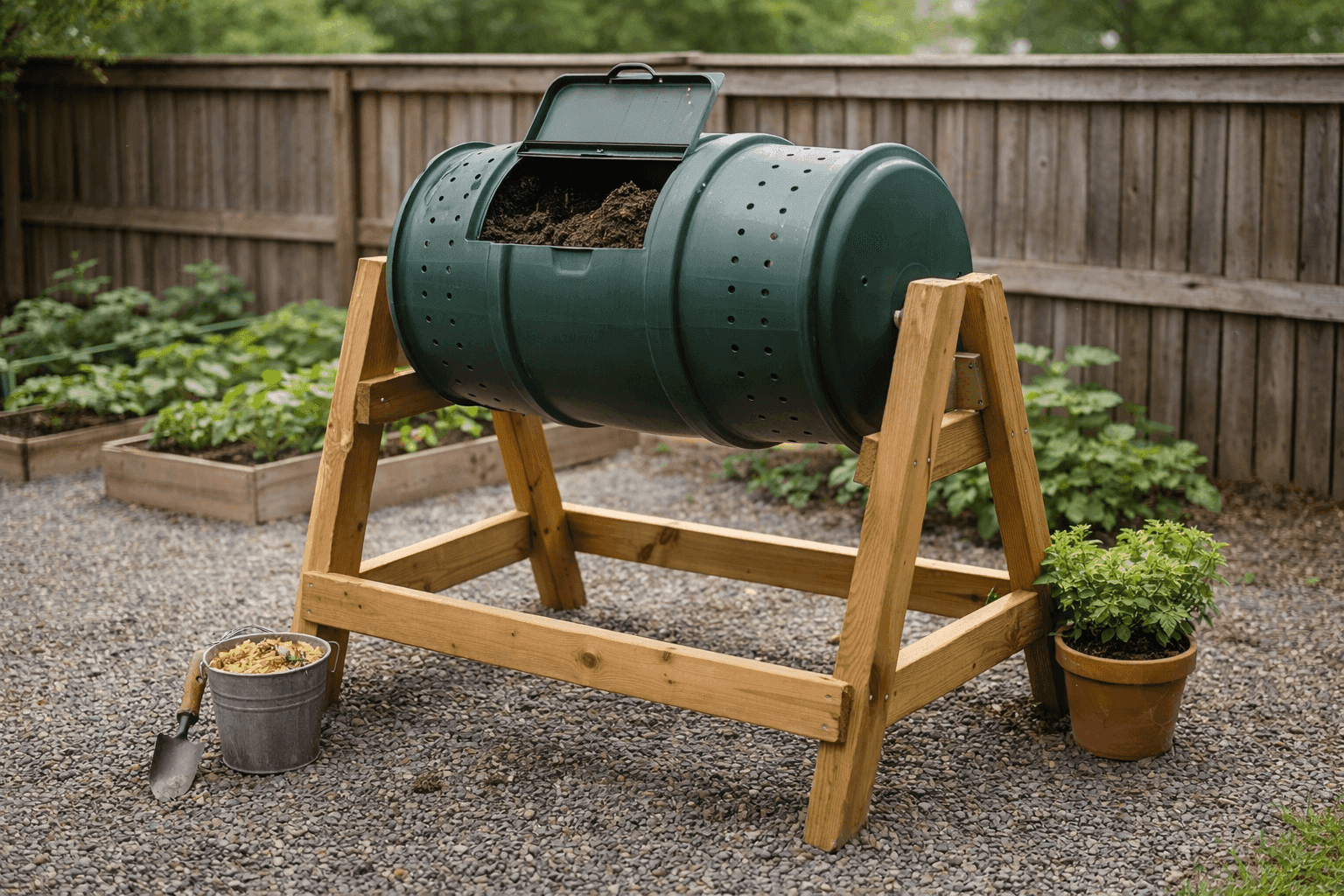
A traditional compost pile is a genuinely virtuous thing — kitchen scraps and yard waste slowly becoming rich garden amendment — but "slowly" is doing a lot of work in that sentence, and most backyard piles take six months to a year to produce finished compost unless you're turning them regularly with a pitchfork in a way that most people do enthusiastically for about two weeks before stopping. A compost tumbler solves the aeration problem mechanically: every time you spin the barrel, you're doing in three seconds what a manual turning does in ten minutes, and the enclosed environment retains heat and moisture in a way that open piles simply can't match. The result is finished compost in two to four weeks rather than six to twelve months, with essentially no smell, no pest attraction, and no labor beyond filling it and giving it a spin every couple of days. Building your own from a food-grade barrel and a simple wooden frame costs $40–70 depending on your material sources, and the finished tumbler is structurally identical to purpose-built models that retail for $100–200.
What You'll Need
- The Barrel
- 30–55 gallon food-grade plastic barrel with a removable or sealable lid — the same sourcing options as a rain barrel apply here: food suppliers, car washes, and online marketplaces often have them for $15–30; a 55-gallon barrel produces serious compost volume, a 30-gallon barrel is more manageable for a small household
- Dark-colored barrels (black or dark green) absorb more solar heat, which accelerates decomposition — a clear or light barrel loses this passive thermal advantage
- Strictly avoid barrels that previously held chemicals, petroleum products, or any non-food industrial material — composting food waste in a contaminated barrel transfers residue directly into your finished garden amendment
- The Axle System
- 1.5-inch galvanized steel pipe or a 1.25-inch hardwood dowel cut to 6 inches longer than the barrel's diameter — this becomes the central axle the barrel rotates on; galvanized pipe outlasts wood significantly in outdoor moisture exposure
- Two pipe flanges or U-bolt pipe clamps sized to your axle pipe — these mount to the frame uprights and cradle the axle ends, allowing rotation (~$4–8 per pair)
- Two 1.5-inch hole saw cuts through the barrel at opposing ends, centered, to accept the axle pipe — the axle passes through the full barrel length and the barrel rotates around it
- The Frame
- 4x4 pressure-treated lumber for the two upright posts — each post needs to be tall enough that the barrel clears the ground by at least 12 inches when mounted (~$6–10 for two 4-foot posts)
- 2x4 lumber for the base cross-members that connect the uprights and provide stability — two base boards and one diagonal brace per side creates a sawhorse-style frame that supports a fully loaded 55-gallon barrel (~$5–8)
- 3-inch exterior structural screws for frame assembly (~$5–7 for a box)
- The Barrel Modifications
- 3/4-inch spade bit or hole saw for drilling ventilation holes — 20 to 30 holes distributed across the full barrel surface provide the airflow that makes the tumbler system work; too few holes and the contents go anaerobic and smell; too many and moisture escapes too readily
- A hasp latch or bungee cord to keep the access lid sealed during rotation — nothing derails a composting session like the lid swinging open mid-spin
- Two large washers for the axle ends to prevent the barrel from sliding laterally along the pipe during rotation
- Tools
- Drill with spade bit and hole saw attachments
- Circular saw or miter saw for frame lumber cuts
- Level, measuring tape, and speed square for frame assembly
- Pipe wrench or adjustable wrench for tightening axle hardware
- Total Cost
- $40–70 depending on barrel source — toward $40 with a low-cost used barrel, toward $70 with a new barrel and full hardware purchase; compare to $100–200 for equivalent purpose-built tumblers
How to Build It
- Source and inspect the barrel first — confirm food-safe provenance, check that the lid seals fully and the barrel body has no cracks or significant dents that would compromise structural integrity under the weight of full wet compost. A 55-gallon barrel loaded with finished compost weighs approximately 200–250 pounds, so the barrel walls need to be in solid condition to hold that load on the axle without deforming.
- Drill ventilation holes across the entire barrel surface in a roughly even grid — 20 to 30 holes of 3/4-inch diameter distributed across the cylindrical body, leaving the very ends of the barrel relatively unperforated to preserve structural integrity around the axle mounting points. Work on a flat surface with the barrel secured against rolling, and wear eye protection against plastic chip spray. Drill the two centered axle holes at opposing ends using a hole saw sized to your pipe diameter.
- Cut an access opening if the barrel lid doesn't provide adequate access for loading — a rectangular hatch cut with a jigsaw on one side of the barrel, approximately 10 by 12 inches, and fitted with a piano hinge and hasp latch creates a loading door that works better than top-only access for a tumbler that rotates past vertical. If your barrel has a full removable lid that seals tightly, this step is optional.
- Build the frame as a pair of matching A-frame or sawhorse-style uprights — cut each 4x4 upright to the same height, attach base cross-members at the bottom with exterior structural screws, and add a diagonal brace from the base cross-member to the upper upright on each side to prevent racking under lateral load. Assemble both uprights identically, then connect them with a base cross-member running the full length of the tumbler so the structure forms one stable unit rather than two independent supports.
- Check frame dimensions before mounting any hardware — set the barrel on the frame uprights and confirm the barrel clears the ground by at least 12 inches at the lowest point of its rotation, and that the upright spacing matches the barrel width so the barrel body sits centered between the posts without contacting the frame during rotation. Mark the exact axle mounting height on each upright before drilling any holes in the frame.
- Mount the axle hardware — attach pipe flanges or U-bolt clamps to the outside face of each upright at the marked height, insert the galvanized pipe axle through one flange, through the full length of the barrel via the pre-drilled axle holes, and out through the second flange on the opposite upright. Secure a washer and locking nut on each axle end to prevent the barrel from sliding laterally along the pipe during rotation, leaving just enough play for smooth spinning without wobble.
- Test the rotation before loading any material — the empty barrel should spin freely and come to rest at any position without snapping back, which indicates well-balanced axle placement. If the barrel consistently rotates to one resting position, the axle holes may be slightly off-center; this is common and can be corrected by enlarging one axle hole by a fraction to allow minor repositioning. Install the hasp latch or bungee cord on the access lid and confirm it secures reliably before loading.
- Load and begin composting with a balanced mix of roughly equal parts green material (kitchen scraps, fresh grass clippings, coffee grounds) and brown material (dry leaves, cardboard torn into small pieces, straw) — the carbon-to-nitrogen balance of this mix is what enables the rapid decomposition that makes a tumbler worth building. Moisten the contents until damp but not dripping, spin the tumbler five to ten rotations, and repeat every two to three days. Finished dark, crumbly, earthy-smelling compost typically appears in two to four weeks under good conditions.
Master composters and permaculture practitioners who use tumbler systems almost universally keep a second container — a simple bucket or bin beside the tumbler — for collecting new kitchen scraps while the tumbler batch finishes rather than adding fresh material to an active batch. The reason is biological: adding new nitrogen-rich kitchen waste to a batch that's already in active decomposition resets the microbial cycle and extends the finish time significantly, often turning a two-week batch into a six-week one. Loading the tumbler in a single batch, sealing it, spinning daily, and not opening it for additions until the batch is finished produces dramatically faster and more consistent results than treating the tumbler as a continuous-fill container the way most people intuitively use it.