Build a Boutique Jewelry Organizer for $30
A painted pegboard, a handful of hooks, and your jewelry goes from tangled drawer chaos to displayed like a shop window
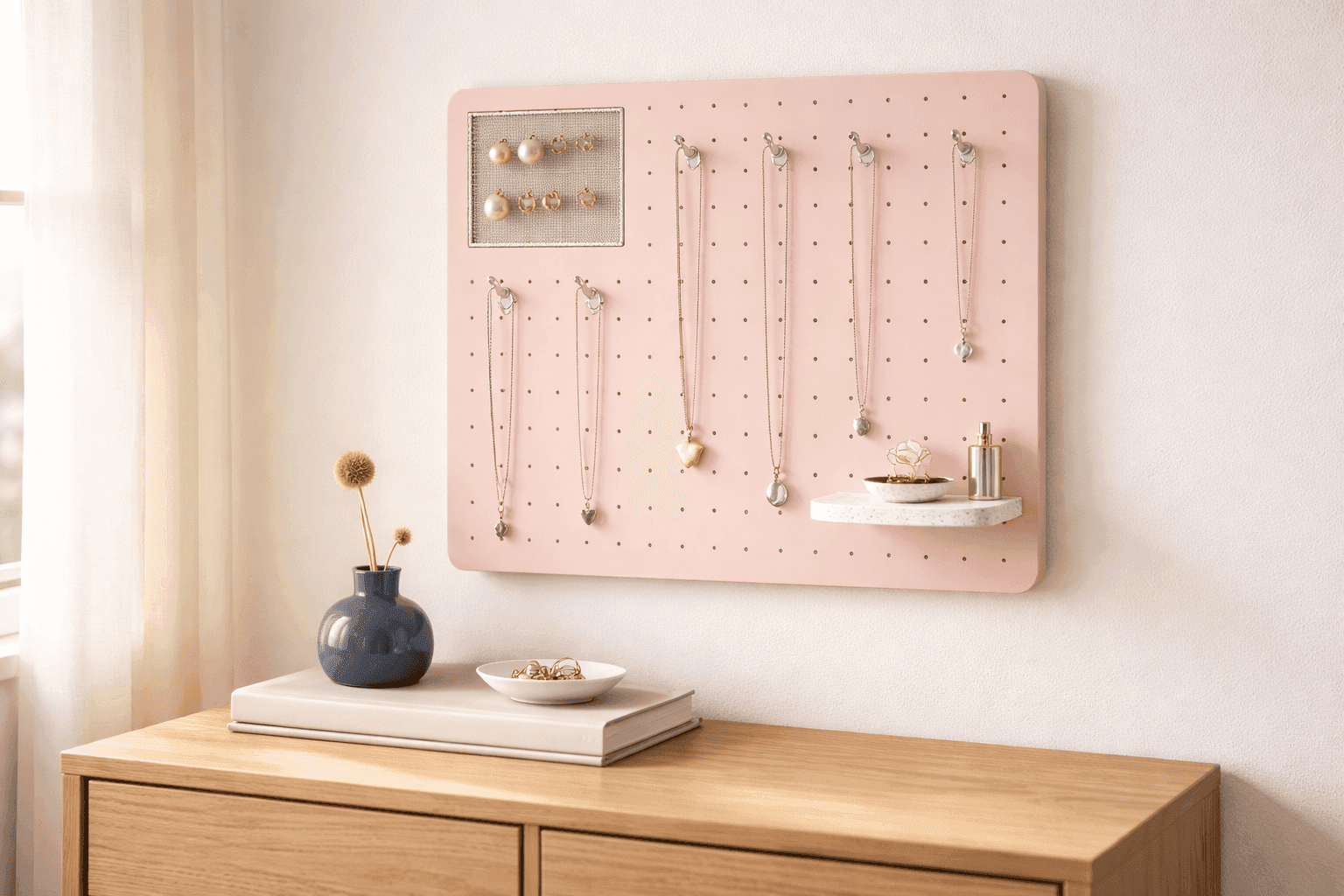
Somewhere in most bedrooms there's a drawer, a bowl, or a corner of the dresser where jewelry goes to get hopelessly tangled — a place where a delicate necklace chain and a pair of earrings and three bracelets become one indistinguishable mass that takes five minutes to sort through every single morning. A pegboard jewelry organizer solves that problem completely and trades it for something genuinely better: a wall display that shows every piece you own at a glance, keeps necklaces hang-separated so they never tangle, and turns the whole collection into a decorative element rather than a hidden mess. A small pre-cut pegboard, a can of paint, and a set of pegboard hooks runs about $25–40 total, takes one to two hours to build and mount, and produces a result that looks like something from a boutique accessories shop — the kind of wall detail that makes people ask where you bought it when the honest answer is that you built it on a Sunday afternoon.
What You'll Need
- The Pegboard
- Pre-cut 1/4-inch hardboard pegboard in 16x24 or 24x24 inches — home improvement stores sell pre-cut hobby sizes that require no sawing and are perfectly sized for a bedroom or closet wall (~$8–12)
- Larger 24x36-inch panels work well for bigger collections or a dedicated walk-in closet display — cut to size at the store if needed
- White, black, blush, or sage green paint reads best as a jewelry backdrop — choose a color that contrasts with your wall so the board reads as a framed display rather than blending into the background
- Hooks and Accessories (~$10–18)
- Standard 1-inch pegboard hooks for hanging necklaces and bracelets — buy more than you think you need since rearranging the layout is half the fun (~$3–5 for a pack of 25)
- Small pegboard shelves or ledges for rings, small dishes, and perfume bottles — typically 3–4 inches wide (~$4–7 for a set of two)
- Pegboard bins or small cups for stud earrings and hair accessories that need a contained spot (~$3–5)
- Pegboard wire mesh panels or small cork inserts — optional additions for displaying stud earrings pushed through the mesh or notes and cards pinned to cork (~$3–5 each)
- Mounting Hardware
- Pegboard mounting standoffs — spacers that hold the board 1/2 to 3/4 inch away from the wall, which is required for pegboard hooks to fit properly behind the board face; without standoffs the hooks have no clearance to insert (~$4–6 for a pack of four)
- 1.5-inch screws and wall anchors or stud screws for securing the standoffs to the wall
- Picture hanging strips as a no-drill alternative for lighter boards in rentals — rated for the weight of pegboard plus hooks and jewelry (~$5–7 for a pack)
- Finishing Supplies
- Small foam roller for applying an even coat of paint with no brush marks — pegboard's hole pattern makes brush painting time-consuming and inconsistent
- Painter's tape to mask the edges for a clean border if you want the pegboard to read as a framed panel
- Matte or satin spray sealer to protect the painted finish from jewelry metal contact and daily handling (~$5–7)
- Total Cost
- $25–40 for board, hooks, shelves, and mounting hardware — toward the lower end with a small board and basic hook set, toward the higher end with a larger board and a fuller accessory kit
How to Build It
- Lay out your jewelry collection before buying any hooks — pull everything you own onto a flat surface and sort it into categories: necklaces by length, bracelets, rings, stud earrings, dangle earrings, and any other accessories. This inventory tells you exactly how many hooks, shelves, and bins you actually need rather than guessing, and it's also the moment you'll rediscover pieces you forgot you owned and want to make sure the finished display can hold.
- Paint the pegboard using a small foam roller in two thin coats, working in one direction across the full face of the board — the roller forces paint into the hole edges cleanly and leaves a far more even finish than a brush on the porous hardboard surface. Let the first coat dry completely before applying the second, usually 30–45 minutes. Apply a light coat of matte spray sealer once fully dry to protect the finish from jewelry oils and daily contact.
- Install the standoffs before mounting the board — mark four corner positions on the wall using a level and pencil, then drive screws with the standoff spacers through the wall into studs or drywall anchors. Standoffs are the step most first-time pegboard builders skip and later regret: without the gap between board and wall, hook tips have nowhere to insert into the holes and the entire functional premise of the pegboard fails.
- Mount the painted board onto the standoffs, pressing it flat and checking level before tightening the mounting screws fully. For a rental-friendly no-drill installation, apply picture hanging strips rated for at least 10 pounds to the back of the board in all four corners and press firmly against the wall for 30 seconds per strip — this holds a small board with a full jewelry display reliably on most painted drywall surfaces.
- Plan the hook layout before inserting anything permanently — hold hooks, shelves, and bins against the mounted board in different positions and step back to view the arrangement from three feet away, which is how you'll actually see it from across the room every morning. Necklaces need the most vertical clearance between hooks to hang freely without touching; earrings and rings can cluster more tightly in their designated zones.
- Install hooks and accessories starting from the top of the board downward — the top section works best for the longest necklaces that need maximum drop clearance, the middle section for shorter necklaces and bracelets on hooks, and the lower section for shelves and bins holding rings, studs, and small accessories. Insert each hook at a slight downward angle so pieces don't slide off when the board is bumped.
- Hang and arrange your jewelry starting with the longest, most dramatic necklaces at the top and working toward smaller pieces downward — the visual weight hierarchy mirrors how a boutique display case is arranged, with statement pieces at eye level and everyday small items within easy reach. Leave a few empty hooks intentionally rather than filling every single hole, which gives the display breathing room and space for new pieces without a full rearrangement.
Jewelry store display designers almost always group pieces by metal tone rather than by jewelry type — all gold-toned pieces in one section, all silver-toned in another, with mixed-metal or statement pieces given their own feature hooks — because the eye reads a collection of similar tones as cohesive and intentional rather than a random assortment. This grouping approach also has a practical morning benefit: when you're choosing a necklace to match an outfit, you're scanning a color-consistent section rather than reading every individual piece across the full board. It takes about five minutes to reorganize an existing display by tone rather than type, and the difference in how the whole arrangement reads from across the room is immediately noticeable.