Bold Move: Paint a Gradient Ombré Fence This Weekend
Four to six paint shades, one weekend, and the commitment to do something your neighbors will absolutely not be able to stop talking about
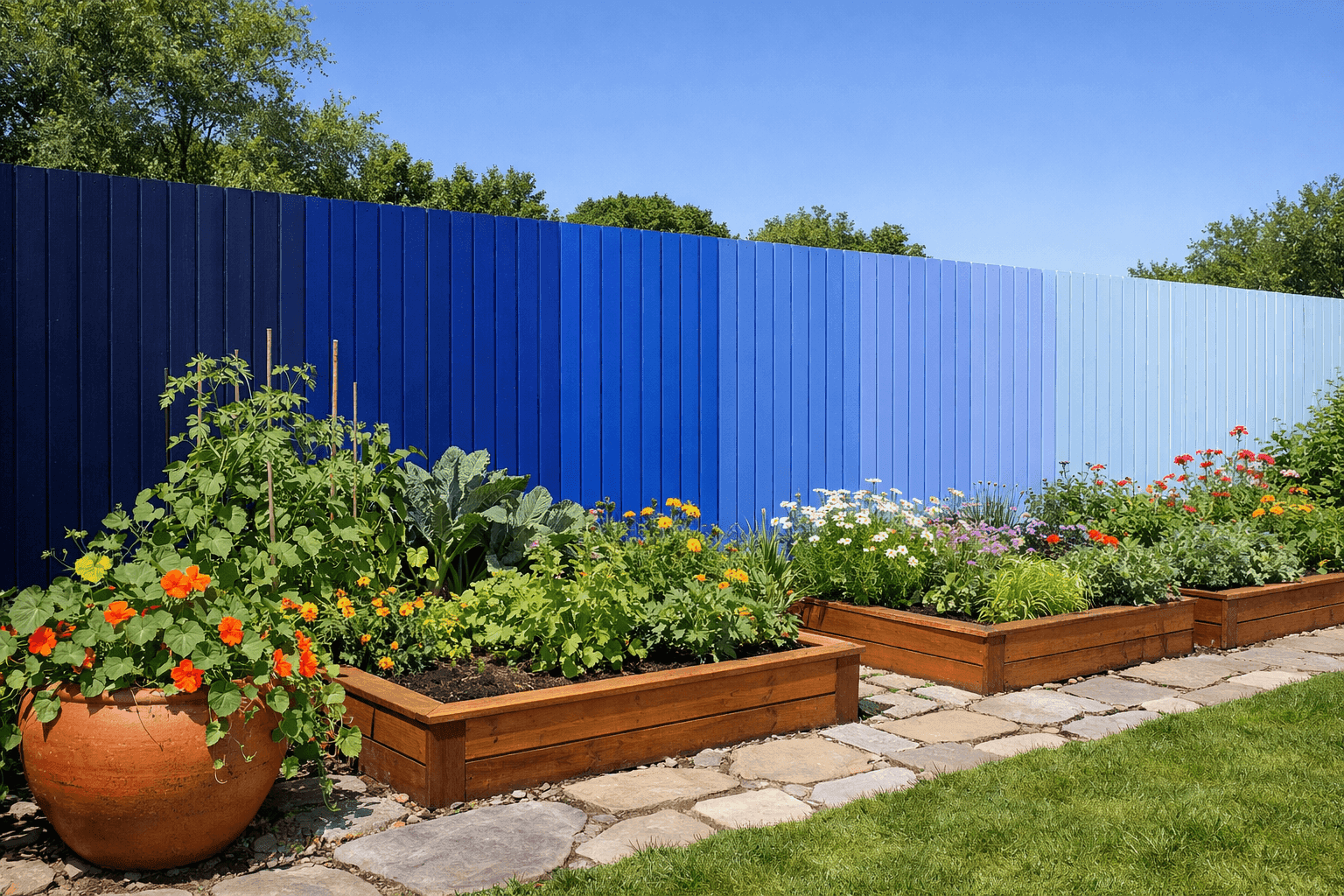
Here's the thing about a plain wood fence: it's not neutral. It's just boring. It's the largest single surface in most backyards, it's visible from every corner of the outdoor space, and painting it the same cedar tone or flat white as every other fence on the block is a choice — just not a very interesting one. A gradient ombré fence is the antidote to that, and it's considerably more achievable than it looks. You don't need to be an artist, you don't need special equipment, and you don't need anything beyond four to six shades of exterior paint in a color family you love and the willingness to commit to something genuinely dramatic. Navy bleeding into sky blue, forest green melting into mint, magenta fading to the palest blush — any of these transforms the largest backdrop in your yard into something people slow down to look at. The neighbors who think you're wild will come around the moment the plants grow up against it. The ones who love it will ask for your paint colors within a week.
What You'll Need
- Paint
- Four to six shades of exterior latex paint in your chosen color family — one quart per shade covers approximately 80–100 square feet, so calculate your fence area and buy accordingly — ~$10–$15 per quart (~$40–$80 total depending on fence length)
- The most foolproof approach is to buy your darkest shade and your lightest shade as full quarts, then ask the paint desk to mix the intermediate transition shades by blending those two — this guarantees a harmonious gradient with no color temperature surprises between sections
- Exterior paint only — interior paint on a fence will peel within one season regardless of how many coats you apply
- Satin or semi-gloss finish holds up better outdoors than flat and shows the gradient color shifts more vividly in changing light conditions
- Prep Supplies
- Exterior wood primer — one gallon covers a standard privacy fence section — ~$18–$25. Priming is non-negotiable on bare or previously unpainted wood if you want the gradient colors to read true rather than being absorbed unevenly into the wood grain
- Pressure washer or garden hose with a high-pressure nozzle for cleaning the fence surface before priming
- 80 and 120-grit sandpaper or a sanding block for smoothing rough boards and weathered grain before primer goes on
- Painter's tape and plastic sheeting for protecting plants, concrete, and any surfaces you don't want painted
- Application Tools
- A 4-inch exterior paint brush for cutting in edges and getting paint into gaps between fence boards
- A 9-inch roller with a ¾-inch nap cover for the main board faces — rolling is dramatically faster than brushing on a large fence and produces a more even finish
- A wide blending brush (3–4 inches, cheap chip brush) for softening the transition zones between shades while paint is still wet
- Six paint trays or buckets — one per shade — so you're never scrambling to rinse and refill mid-section while wet paint is waiting
- Painter's plastic drop cloth for the ground beneath the fence
- Planning Tools
- Tape measure for calculating your fence length and dividing it into equal gradient sections before painting
- Chalk line or pencil marks on the fence to mark section boundaries — these disappear under paint and keep your gradient zones consistent
- A phone or camera for photographing each transition zone while wet so you can replicate the blending technique consistently across the full fence length
How to Paint It
- Prep the fence surface thoroughly — pressure wash or hose down every board to remove dirt, mildew, and loose paint, let it dry completely for at least 24 hours, then sand any rough grain, splinters, or weathered board faces that would show through the finished paint. A gradient painted over a dirty, rough fence looks like a gradient painted over a dirty, rough fence no matter how good the color is — surface prep is what separates a stunning result from a disappointing one.
- Prime every board with one coat of exterior wood primer and let it cure fully before touching color — on raw or weathered wood this step is the difference between vibrant, true-to-chip paint colors and washed-out, uneven gradient sections where the dark shade looks muddy and the light shade looks dingy. Two coats of primer on any boards that are visibly thirsty or heavily weathered before you begin the color work.
- Measure and mark your gradient sections by dividing the total fence length by the number of paint shades and marking each transition point with chalk directly on the fence boards. For a 30-foot fence with six shades, each pure color section runs about 4 feet with a 1-foot blending zone on each side — mark these boundaries clearly before opening a single paint can so the gradient proportions are locked in before the pressure of wet paint is involved.
- Paint the pure color sections first starting with your darkest shade at one end, applying two full coats to the first section and letting each coat dry before the next — these solid sections on each end anchor the gradient and give you a reference point for how the transition zones should read visually. Work your way across the fence painting each pure shade section in order from darkest to lightest, leaving the transition zones between them unpainted for now.
- Blend the transition zones while working wet-into-wet — paint the darker shade 6–8 inches into the transition zone, immediately paint the lighter shade 6–8 inches from the other direction so the two meet in the middle, then use your wide blending brush in long vertical strokes to feather the two wet colors together where they overlap. Work quickly and decisively in each transition zone — overworking wet paint creates muddy mixing rather than clean gradients, so commit to your blending strokes and move on.
- Step back and assess the full gradient from at least 15–20 feet away before the paint dries — the distance at which a gradient reads as seamless and beautiful is always much further than the distance at which you painted it, and an adjustment that seems necessary up close often disappears entirely when viewed from the yard. If a transition zone looks harsh from a distance, it can be softened with a second blending pass while still wet or a thin glaze of the midpoint shade once fully dry.
- Apply a second coat to the entire fence in the same section order once the first coat is fully dry — the gradient will deepen and become significantly more vibrant on the second coat, and any blending zones that looked slightly patchy on the first coat will smooth out considerably as the second coat evens the coverage. The second coat is also when the full drama of the color choice becomes apparent for the first time, which is the moment most people either pump their fist or reach for a slightly different shade.
- Seal with exterior topcoat once the final paint coat has cured for 48 hours — a clear exterior polyurethane or fence topcoat in satin finish adds a protective layer that dramatically extends the life of the gradient by resisting UV fade, which is the number one enemy of bold exterior paint colors. Bold, saturated shades like deep navy and magenta fade faster than neutrals in direct sun, so sealing is not optional on a fence that gets significant sun exposure if you want the gradient to still look intentional rather than tired after the first full summer.
The color direction of your gradient matters more than most people think before they start painting — and getting it right means working with the light rather than against it. Exterior designers who work with bold fence color consistently recommend running the gradient from dark to light in the same direction as the dominant light source: if your fence gets morning sun from the east, run dark on the west end and light on the east end so the lightest section is always catching the most direct light and glowing at peak color. Running the gradient the wrong way — light end in shadow, dark end in full sun — mutes the lightest shades and makes the whole effect read muddier and heavier than it looks in the paint chips. The other thing pros never skip is a test section: paint two to three boards in your full gradient sequence before committing to the entire fence, photograph it in morning, midday, and late afternoon light, and live with it for a day before scaling up. Paint colors behave completely differently on a large outdoor surface than they do on a chip or a sample pot, and discovering that your "forest green to mint" reads as "swamp to fluorescent" on your specific fence wood is a much more manageable discovery on three boards than on thirty feet of fence.