Bold & Futuristic: Wrap Appliances in Eye-Popping Holographic Vinyl
Transform boring kitchen gear into color-shifting statement pieces that scream personality
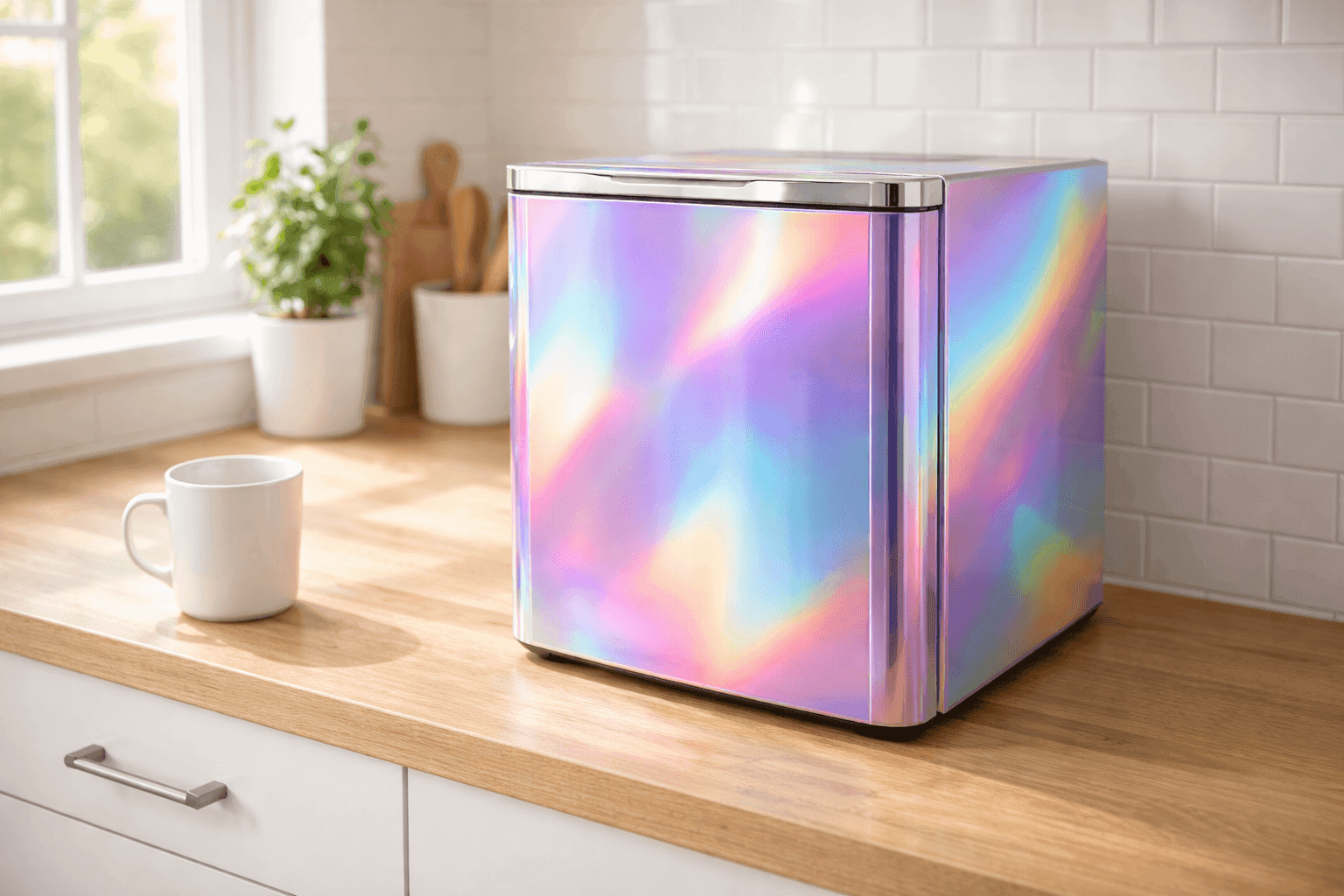
Let's be completely honest: most rental kitchens and even many owned homes feature boring, utilitarian appliances in predictable stainless steel, black, or white that do absolutely nothing to express your actual personality or design preferences. Holographic vinyl wrap is the answer for anyone who wants dramatic visual impact without permanent commitment—it's like temporary tattoos for your appliances, creating that jaw-dropping futuristic aesthetic that makes people stop and say "wait, where did you get that?" before you gleefully reveal you made it yourself for $10-20 per appliance. This is not a subtle design intervention; we're talking full-on rainbow oil slick effects, chrome mirror finishes, and iridescent color shifts that change as you move around the kitchen and as light hits from different angles throughout the day. I absolutely love this project for renters who are tired of beige everything but can't paint walls or replace appliances, and for homeowners who want to experiment with bold design without the financial or emotional commitment of buying entirely new appliances just to get the aesthetic they crave. Each piece takes 20-30 minutes to wrap, the vinyl is completely removable without residue if you change your mind or move, and the transformation is so dramatic that it legitimately feels like you have brand new appliances even though you're just covering the ones you already own.
What You'll Need
- Holographic Vinyl Wrap: Choose from rainbow holographic, oil slick iridescent, chrome mirror, or color-shift effects—available in sheets (12"x12" for $8-12) or rolls (12"x60" for $15-25) online or at craft stores
- Target Appliances: Mini fridges, microwaves, toaster ovens, stand mixers, coffee makers—smooth flat surfaces work best, avoid deeply textured finishes
- Rubbing Alcohol: 70% or higher concentration for thorough surface cleaning that removes oils, fingerprints, and residue that prevent vinyl adhesion
- Measuring Tape: For accurately measuring appliance surfaces before cutting vinyl to minimize waste
- Sharp Craft Knife: New blade essential for clean cuts and precise trimming around edges, vents, and details
- Squeegee or Credit Card: For smoothing vinyl during application and pushing out air bubbles—plastic squeegees work better than metal to avoid scratching
- Heat Gun or Hair Dryer: For helping vinyl conform around curves and edges, making it more pliable during application
- Clean Microfiber Cloths: Lint-free cloths for final surface prep and wiping away alcohol residue
Step-by-Step Instructions
- Clean surfaces meticulously using rubbing alcohol and microfiber cloths to remove every trace of grease, fingerprints, dust, and residue—vinyl only adheres permanently to perfectly clean surfaces, so this step determines success or failure.
- Measure and cut vinyl generously, adding 2-3 inches extra on all sides beyond your actual measurements—it's much easier to trim excess than try to stretch vinyl that's cut too small.
- Position vinyl carefully before removing backing completely by peeling just 2-3 inches of backing and tacking the exposed adhesive edge in place, ensuring alignment is perfect before committing to full application.
- Apply using squeegee method by slowly peeling backing while simultaneously smoothing vinyl with firm, overlapping strokes from center outward, which pushes air bubbles toward edges rather than trapping them underneath.
- Work in sections for larger surfaces, peeling backing progressively as you smooth each 6-8 inch section rather than removing all backing at once and risking wrinkles or misalignment that's difficult to fix.
- Eliminate bubbles immediately by lifting vinyl edge slightly and reapplying with squeegee pressure, or using a pin to puncture tiny bubbles and smooth flat—trapped air becomes permanent if you wait too long.
- Heat and conform around curves, corners, and edges using a hair dryer on low setting to make vinyl pliable and stretchable, gently pulling and smoothing for professional-looking wrapped edges.
- Trim excess precisely using a fresh craft knife blade and metal ruler or straight edge for clean lines, cutting at a slight angle toward the appliance to tuck edges neatly rather than leaving visible seams.
- Seal edges firmly by running your squeegee or thumb along all trimmed edges with firm pressure to ensure complete adhesion that prevents peeling from repeated opening/closing or daily use.
Here's the advanced technique that separates amateur vinyl wraps from professional-looking results: instead of wrapping every visible surface of an appliance in holographic vinyl, create strategic accent panels by wrapping only the front face or specific sections while leaving sides and top in original finish. This "color-blocking" approach looks more intentional and sophisticated than completely covered appliances, which can read as overwhelming or chaotic especially in small kitchens. Professional vehicle wrappers use this exact principle—they know that partial wraps with clean lines and defined boundaries create more visual impact than total coverage because your eye registers the deliberate design choice rather than seeing it as an attempt to hide the original appliance. Try wrapping just the door panel of a mini fridge with holographic vinyl while leaving the top and sides black, or wrap only the front face of a microwave while keeping the sides in brushed steel. This technique also uses less material, costs less money, and importantly, makes the project more approachable for beginners who might feel intimidated by wrapping complex three-dimensional objects. The psychological effect is fascinating—the contrast between original finish and holographic accent makes the holographic element feel even more special and intentional rather than like you ran out of subtlety halfway through decorating.