Bloom & Twine: DIY Spring Flower Garlands
Create stunning floral garlands to adorn mirrors, mantels, and open shelving
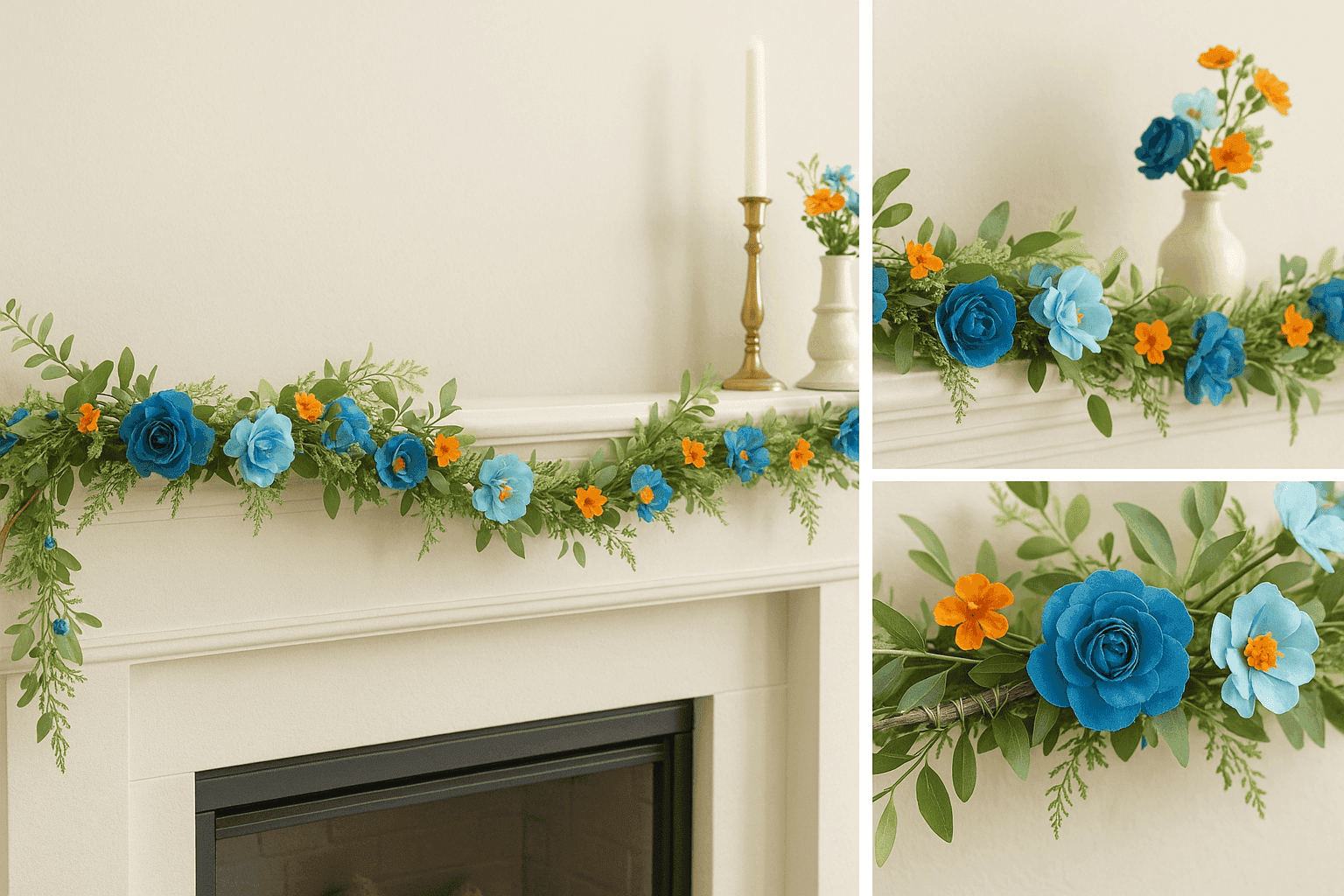
Floral garlands add an enchanting touch to spring decor, bringing the garden indoors with cascading blooms and greenery. Whether draped across a mantel, woven through banisters, or framing a mirror, these versatile decorations create instant seasonal charm. While store-bought versions can be expensive, creating your own custom garlands allows you to match your home's color scheme and style while expressing your creativity. With a few simple techniques and materials, you can craft garlands that look professional but reflect your personal aesthetic.
What You'll Need
| Base Materials: |
| • Twine, jute, or floral wire for the garland base |
| • Green floral tape |
| • Thin gauge wire (22-26 gauge) |
| • Wire cutters |
| Floral Elements: |
| • Faux flowers (small to medium blooms work best) |
| • Faux greenery and foliage |
| • Dried flowers (optional, for mixed-media effect) |
| • Small faux or dried berries |
| Additional Materials: |
| • Hot glue gun and glue sticks |
| • Sharp scissors |
| • Ribbon in coordinating colors |
| • Floral pins or small command hooks for hanging |
| • Measuring tape |
| • Work gloves (optional, for working with wire) |
How To Do It
- Prepare your materials:
- Measure the area where your garland will hang and add 12" for draping
- Cut flowers from stems, leaving 2-3 inches of stem for attaching
- Sort flowers by type, size, and color for easier assembly
- Create a small "test arrangement" to visualize how colors and textures will work together
- Create your base:
- For a simple base, cut twine or jute to your desired length
- For a fuller base, twist together 2-3 strands of greenery garland
- For a mixed base, wrap thin wire around twine at intervals for attachment points
- If using floral wire as your base, form it into a loose spiral for flexibility
- Attach greenery foundation:
- Begin by attaching larger foliage pieces to create volume
- Secure each piece by wrapping floral wire around the base and twine
- Overlap pieces slightly for a continuous look
- Vary the direction of foliage for a natural appearance
- Work in sections of about 6-8 inches at a time
- Add focal flowers:
- Place larger blooms first, spacing them evenly along the garland
- Secure each flower by wrapping the stem with wire and attaching to the base
- For delicate flowers, reinforce with a small dab of hot glue
- Turn the garland frequently to ensure flowers face different directions
- Create rhythm by repeating certain flowers at regular intervals
- Fill with secondary flowers:
- Add medium and small blooms around the focal flowers
- Create clusters of similar flowers for greater visual impact
- Balance colors and shapes throughout the length
- Fill any gaps where the base is visible
- Step back occasionally to check the overall composition
- Add special touches:
- Incorporate small berries or decorative elements for texture
- Weave in ribbon tails at intervals or the ends of the garland
- Add lightweight decorative elements like small butterflies or birds
- Consider attaching small fairy lights for evening ambiance
- Secure any loose elements with additional wire or hot glue
- Display your garland:
- Mantel: Use small floral pins or removable hooks at either end
- Mirror: Attach with ribbon loops or command hooks at the top corners
- Staircase: Secure to banister with ribbon ties every 1-2 feet
- Shelving: Drape across the front, securing ends with small adhesive hooks
- Doorway: Hang across the top using removable hooks or ribbon
- Maintain your garland:
- Dust occasionally with a hair dryer on cool setting or soft brush
- Store flat in a large box lined with tissue paper when not in use
- Refresh as needed by replacing any damaged flowers
- For outdoor use, spray with UV-resistant clear coat to prevent fading
Professional florists and stylists use several techniques to elevate DIY garlands. First, consider the principle of "forced perspective" by making the garland fuller and more detailed in areas that will be viewed up close, while keeping distant sections simpler. This creates depth while saving materials. Another designer secret is to create an intentional color gradient or "ombré effect" by transitioning between hues across the length of the garland—perhaps from pale pink to deeper rose, or from white to soft blue. For the most natural appearance, professionals use the "rule of three" for floral arrangements, creating triangular clusters of three different elements (for example, a focal flower, a textural element, and a greenery piece) repeated throughout the garland. Finally, for a truly custom look, incorporate unexpected elements like small vintage brooches, miniature picture frames with spring images, or even tiny decorative birds' nests tucked among the flowers.