Banner Day: Sew Fabric Bunting Banners for $8
Fabric scraps, pinking shears, ribbon, and one straight stitch per flag — the 90-minute banner that transforms any celebration space and stores flat for every party after this one
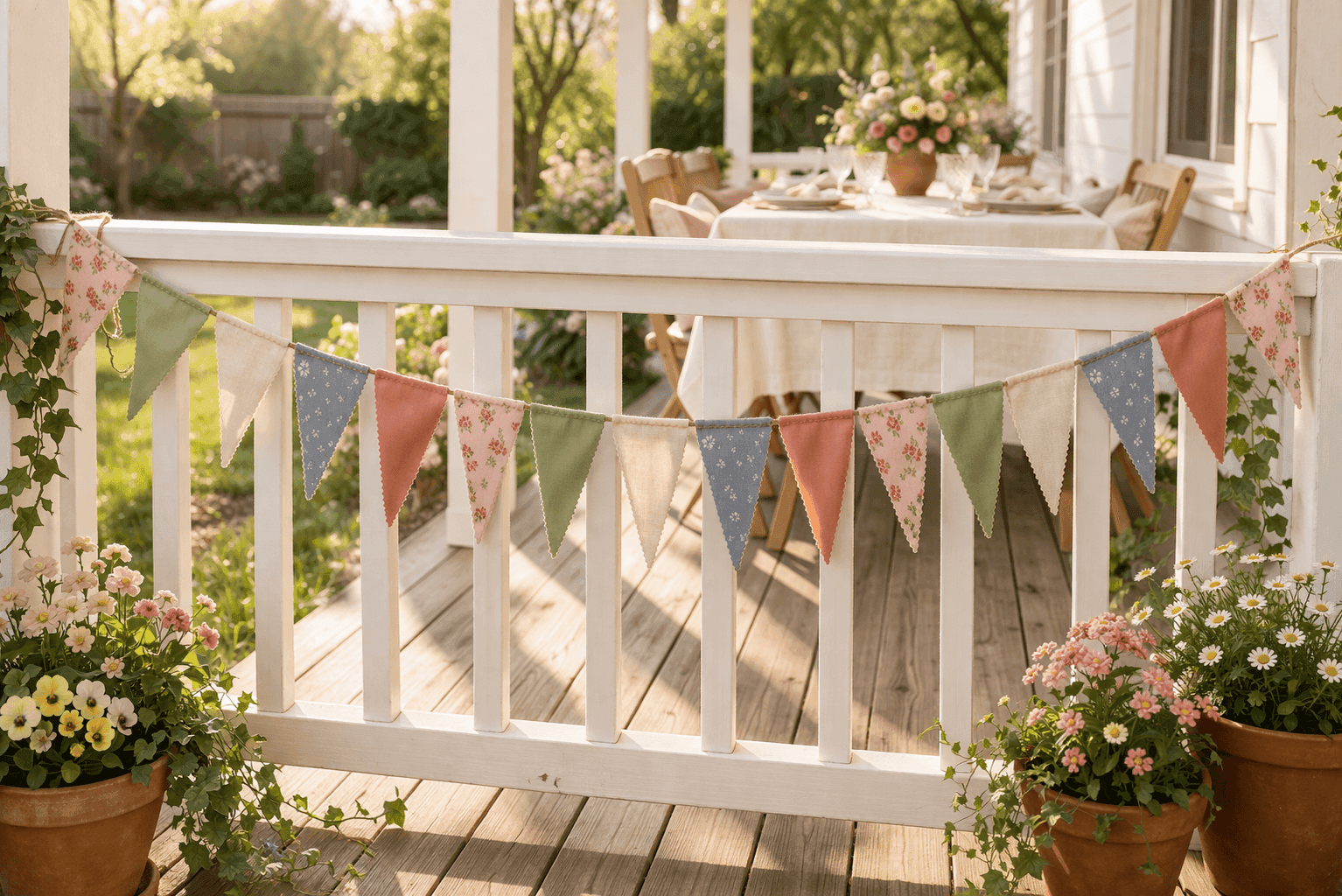
There are very few party decorations that deliver as much visual impact per dollar as a length of fabric bunting — the way a string of colorful triangles transforms a plain porch, a backyard fence, or a dining room wall into something that looks genuinely festive is disproportionate to both the cost and the effort involved. The whole project costs about $8 in ribbon and fabric if you're starting from scratch, significantly less if you have a scrap bin to raid, and 90 minutes of cutting and sewing produces a banner long enough to span a standard porch or frame a doorway in a single session. Pinking shears along the triangle edges handle the fraying problem without requiring any hemming — each flag gets one fold and one straight stitch, and that's the entire construction. The finished banner stores flat in a zip-lock bag, comes out looking perfect for the next occasion, and gets reused for spring parties, birthday brunches, graduation celebrations, and any other gathering that deserves something handmade and colorful hanging above it. Make it once and you'll bring it out for years.
What You'll Need
- Fabric
- Cotton quilting fabric in your chosen color palette — fat quarters from a fabric or craft store give you the most color and pattern variety for the least cost, at ~$2–$4 each. One fat quarter yields six to eight standard-sized bunting flags depending on your triangle dimensions
- Fabric scraps from previous projects are ideal — bunting is one of the best uses for the small leftover pieces that aren't large enough for anything else but are exactly the right size for a triangle flag
- Lightweight to medium-weight cotton is the easiest fabric to work with for bunting — it cuts cleanly with pinking shears, folds crisp at the top, and hangs with a gentle drape rather than the stiffness of heavier fabric or the limpness of very lightweight voile
- Choose three to five coordinating fabrics rather than a single print — variety in scale, pattern, and solid versus print creates the collected, layered quality that makes handmade bunting look intentionally designed rather than all-from-one-bolt
- The Hanging String
- Grosgrain ribbon in ½-inch or ¾-inch width — the most polished option for the banner string, available in every color and pattern at craft stores for ~$2–$4 per yard. Buy 20–30 percent more length than the finished banner span to allow for the flag attachment process and the hanging tails at each end
- Jute twine as a free or nearly free alternative that gives the banner a rustic, natural quality that suits outdoor spring celebrations particularly well — the texture contrast between the colorful fabric flags and the natural fiber string is genuinely charming
- Thin cotton rope or baker's twine as additional alternatives — baker's twine in a coordinating color reads as a more deliberate design choice than plain twine and is available at craft stores for ~$3–$4 per spool
- Cutting Tools
- Pinking shears — the single most important tool for efficient bunting construction, cutting the zigzag edge that prevents fraying without any hemming required. A quality pair of pinking shears cuts cleanly through two layers of cotton without dragging — ~$15–$25 for a decent pair at any craft or fabric store, and they last for years of regular use
- A cardboard triangle template cut to your chosen flag dimensions — trace around the template for each flag rather than measuring every cut individually, which dramatically speeds up the cutting stage. A 6-inch wide by 8-inch tall triangle is the most versatile bunting flag size, large enough to show fabric patterns clearly and small enough that a 6-foot banner contains enough flags to look full rather than sparse
- Fabric scissors for the straight top edge of each flag — pinking shears on all three sides including the top creates unnecessary bulk at the fold line where the flag attaches to the ribbon
- Sewing Supplies
- A sewing machine for the fastest construction — bunting is one of the best beginner sewing machine projects because it requires only straight stitches at a consistent seam allowance with no curves, zippers, or complicated construction
- OR needle and thread for hand sewing — a running stitch along the folded top edge of each flag takes about three minutes per flag by hand and produces a perfectly functional banner without a machine
- Coordinating thread in a neutral color that blends with multiple fabrics — cream or light gray works across most color palettes without requiring thread changes between flags
- Straight pins or Wonder Clips for holding the folded fabric over the ribbon while stitching each flag in place
How to Make It
- Make your cardboard template first by cutting a triangle from a cereal box or piece of cardboard to your chosen flag dimensions — 6 inches wide at the top and 8 inches tall to the point produces a flag with good visual presence on a standard banner span. Cut the template carefully with straight scissors so the edges are clean and the two sides are equal in length, and label it with the dimensions so it's usable for future banner projects without re-measuring.
- Plan your color sequence before cutting a single flag — lay your fabric selections out and decide the order in which colors and patterns will repeat along the banner. A simple repeating sequence of three to five fabrics produces a banner that looks designed; a random arrangement of the same fabrics produces one that looks assembled from whatever was available. Cut all flags in the planned sequence so they're ready to attach in order without sorting mid-sewing.
- Cut all your flags at once by folding each fabric piece in half or stacking two layers before tracing and cutting — this doubles your cutting speed without sacrificing accuracy. Trace the template onto the fabric with a fabric marker or chalk, cut the two angled sides with pinking shears for the fringe-resistant edge, and cut the straight top edge with fabric scissors for a clean fold line. Stack the cut flags in sequence order as you go so they're ready to attach to the ribbon in the correct color pattern without any sorting step.
- Prepare your ribbon or twine by cutting it to the total banner length — span measurement plus 12 inches of tail at each end for tying. Fold a small piece of tape over each cut end of ribbon to prevent fraying during the sewing process, since ribbon ends that fray under the presser foot catch on the feed dogs and create uneven attachment stitching. Mark the ribbon at the spacing intervals between flags with a fabric marker — consistent spacing of ¼ to ½ inch between flags produces a banner that looks full and evenly paced rather than crowded in some areas and sparse in others.
- Fold the first flag over the ribbon by placing the ribbon across the wrong side of the fabric at the straight top edge, folding the top inch of fabric over the ribbon toward the right side of the fabric, and pinning or clipping it in place so the fold sits snugly against the ribbon without bunching. The ribbon should be sandwiched inside the fold with approximately ½ inch of fabric on each side — enough to stitch through cleanly without the ribbon pulling free under the tension of the finished hanging banner.
- Stitch each flag to the ribbon with one straight stitch across the full width of the folded top edge — feed the folded flag under the presser foot, stitch straight across ¼ inch from the fold edge, backstitch at each end to secure, and clip the thread. That single stitch per flag is the entire construction — there is no second pass, no trimming, no pressing required at this stage. Attach all flags to the ribbon in sequence, leaving your planned spacing gap between each flag, and work at whatever pace keeps your stitching straight without rushing.
- Work continuously along the ribbon without cutting thread between flags — stitch the first flag, leave the needle down at the end of the stitch, feed the gap of bare ribbon under the foot until the next flag's fold reaches the needle, and stitch across without lifting the presser foot or cutting the thread between them. This chain stitching technique connects all flags in a single continuous thread chain that can be snipped between flags at the end if desired or left intact as a structural reinforcement, and it reduces the total sewing time for a 20-flag banner by more than half compared to cutting and rethreading between every flag.
- Press the finished banner lightly with a warm iron on the back of each flag fold to set the stitching and give the banner a polished, crisp hang — run the iron along the ribbon and over the back of each flag attachment without pressing the decorative pinking-shear edge flat, which would crush the textured zigzag detail that gives the banner its handmade quality. Hang the finished banner by its ribbon tails, adjust any flags that twisted during sewing to hang straight, and store flat in a zip-lock bag labeled with the occasion color palette so you can identify it at a glance for the next party it belongs at.
Event stylists and party designers who create professional celebration installations use a layering technique for fabric bunting that takes a single banner from pretty to genuinely stunning in about ten extra minutes of work — and it requires nothing beyond a second strand of twine and a few additional flags. Instead of hanging a single banner in a straight horizontal line, they create a double or triple layer by hanging two or three banners at slightly different heights and forward positions — one close to the wall, one a few inches in front and slightly lower, and a third in front of that one lowest of all. Viewed from the front, the layered banners read as a single deep, dimensional installation with flags at multiple depths that catch light and move in the breeze at different times. The second technique that elevates bunting from decoration to design statement is mixing flag sizes within the same banner — a few larger flags (8 inches wide by 10 inches tall) alternating with the standard size creates a varied silhouette along the banner bottom edge that looks curated rather than uniform. Both techniques add minimal material cost and minor additional sewing time while producing results that read as significantly more professional than a single row of identical flags — which is the entire gap between a banner that gets a compliment and one that gets a question about where you bought it.